
 Login
Login Register
 Submit a Paper
 Propose a Special lssue
 Open Access
REVIEW
Ionic Electroactive Polymers as Renewable Materials and Their Actuators: A Review
1 Institute for Bionic Technologies and Engineering, I.M. Sechenov First Moscow State Medical University (Sechenov University), Bolshaya Pirogovskaya Street 2-4, Moscow, 119991, Russia
2 Department of Physical Chemistry, National University of Science and Technology “MISIS”, Moscow, 119049, Russia
3 Institute of Biomedical Systems, National Research University of Electronic Technology, Zelenograd, Moscow, 124498, Russia
* Corresponding Author: Tarek Dayyoub. Email:
Journal of Renewable Materials 2025, 13(7), 1267-1292. https://doi.org/10.32604/jrm.2025.02024-0022
Received 21 October 2024; Accepted 05 February 2025; Issue published 22 July 2025
 View Full Text
 Download PDF
Abstract
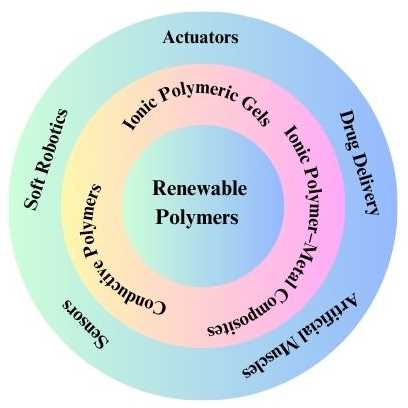
The development of actuators based on ionic polymers as soft robotics, artificial muscles, and sensors is currently considered one of the most urgent topics. They are lightweight materials, in addition to their high efficiency, and they can be controlled by a low power source. Nevertheless, the most popular ionic polymers are derived from fossil-based resources. Hence, it is now deemed crucial to produce these actuators using sustainable materials. In this review, the use of ionic polymeric materials as actuators is reviewed through the emphasis on their role in the domain of renewable materials. The review encompasses recent advancements in material formulation and performance enhancement, alongside a comparative analysis with conventional actuator systems. It was found that renewable polymeric actuators based on ionic gels and conductive polymers are easier to prepare compared to ionic polymer-metal composites. In addition, the proportion of actuator manufacturing utilizing renewable materials rose to 90%, particularly for ion gel actuators, which was related to the possibility of using renewable polymers as ionic or conductive substances. Moreover, the possible improvements in biopolymeric actuators will experience an annual rise of at least 10% over the next decade, correlating with the growth of their market, which aligns with the worldwide goal of reducing global warming. Additionally, compared to fossil-derived polymers, the decomposition rate of renewable materials reaches 100%, while biodegradable fossil-based substances can exceed 60% within several weeks. Ultimately, this review aims to elucidate the potential of ionic polymeric materials as a viable and sustainable solution for future actuator technologies.Graphic Abstract
Keywords
Cite This Article
 Copyright © 2025 The Author(s). Published by Tech Science Press.
This work is licensed under a Creative Commons Attribution 4.0 International License , which permits unrestricted use, distribution, and reproduction in any medium, provided the original work is properly cited.
 Downloads
 Citation Tools
