
 Login
Login Register
 Submit a Paper
 Propose a Special lssue
 Open Access
ARTICLE
Characteristics of Bioplastics Based on Chitosan and Kraft Lignin Derived from Acacia mangium
1 Department of Agricultural Industry Technology, Faculty of Agriculture, Lampung University, Bandar Lampung, 35145, Indonesia
2 Department of Forestry, Faculty of Agriculture, Lampung University, Bandar Lampung, 35145, Indonesia
3 Research Center for Biomass and Bioproducts, Research Organization for Life Sciences and Environment, National Research and Innovation Agency (BRIN), Jl. Raya Bogor KM 46, Cibinong Bogor, 16911, Indonesia
4 Department of Fisheries Processing Technology, Faculty of Fishery and Marine Science, Padjadjaran University, Jatinangor, 45363, Indonesia
5 Research Collaboration Center for Marine Biomaterials, Jl. Ir. Sukarno, Jatinangor, 45360, Indonesia
6 Department of Wood Industry, Faculty of Applied Sciences, University Technology MARA Pahang Branch Jengka Campus, Bandar Tun Razak, 26400, Malaysia
7 Research School of Chemistry & Applied Biomedical Sciences, Tomsk Polytechnic University, Tomsk, 634000, Russian
8 Department of Forest Products, Faculty of Forestry, Universitas Sumatera Utara, Kampus USU Padang Bulan, Medan, 20155, Indonesia
* Corresponding Authors: Sri Hidayati. Email: ; Widya Fatriasari. Email:
Journal of Renewable Materials 2025, 13(7), 1367-1388. https://doi.org/10.32604/jrm.2025.02025-0006
Received 04 January 2025; Accepted 11 March 2025; Issue published 22 July 2025
 View Full Text
 Download PDF
Abstract
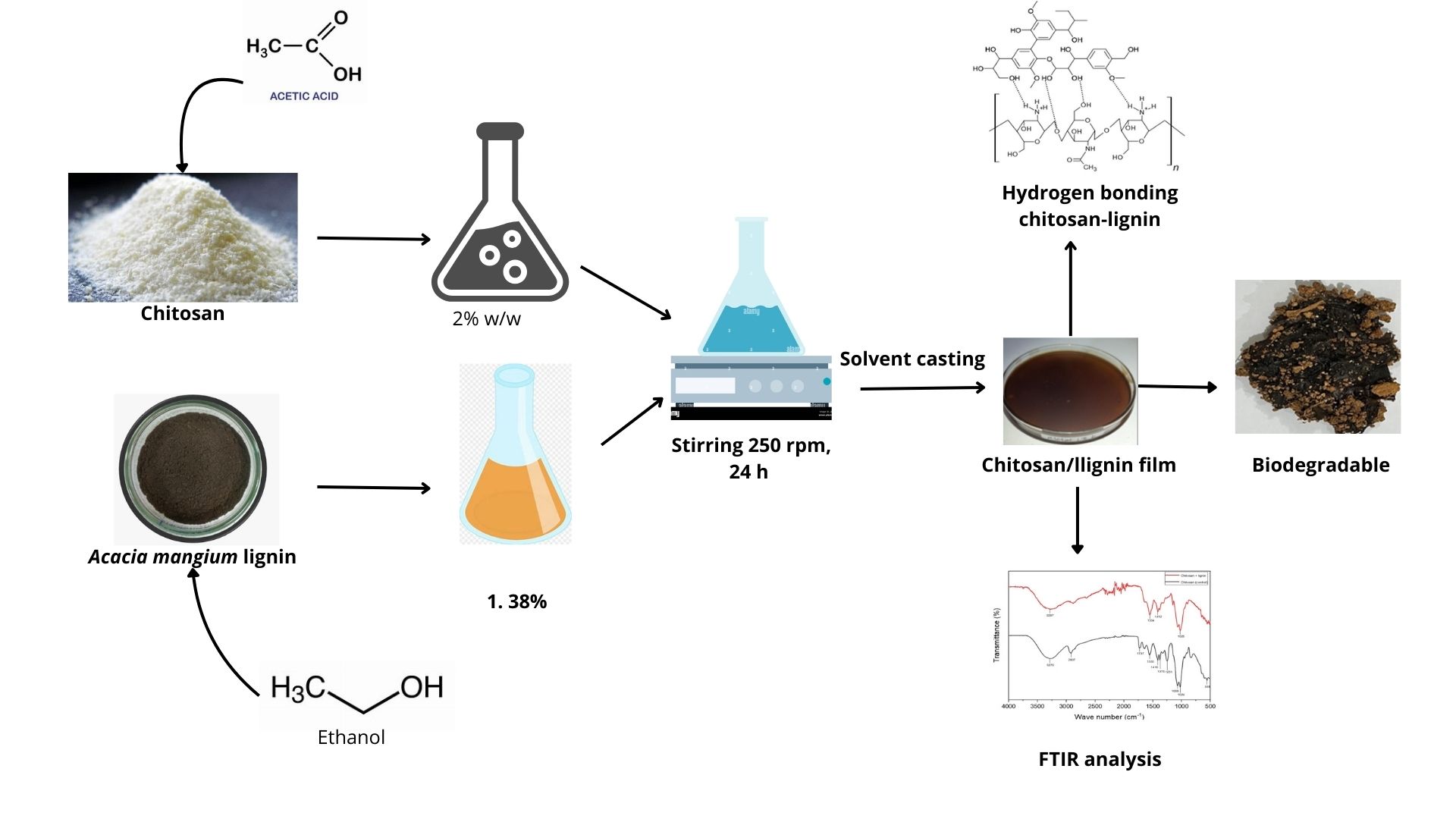
Biodegradable plastics are types of plastics that can decompose into water and carbon dioxide the actions of living organisms, mostly by bacteria. Generally, biodegradable plastics are obtained from renewable raw materials, microorganisms, petrochemicals, or a combination of all three. This study aims to develop an innovative bioplastic by combining chitosan and lignin. Bioplastic was prepared by casting method and characterized by measuring the mechanical properties like tensile strength, Young’s modulus, and elongation at break. The chemical structure, together with the interactions among chitosan and lignin and the presence of new chemical bonds, were evaluated by FTIR, while the thermal properties were assessed by thermogravimetric analysis. The water vapor permeability, tests and transparency as well as biodegradability, were also carried out. The results show a tensile strength value of 34.82 MPa, Young’s modulus of 18.54 MPa, and elongation at a break of 2.74%. Moreover, the interaction between chitosan and lignin affects the intensity of the absorption peak, leading to reduced transparency and increased thermal stability. The chitosan/lignin interactions also influence the crystalline size, making it easier to degrade and more flexible rather than rigid. The contact angle shows the bioplastic’s ability to resist water absorption for 4 minutes. In the biodegradation test, the sample began to degrade after 30 days of soil burial test observation.Graphic Abstract
Keywords
Cite This Article
 Copyright © 2025 The Author(s). Published by Tech Science Press.
This work is licensed under a Creative Commons Attribution 4.0 International License , which permits unrestricted use, distribution, and reproduction in any medium, provided the original work is properly cited.
 Downloads
 Citation Tools
