
 Login
Login Register
 Submit a Paper
 Propose a Special lssue
 Open Access
ARTICLE
Study of Biosynthesis and Biodegradation by Microorganisms from Plastic-Contaminated Soil of Polyhydroxybutyrate Based Composites
1 Department of Physical Chemistry of Fossil Fuels of the Institute of Physical-Organic Chemistry and Coal Chemistry Named after L. M. Lytvynenko of the National Academy of Sciences of Ukraine, Lviv, 79060, Ukraine
2 Department of Chemical Technology and Plastic Processing, Lviv Polytechnic National University, Lviv, 79013, Ukraine
3 Institute of Chemical Engineering, Polish Academy of Sciences, Gliwice, 44-100, Poland
4 Department of Chemical Technology of Oil and Gas Processing, Lviv Polytechnic National University, Lviv, 79013, Ukraine
* Corresponding Author: Serhiy Pyshyev. Email:
Journal of Renewable Materials 2025, 13(7), 1439-1458. https://doi.org/10.32604/jrm.2025.02025-0030
Received 03 February 2025; Accepted 29 April 2025; Issue published 22 July 2025
 View Full Text
 Download PDF
Abstract
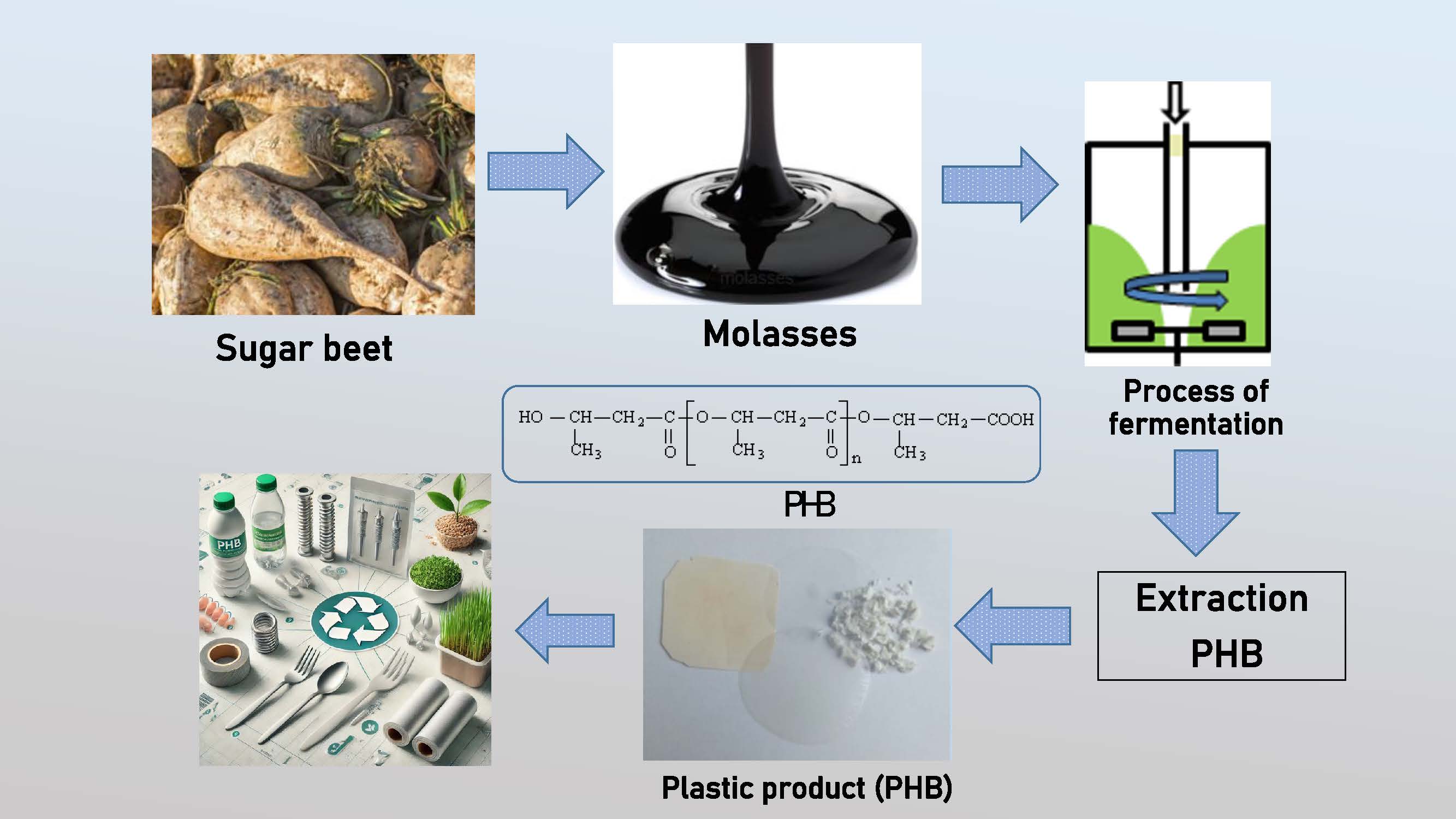
The selection of carbon sources and the biosynthesis of polyhydroxybutyrate (PHB) by the Azotobacter vinelandii N-15 strain using renewable raw materials were investigated. Among the tested substrates (starch, sucrose, molasses, bran), molasses as the carbon source yielded the highest PHB production. The maximum polymer yield (26% of dry biomass) was achieved at a molasses concentration of 40 g/L. PHB formation was confirmed via thin-layer chromatography, gas chromatography and Fourier transform infrared spectroscopy. Composite films based on PHB, polylactic acid (PLA), and their blends were fabricated using the solvent casting. The biodegradation of these films was studied with bacteria isolated from plastic-contaminated soil. These bacteria utilized the biopolymers as their sole carbon source, with the biodegradation process lasting three months. Structural and chemical changes in the films were analyzed using FTIR spectroscopy, differential scanning calorimetry, and thermogravimetry. Among the microorganisms used to study the biodegradation of PHB, PLA, and their blends, Streptomyces sp. K2 and Streptomyces sp. K4 exhibited the highest biodegradation efficiency. PHB-containing films demonstrated significant advantages over other biodegradable polymers, as they degrade under aerobic conditions via enzymatic hydrolysis using microbial depolymerases.Graphic Abstract
Keywords
Cite This Article
 Copyright © 2025 The Author(s). Published by Tech Science Press.
This work is licensed under a Creative Commons Attribution 4.0 International License , which permits unrestricted use, distribution, and reproduction in any medium, provided the original work is properly cited.
 Downloads
 Citation Tools
