
 Login
Login Register
 Submit a Paper
 Propose a Special lssue
 Open Access
REVIEW

Arrowroot Based Nanocomposite Films: Properties, Applications, and Sustainability Prospects: A Review
1 Institute of Tropical Forestry and Forest Products (INTROP), Universiti Putra Malaysia, Serdang, 43400, Selangor, Malaysia
2 Advanced Engineering Materials and Composites Research Center (AEMC), Department of Mechanical and Manufacturing Engineering, Faculty of Engineering, Universiti Putra Malaysia, Serdang, 43400, Selangor, Malaysia
3 Interdisciplinary Research Center for Advanced Materials, King Fahd University of Petroleum and Minerals, Dhahran, 31261, Saudi Arabia
* Corresponding Author: Edi Syams Zainudin. Email:
(This article belongs to the Special Issue: Biomass-based Thermoset and Thermoplastic Polymers for Biomass-based Composites)
Journal of Renewable Materials 2026, 14(2), 1 https://doi.org/10.32604/jrm.2025.02025-0139
Received 07 July 2025; Accepted 11 November 2025; Issue published 25 February 2026
 View Full Text
 Download PDF
Abstract
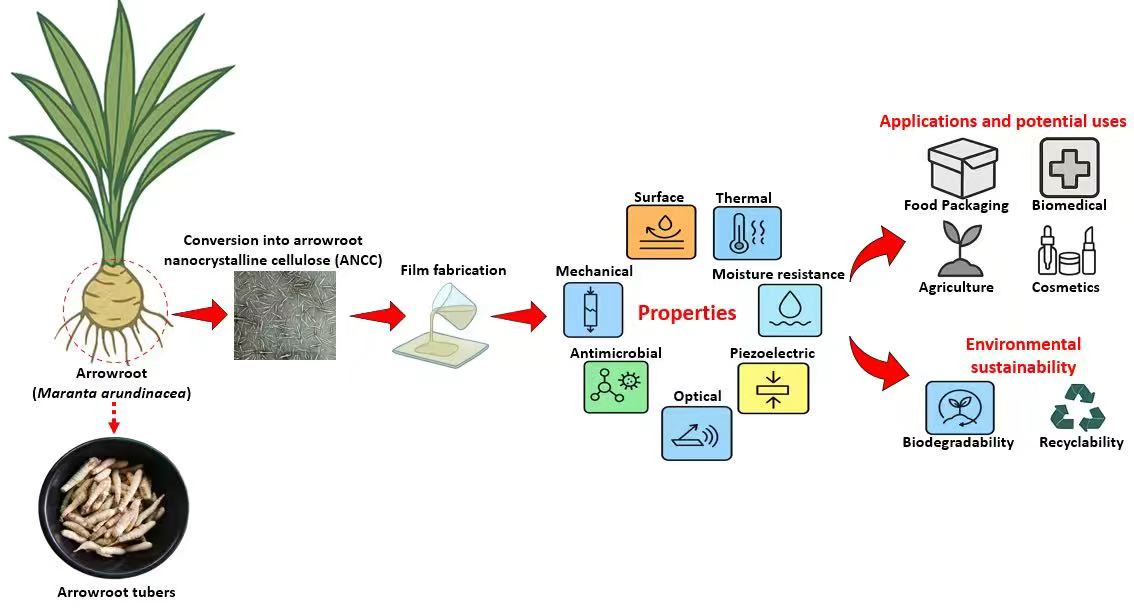
This review draws attention to the innovative use of arrowroot (Maranta arundinacea) fiber as a unique and underutilized biomass source for nanocrystalline cellulose (NCC)-based nanocomposites, presenting a noteworthy alternative to extensively researched materials like wood pulp, bacterial cellulose, and chemically modified NCCs. In contrast to traditional sources, arrowroot possesses a naturally elevated cellulose and diminished lignin content, facilitating more effective NCC extraction requiring reduced chemical input and enabling environmentally friendly processing techniques. The review evaluates the performance of arrowroot-derived nanocomposites against systems documented in the literature, including NCC-based shape memory composites and nanoparticle-reinforced films, demonstrating enhanced tensile strength, improved moisture barrier properties, and thermal stability, as well as potential piezoelectric response. This study recognizes arrowroot as a viable option in the biomass-based nanocellulose sector, providing ecological and functional benefits while tackling significant issues such as process scalability and feedstock variability, thereby offering important insights for the advancement of sustainable materials.Graphic Abstract
Keywords
Cite This Article
 Copyright © 2026 The Author(s). Published by Tech Science Press.
This work is licensed under a Creative Commons Attribution 4.0 International License , which permits unrestricted use, distribution, and reproduction in any medium, provided the original work is properly cited.
 Downloads
 Citation Tools
