
 Login
Login Register
 Submit a Paper
 Propose a Special lssue
 Open Access
ARTICLE

Biobenzoxazines Generated in Hardened Tannin-Hexamine Wood Adhesives
LERMAB-ENSTIB, University of Lorraine, 27 rue Philippe Seguin, Epinal, France
* Corresponding Author: Antonio Pizzi. Email:
Journal of Renewable Materials 2026, 14(7), 1 https://doi.org/10.32604/jrm.2026.02026-0056
Received 16 April 2026; Accepted 16 June 2026; Issue published 28 July 2026
 View Full Text
 Download PDF
Abstract
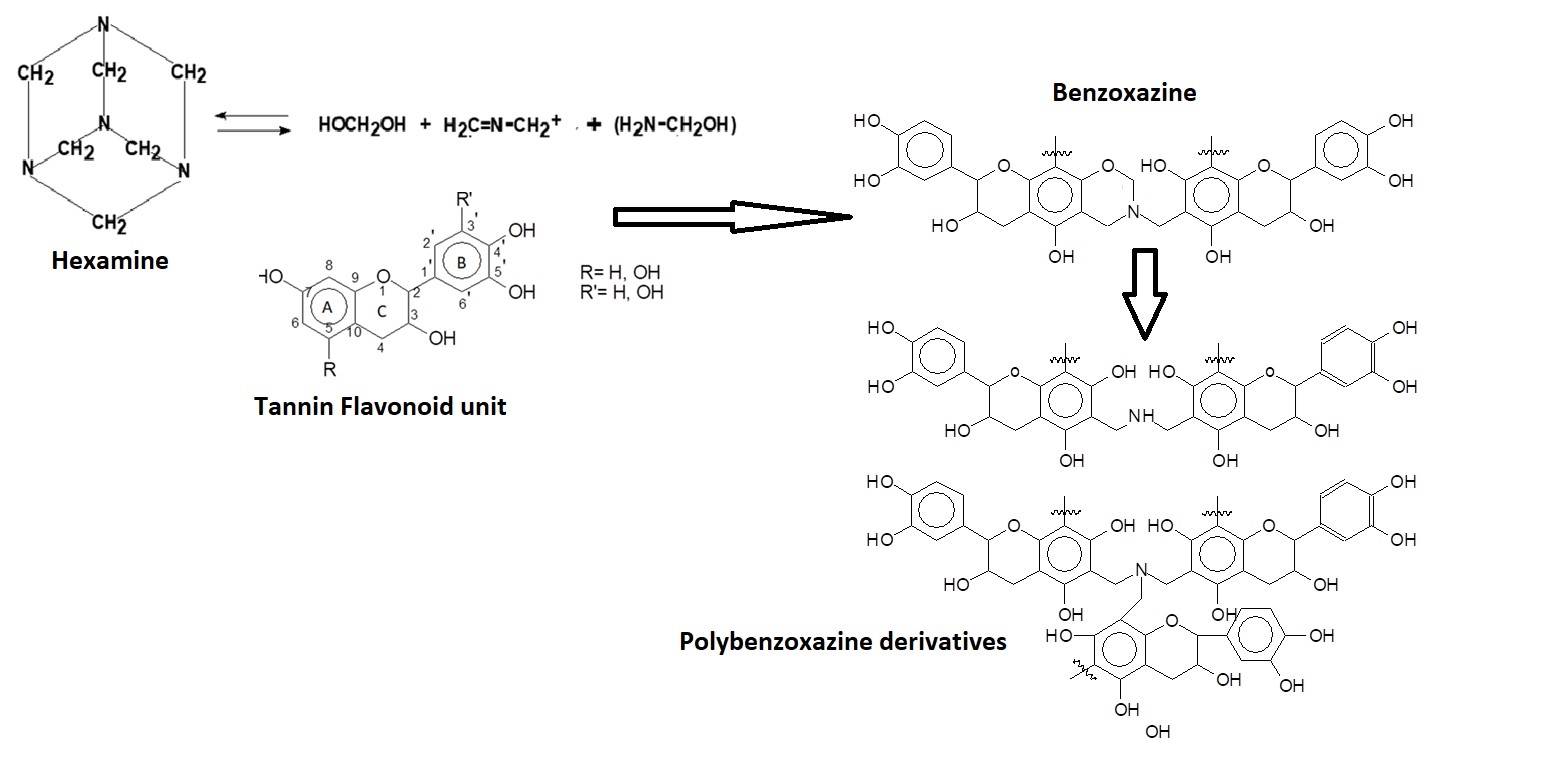
Cross Polarization Magic Angle Spinning Carbon 13 Nuclear Magnetic Resonance (CP-MAS 13C NMR) analysis of commercial procyanidin (pine bark) and delphinidin (pecan nut membranes) condensed flavonoid tannin extracts reacted with hexamethylenetetramine (hexamine) have shown that due to the highly reactive imino-amino methylene species formed before its degradation reaches the generation of formaldehyde, benzylamine bridges between the flavonoid units are formed. This study shows that tannin-based biobenzoxazines are also generated at the same time, with both benzylamines and benzoxazines bridges being in more marked proportions, the more reactive the tannin reacted with hexamethylenetetramine is. This is not the case for slower reacting condensed tannins where aminated bridges are not noticeable either because they are present in the great minority or are even totally absent. This also indicates that tannin-based benzoxazines can be prepared in water solution, at faster reaction times with their proportion increasing with the proportions of hexamine coreactant used, and not only by fusion of phenolic material with hexamine.Graphic Abstract
Keywords
Benzoxazines are heterocyclic chemical species having particularly interesting characteristics that render them suitable for a variety of applications in the preparation of synthetic polymers. Their excellent characteristics, both chemical and physical, have attracted a growing interest in them. For instance, benzoxazines have been employed to improve inherent drawbacks of thermosetting resins by decreasing their too high curing temperatures. The approaches recorded in the relevant articles to tailor-make and improve benzoxazine characteristics are several, like molecular modifications, coreaction with other thermosets, the use of catalysts or additives to design and improve the characteristics of poly-benzoxazine networks [1–3]. Benzoxazines are in general prepared by condensing some sort of a phenol, with an aldehyde, mainly formaldehyde, and a primary amine through intermediate phases leading to their characteristic cyclic ring [4–7]. The variety of possible combinations of these materials is such to ensure the preparation of a variety of benzoxazines of structure suitable for any aimed application. In particular, the field of bio-sourced benzoxazines has gained a particular focus due to the interest in developing environmentally friendly and non-toxic materials. Several bio-sourced materials have been used for this purpose, as for example urushiol [8,9], cardanol [10–12], catechol [13], guaiacol [9], chitosan [14] and cashew nut shell liquid (CNSL) [15], cardanol being the main component of the latter.
Formaldehyde, being now classified as toxic, a recent work has explored the possibility of reacting cardanol with hexamethylenetetramine (hexamine) as a substitute, this compound having the double advantage of introducing simultaneously both the wanted methylene bridges as well as the nitrogen, both necessary to form the benzoxazine heterocyclic ring structure [16]. The authors used a method already on record for cardanol-sourced benzoxazine [4] in view of limiting to lower levels the temperature needed for their curing, this being around 180°C. They reacted at 100°C for cardanol with the addition by weight of 13% hexamine, the reaction having apparently been carried out in a solid molten phase. While this is an excellent result, it must be kept in mind that hexamine has been used as a hardener of biosourced thermosetting resins for almost 40 years. The most known and used of these approaches has been by reacting 6.5% by weight of hexamine in a 45%–50% water solution of a condensed flavonoid tannin, a class of very reactive bio-polyphenolics, a system first introduced to limit free formaldehyde in thermosetting tannin-based wood adhesive [17–19] and since then used industrially for such a use [20]. The reaction is carried out exclusively in a hot press for no more than 5–10 min after applying the mixture to the wood for both wood particleboards and plywood. The temperature in the hot press platens is 190°C, but the temperature reached in the inner core of the panel is never higher than 110°C–120°C due to the cooling effect of the evaporation of water as steam. There are several more advantages in this method: the reaction is carried out in a water solution, the curing time is very rapid, a matter of a few minutes, and the percentage of hexamine is half [17] than that reported for cardanol [16].
It must be remembered that studies on the reaction of hexamine with other very reactive species, such as condensed tannins, have determined that hexamine decomposition leads first to imino-amino methylene basis (CH2=N-CH2+) of such a high reactivity that formation of formaldehyde is inhibited by the imino-amino methylene base being the real bridge-generating species [21–24] (Fig. 1) with even older, but only partially correct findings in this line being also on record [25–27].

Figure 1: Mechanism of decomposition of hexamine in the presence of very reactive species.
It is of interest then to determine if, as a consequence of this reaction, not only benzyl amine bridges are formed, but also benzoxazine bridges do occur.
Commercial pecan (Carya illinoensis) nut pith and pine (Pinus radiata) bark condensed polyflavonoid tannin extracts spray-dried powders were the former obtained from old tannin stock originally obtained from the Quaker Oats extraction factory (Milwaukee, USA), and the latter from tannin stocks originally obtained from Diteco Ltd. a (Coronel, Chile).
The tannin extracts spray-dried powders were each dissolved at 40% concentration in water, the pH adjusted to 4.5 with acetic acid and gelled at 100°C by the addition of 6.5% by weight of hexamine on tannin extract solids. The hexamine was added as a 40% solution in water. The two tannin extracts+hexamine gelled at respectively 45 s for pecan tannin extract and 100 s for pine. The hardened materials were then air dried at ambient temperature for some days and then ground to fine powders for analysis by Cross Polarization Magic Angle Spinning Carbon 13 Nuclear Magnetic Resonance (CP-MAS 13C NMR) spectrometry at 74.47 MHz frequency in a Brüker MSL 300 FT-NMR spectrometer (Brüker, Wissembourg, France). Chemical shifts were calculated relative to tetramethylsilane (TMS) as a control. The spectra were run overnight, with a 0.026 s acquisition time at about 10,000 transients, with 5 s relaxation delay and 1 ppm accuracy, with suppression of spinning side bands and a 20,000 Hz spectral width.
Pine tannin is composed of polyflavonoid oligomers constituted in the great majority by catechin units linked to each other C4-C8 (Fig. 1). Fig. 2 shows the structure of a flavonoid tannin unit, and Fig. 3 shows the CP-MAS 13C NMR spectrum of the commercial pine tannin extract as obtained. The spectrum shows the shifts for the C5, C7 and C9 of the A-ring at 156–158 ppm, the 146–148 ppm shift belonging to the C3′, C4′ and C5′ of the B-ring, the 96–98 ppm shift belonging to the unreacted C6 shift, the 95–98 ppm shift of the still unreacted C8, the 110–111 ppm of the C4–C8 flavonoid inter-unit linkage, the 130–132 ppm shift assigned to the C1′ (for catechol B-rings) and the 132–135 ppm shift (for pyrogallol B-rings). The C2 and C3 shifts appear as a shoulder at 75 ppm and 65 ppm, respectively, both partly covered by the high peak of the fraction of oligomeric carbohydrates always present in the tannin extract, and the unlinked free C4 shift appears at 37.5 ppm [28].

Figure 2: Structure of a condensed tannin flavonoid unit.

Figure 3: Pine tannin extract CP-MAS 13C NMR.
In the spectra of Fig. 4 of the hexamethylenetetramine(hexamine) hardened pine tannin extract bands at 37 and 33 ppm can be noticed, these bands being those of methylene (-CH2-) bridges between flavonoid units phenolic A-rings. Bands at 45, 51 and 57.5 ppm are also present, these being attributed to benzyl amines, respectively mono-, di- and tri-benzyl amines. While in synthetic phenols reactions with hexamine [18], the predominance is that of di-benzylamines, in fast-reacting tannins such as pine tannin extract, the predominance is clearly in favor of mono- and tri-benzylamines. Thus, a 40%–50% methylene bridges predominance over benzyl amines bridges appears to occur when pine tannin extract is hardened with hexamine. The 98 ppm and 105–110 ppm shifts variation are assigned respectively to the unreacted C6/C8 flavonoid sites, and the reacted C6/C8 sites (Figs. 3 and 4) [18]. The first is markedly decreased while the second does increase after reaction with hexamine (Figs. 3 and 4), inferring that the reaction has occurred at the flavonoid units at their C6/C8 sites.

Figure 4: CP-MAS 13C NMR Pine tannin extract reacted with 6.5% hexamine. All the nitrogen containing species are indicated.
Example benzylamines species generated are shown by the structures in Fig. 5.

Figure 5: The range of benzylamines generated by the reaction of pine bark tannin extract with hexamine.
As regards the reaction with hexamine however, small peaks at 80.5, 54.5 and 49 ppm are remarked, notwithstanding the low proportion of hexamine used, indicating the formation not only of benzylamines but also of tannin-based benzoxazines (Fig. 6). These three small peaks indicate that bridges as indicated in Fig. 7 as a (80.5 ppm), b (54.5 ppm) and c (49 ppm) are formed as shown by other authors with different phenolic materials [16]. This implies the formation of condensed tannin benzoxazines.

Figure 6: CP-MAS 13C NMR of pine tannin extract reacted with 6.5% hexamine, indicating the peaks relevant to the benzoxazines generated.

Figure 7: Examples of the isomers of tannin-based benzoxazine likely to be formed by the reaction of pine bark tannin extract and hexamine. The three a (80.5 ppm), b (54.5 ppm) and c (49 ppm) bridges corresponding to the arrows in Fig. 6 are shown.
The example shown in Fig. 7 indicates the type of benzoxazine structures formed by the reaction of tannins with hexamine. The three a, b and c linkages of the benzoxazine isomers likely to be generated by the reaction are indicated in Fig. 7.
From Fig. 8, it must be considered that some free formaldehyde is generated and exists in water solution in its hemiformal form HOCH2OH and that this can react rapidly with the imino-amino methylene base CH2=NH-CH2+ to yield the form HOCH2-N(CH2+)-CH2OH leading to the generation of the biobenzoxazine as shown in Fig. 7. In the case where it is the iminoamino methylene basis that reacts directly with the tannin bridges to polybenzoxazine are not formed but rather monomeric tannin benzoxazines are formed of the type as shown as follows:

Figure 8: The final reactive forms of decomposition of hexamine present for reaction.

The very likely presence of this species indicates that the benzoxazines, as shown in Fig. 7, are also very likely to be formed by reaction with this species of the HOCH2OH hemiformal form of formaldehyde in water solution.
This infers that in the case of procyanidin type condensed tannins, when reacted with hexamine while methylene bridges do predominate, with the relatively high proportion of benzyl amine bridges also occurring, even a minor proportion of benzoxazine bridges also occurs, even at the faible proportion of 6.5% by weight of hexamine on tannin extract solids. And this occurs even at the short heating times used for bonding wood particleboards and for the low core temperature of 110°C–120°C observed when the hot platen temperature is at 190°C.
This infers that when highly reactive condensed tannins are used for reaction with hexamine in a water solution, the hexamine does not fully decompose to formaldehyde but in part only decomposes to more reactive species, yielding benzyl amine and benzoxazine bridges. Moreover, it also infers that the decomposition of such reactive species occurs in water solution and at an acid pH (pH = 4.5). This indicates that benzoxazine and benzyl amines also form not only as for phenols when the reaction is in molten form [16]. This is also in line with the manner of decomposition reported for hexamine down to a very reactive imino-amino methylene basis [22–24]. It shows that hexamine decomposition in the presence of very reactive species such as procyanidin tannins only partially reaches to formaldehyde for reacting with the tannin, and its proportion has been limited to the formaldehyde initially present and formed during hardening in the solution as a consequence of the hexamine to HCHO+ammonia equilibrium. Two reactions in competition then occur, namely both the hexamine decomposition and the fast reaction of the fleetingly-formed intermediate amine species with the phenol A-rings of the tannin. The inference is that both benzylamines and benzoxazines are then present in higher proportions, the more reactive the tannins are. Thus, the gel time of the system is the parameter determining the proportion of the benzylamines and benzoxazine species in the gelled resin. This depends on the pH of the system and the reactivity of the flavonoid tannin A-ring: the faster gel times correspond to a higher proportion of aminated species in the hardened structure, and vice versa at longer gel times, the lesser their proportion is. Thus, the longer the gel time, the more time is left for the decomposition of the hexamine to reach the formaldehyde stage.
This effect is also noticeable for prodelphinidin tannins, such as the case of pecan nut tannin, a tannin more reactive and gelling at an even faster rate than procyanidins. This can also be seen by comparing under equal conditions of 100°C and pH 4.5, the 45 s gelling of the pecan tannin and the 100 s gelling of the pine tannin. This is reflected in the higher proportion of benzyl amines and benzoxazines in the gelled/hardened pecan tannin case (Fig. 4). Mono-, di- and tribenzyl amines at 45, 51 and 57.5 ppm, respectively, are clearly in higher proportions than the 33 and 35 ppm methylene bridges. Di-and tri-benzyl amines predominate in pecan tannin+hexamine. The same trend is noticeable for the benzoxazines at 80.5, 54.5 and 49 ppm (Figs. 6 and 9). In pecan tannin+hexamine systems, the proportion of benzylamine/benzoxazine bridges can be estimated to be even up to 70% to 80% of the total cross-linking bridges (Fig. 9).

Figure 9: CP-MAS 13C NMR of pecan nut tannin extract reacted with 6.5% hexamine with arrows indicating the peaks relevant to the formation of benzylamines and benzoxazines.
It has already been reported that in slower reacting tannins, such as profisetinidin/prorobinetindin ones, like quebracho or mimosa tannin extract, when they are reacted with hexamine, methylene bridges are greatly predominant. Thus, the few benzylamines if any present will be in the form of mono-benzylamines [18], hence not as bridges linking flavonoid units. It is this characteristic that renders hardening of these latter types of tannins with hexamine more subject to moisture and water attack, hence mostly as interior grade adhesives, while the much faster reacting tannins can yield exterior grade adhesives once reacted with hexamine. The work published by several authors on fast reacting phenols [28–31] and of the way hexamine does really decompose to form very fast reacting intermediates negating the reaching of the formaldehyde stage [17,18,23–25], supports the findings above.
The reaction of condensed tannins with hexamethylenetetramine only partly leads to methylene (-CH2-) bridges formed by the formaldehyde that has been generated by the hexamine. Instead, it also leads to benzylamine bridges as well as benzoxazine bridges, the higher the proportion of these latter two, the more reactive the condensed tannin used. Thus, the cross-link structure of these bridges is determined by the intrinsic reactivity of the tannin under the conditions used. Highly reactive condensed tannins such as procyanidins and prodelphinidins present a relatively high proportion of benzylamine and of benzoxazine bridges in their final gelled and hardened network. This renders hexamine a hardener also suitable for exterior grade tannin-based wood adhesives, this not being the case for slower reacting condensed tannins under equivalent reaction conditions. These amine bridges are the consequence of the mechanism of formation of highly reactive amino compounds due to the mechanism of decomposition of hexamine. Moreover, of considerable interest is also that tannin-based benzoxazines can be prepared in a water solution, at faster reaction times with their proportion increasing with the proportion of hexamine coreactant used. Moreover, this appears to be achievable at fast reaction times as used in wood panel curing.
Acknowledgement: Not applicable.
Funding Statement: The authors received no specific funding for this study.
Availability of Data and Materials: All data are contained in the publication.
Ethics Approval: Not applicable.
Conflicts of Interest: The author declares no conflicts of interest.
References
1. Abdelkawy MA, Khedr AM. Synthesis and characterization of polybenzoxazine-metal hybrids and evaluation of their thermal property. Polym Bull. 2025;83(3):154. doi:10.1007/s00289-025-06046-1. [Google Scholar] [CrossRef]
2. Lyu Y, Ishida H. Natural-sourced benzoxazine resins, homopolymers, blends and composites: a review of their synthesis, manufacturing and applications. Prog Polym Sci. 2019;99:101168. doi:10.1016/j.progpolymsci.2019.101168. [Google Scholar] [CrossRef]
3. Lochab B, Monisha M, Amarnath N, Sharma P, Mukherjee S, Ishida H. Review on the accelerated and low-temperature polymerization of benzoxazine resins: addition polymerizable sustainable polymers. Polymers. 2021;13(8):1260. doi:10.3390/polym13081260. [Google Scholar] [PubMed] [CrossRef]
4. Oliveira JR, de Freitas DB, de Oliveira JFR, Mele G, Mazzetto SE, Lomonaco D. New opportunity for sustainable benzoxazine synthesis: a straight and convenient one-pot protocol for formaldehyde-free bio-based polymers. Eur Polym J. 2021;156(6):110596. doi:10.1016/j.eurpolymj.2021.110596. [Google Scholar] [CrossRef]
5. Oliveira JR, Kotzebue LRV, Ribeiro FWM, Mota BC, Zampieri D, Mazzetto SE, et al. Microwave-assisted solvent-free synthesis of novel benzoxazines: a faster and environmentally friendly route to the development of bio-based thermosetting resins. J Polym Sci Part A Polym Chem. 2017;55(21):3534–44. doi:10.1002/pola.28755. [Google Scholar] [CrossRef]
6. Wang YX, Ishida H. Cationic ring-opening polymerization of benzoxazines. Polymer. 1999;40(16):4563–70. doi:10.1016/S0032-3861(99)00074-9. [Google Scholar] [CrossRef]
7. Chen J, Jian R, Yang K, Bai W, Huang C, Lin Y, et al. Urushiol-based benzoxazine copper polymer with low surface energy, strong substrate adhesion and antibacterial for marine antifouling application. J Clean Prod. 2021;318:128527. doi:10.1016/j.jclepro.2021.128527. [Google Scholar] [CrossRef]
8. Yang W, Xie Y, Chen J, Huang C, Xu Y, Lin Y. Metal ion-catalyzed low-temperature curing of urushiol-based polybenzoxazine. Front Chem. 2022;10:879605. doi:10.3389/fchem.2022.879605. [Google Scholar] [PubMed] [CrossRef]
9. Krishnan A, Arumugam H, Luengrojanakul P, Boonnao N, Muthukaruppan A, Ahn CH, et al. Development of new bio-based shape memory hybrid polybenzoxazines through green strategy. Eur Polym J. 2025;231:113926. doi:10.1016/j.eurpolymj.2025.113926. [Google Scholar] [CrossRef]
10. Ribeiro FWM, Kotzebue LRV, Oliveira JR, Maia FJN, Mazzetto SE, Lomonaco D. Thermal and mechanical analyses of biocomposites from cardanol-based polybenzoxazine and bamboo fibers. J Therm Anal Calorim. 2017;129(1):281–9. doi:10.1007/s10973-017-6191-x. [Google Scholar] [CrossRef]
11. Calò E, Maffezzoli A, Mele G, Martina F, Mazzetto SE, Tarzia A, et al. Synthesis of a novel cardanol-based benzoxazine monomer and environmentally sustainable production of polymers and bio-composites. Green Chem. 2007;9(7):754–9. doi:10.1039/b617180j. [Google Scholar] [CrossRef]
12. Kotzebue LRV, De Oliveira JR, Da Silva JB, Mazzetto SE, Ishida H, Lomonaco D. Development of fully biobased high-performance bis-benzoxazine under environmentally friendly conditions. ACS Sustain Chem Eng. 2018;6(4):5485–94. doi:10.1021/acssuschemeng.8b00340. [Google Scholar] [CrossRef]
13. Periyasamy T, Asrafali SP, Raorane CJ, Raj V, Shastri D, Kim SC. Sustainable chitosan/polybenzoxazine films: synergistically improved thermal, mechanical, and antimicrobial properties. Polymers. 2023;15(4):1021. doi:10.3390/polym15041021. [Google Scholar] [PubMed] [CrossRef]
14. Luo Y, Zu L, Dong S, Lan T, Zhang L, Zhang W, et al. Research progress and application of solvent-free technology, green catalysis and biomass resource strategy for the synthesis of benzoxazine. React Funct Polym. 2025;216(1):106434. doi:10.1016/j.reactfunctpolym.2025.106434. [Google Scholar] [CrossRef]
15. Martins MG, Marciano SJ, Clemente E, de Menezes LM, da Costa Júnior AE, Mele G, et al. Investigation of the structural features and polymerization mechanism of a novel bio-based benzoxazine using different lewis acids. J Polym Res. 2026;33(3):94. doi:10.1007/s10965-026-04786-w. [Google Scholar] [CrossRef]
16. Pizzi A. Hardening mechanism of tannin adhesives with hexamine. Holz Als Roh Und Werkstoff. 1994;52(4):229. doi:10.1007/BF02619098. [Google Scholar] [CrossRef]
17. Pizzi A. Ambient temperature gelling of Tannin adhesives with hexamine. Holz Als Roh Und Werkstoff. 1994;52(5):286. doi:10.1007/BF02621414. [Google Scholar] [CrossRef]
18. Wang S, Pizzi A. Dependence of tannin/hexamine particleboard performance from pressing conditions. Holz Als Roh Und Werkstoff. 1997;55(2):174. doi:10.1007/BF02990540. [Google Scholar] [CrossRef]
19. Valenzuela J, von Leyser E, Pizzi A, Westermeyer C, Gorrini B. Industrial production of pine tannin-bonded particleboard and MDF. Eur J Wood Wood Prod. 2012;70(5):735–40. doi:10.1007/s00107-012-0610-2. [Google Scholar] [CrossRef]
20. Pizzi A, Tekely P. Mechanism of polyphenolic tannin resin hardening by hexamethylenetetramine: CP–MAS 13C-NMR. J Appl Polym Sci. 1995;56(12):1645–50. doi:10.1002/app.1995.070561215. [Google Scholar] [CrossRef]
21. Kamoun C, Pizzi A. Mechanism of hexamine as a non-aldehyde polycondensation hardener, part 1: hexamine decomposition and reactive intermediates. Holzforsch Und Holzverwert. 2000;52(1):16–9. [Google Scholar]
22. Kamoun C, Pizzi A. Mechanism of hexamine as a non-aldehyde polycondensation hardener, part 2: hexamine recomposition and reactive intermediates. Holzforsch Und Holzverwert. 2000;52(3):66–7. [Google Scholar]
23. Kamoun C, Pizzi A, Zanetti M. Upgrading of MUF resins by buffering additives—Part 1: hexamine sulphate effect and its limits. J Appl Polym Sci. 2003;90(1):203–14. [Google Scholar]
24. Hultzsch K. Studien auf dem gebiet der phenol-formaldehyd-harze, XIV. mitteil.: über die ammoniak-kondensation und die reaktion von phenolen mit hexamethylentetramin. Chem Ber. 1949;82(1):16–25. doi:10.1002/cber.19490820105. [Google Scholar] [CrossRef]
25. Hultzsch K. Chemie der phenolharze. Berlin/Heidelberg, Germany: Springer; 1950. [Google Scholar]
26. Megson NJL. Phenolic resin chemistry. London, UK: Butterworth; 1958. [Google Scholar]
27. Pizzi A. Advanced wood adhesives technology. New York, NY: Marcel Dekker; 1994. [Google Scholar]
28. Zinke A, Zigeuner G, Weiss G. Zur kenntnis des härtungsprozesses von phenol-formaldehyd-harzen: XIX., vorläufige mitteilung: über die härtung mit hexamethylentetramin IV. Monatsh Für Chem Und Verwandte Teile Anderer Wissen. 1949;80(1):148–50. doi:10.1007/BF00899934. [Google Scholar] [CrossRef]
29. Zinke A, Zigeuner G, Weiss G, Wiesenberger E. Zur kenntnis des härtungsprozesses von phenol-formaldehyd-harzen: XVII. mitteilung: über die härtung mit hexamethylentetramin III. Monatsh Für Chem. 1949;80(2):160–9. doi:10.1007/bf00906458. [Google Scholar] [CrossRef]
30. Zinke A, Zigeuner G, Weiß G, Leupold-Löwenthal W, Wiesenberger E. Zur kenntnis des härtungsprozesses von phenol-formaldehydharzen: XXI. mitteilung: über die härtung mit hexamethylentetramin V. Monatsh Für Chem. 1950;81(7):1098–107. doi:10.1007/bf00899354. [Google Scholar] [CrossRef]
31. Zinke A, Zigeuner G, Weiß G, Schaden W, Wiesenberger E. Zur kenntnis des härtungsprozesses von phenol-formaldehydharzen: XX. mitteilung: über die härtung mit hexamethylentetramin V. Monatsh Für Chem Und Verwandte Teile Anderer Wissen. 1950;81(7):999–1006. doi:10.1007/BF00899344. [Google Scholar] [CrossRef]
Cite This Article
 Copyright © 2026 The Author(s). Published by Tech Science Press.
This work is licensed under a Creative Commons Attribution 4.0 International License , which permits unrestricted use, distribution, and reproduction in any medium, provided the original work is properly cited.
 Downloads
 Citation Tools
