
 Login
Login Register
 Submit a Paper
 Propose a Special lssue
 Open Access
ARTICLE
Thermodynamic Approach to Migration Stability of Biosourced Plasticizers via Hysteresis Analysis
Nanotechnology Research & Education Centre, South Ural State University, Lenin Prospect 76, Chelyabinsk, Russia
* Corresponding Authors: Irina N. Vikhareva. Email: ,
Journal of Renewable Materials 2026, 14(8), 6 https://doi.org/10.32604/jrm.2026.02026-0042
Received 15 March 2026; Accepted 07 July 2026; Issue published 26 August 2026
 View Full Text
 Download PDF
Abstract
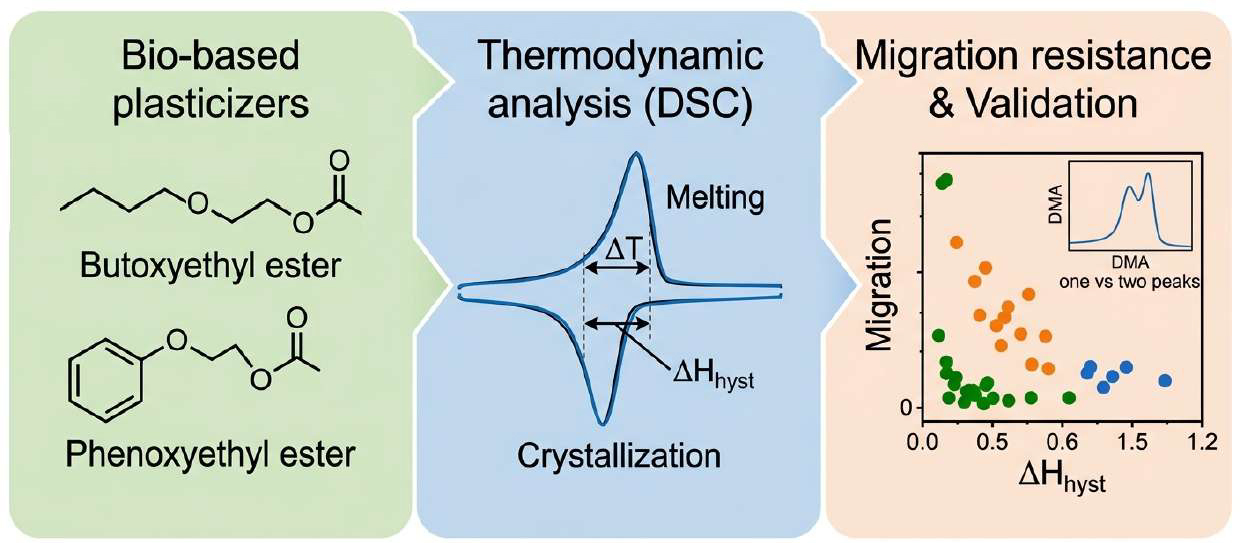
The development of efficient and migration-resistant plasticizers from renewable resources is an important challenge for the modern polymer industry. This work presents a thermodynamic approach for the rapid screening of novel bio-based plasticizers-esters of dicarboxylic acids. Using differential scanning calorimetry (DSC), the temperatures and enthalpies of melting and crystallization of the individual esters were determined, and the hysteresis of phase transition parameters was calculated as a predictive indicator. It is shown that bio-based butoxyethyl esters are characterized by low temperature hysteresis ΔT ~ 20°C and enthalpy hysteresis close to zero, indicating weak intermolecular interactions and equilibrium crystallization. In contrast, phenoxyethyl esters exhibit pronounced hysteresis with ΔT up to 76°C and significant variations in the ΔHhyst parameter. The negative value of ΔHhyst for decylphenoxyethyl adipate (−63.4 J/g) indicates a thermodynamic predisposition towards the formation of highly ordered structures. To validate the thermodynamic predictions, the bio-based plasticizers were incorporated into a model polyvinyl chloride (PVC) matrix and studied by dynamic mechanical analysis (DMA). DMA data confirmed that phenoxyethyl esters with high ΔT values induce microphase separation in the PVC matrix, manifested as two distinct mechanical loss peaks, which correlates with an increased risk of migration. However, due to specific interactions with PVC, these esters impart enhanced modulus and thermal stability to the composites. Bio-based butoxyethyl esters, which form homogeneous systems, are, in contrast, optimal candidates for creating migration-resistant materials requiring high elasticity. The proposed thermodynamic criteria represent an effective tool for the rational design and selection of bio-based plasticizers depending on the required property profile.Graphic Abstract
Keywords
The development of effective plasticizers from renewable sources is an important challenge driven by the need to replace toxic phthalates [1–5]. Polyvinyl chloride (PVC) is a demanding matrix for testing new materials due to its large production volume [6,7]. This study focuses on novel bio-based plasticizers-esters of dicarboxylic acids—and their evaluation in PVC. By embedding into the polymer matrix, these compounds increase free volume and segmental mobility, improving elasticity and processability [3,4].
Phthalates, despite their favorable characteristics [8], pose significant health risks [5,9,10], leading to stringent regulations [11–13] and the need for migration-resistant alternatives [14,15]. The transition to third-generation plasticizers emphasizes biodegradability and renewable sourcing [16–24].
Recent research has increasingly focused on bio-based alternatives derived from renewable resources, aligning with global sustainability goals and circular economy principles [25,26]. A particularly illustrative example is the development of plasticizers from cashew nutshell liquid (CNSL), an agricultural waste product. Cardanol, the principal CNSL component, features a phenolic ring with a long C15 alkyl chain—a structural motif demonstrating promising PVC plasticization performance [27,28]. This combination of an aromatic fragment for compatibility and a flexible aliphatic chain for mobility bears striking similarity to the phenoxyethyl adipates investigated in the present study, suggesting common design principles for bio-inspired, high-performance plasticizers [29,30]. Other renewable feedstocks successfully explored include vegetable oils (soybean, castor, palm), tartaric acid, citric acid, succinic acid, gallic acid, rosin, isosorbide, and various plant biomass extracts [5,31–33]. It is worth noting that the diester structures investigated here are not limited to PVC plasticization. Similar ester-based plasticizers have recently demonstrated excellent performance in other polymer matrices, such as poly(lactide) (PLA), where the chain length of geraniol esters governs the plasticization efficiency [34]. This versatility highlights the broader relevance of our thermodynamic hysteresis approach for designing bio-based plasticizers across different polymer systems.
The fundamental basis for predicting plasticizer migration lies in the thermodynamics of polymer-plasticizer systems. Real systems deviate from ideality due to specific intermolecular interactions, creating kinetic barriers during phase transitions [35–37]. This manifests as phase transition hysteresis—a disparity between melting and crystallization parameters—which serves as a sensitive indicator of a compound’s tendency to self-organize [38,39]. Although hysteresis is a universal phenomenon, its implications for migration in molecular systems such as plasticizers remain unexplored [40]. Molecular dynamics simulations have demonstrated that plasticizers can be expelled from crystalline regions during polymer crystallization, concentrating in amorphous domains and potentially initiating migration [41]. While surface modification strategies (plasma treatment, coating, crosslinking) can reduce migration by 75%–98%, they address symptoms rather than fundamental causes [42]. A more fundamental solution lies in the molecular design of plasticizers that are thermodynamically predisposed to remain stably integrated within the PVC matrix—a principle probed through careful analysis of phase transition parameters [43,44].
Among emerging bio-based plasticizers, adipate esters have attracted particular attention due to their excellent low-temperature flexibility, biodegradability, and structural versatility [5,45]. Adipic acid-derived plasticizers can be functionalized with various alcohol moieties, enabling fine-tuning of compatibility, plasticization efficiency, and migration resistance [46].
The aim of this work was to establish a direct correlation between the molecular structure of new dicarboxylic acid esters derived from renewable resources (specifically, butoxy- and phenoxyethyl derivatives) and their predicted migration stability. To achieve this goal, a thermodynamic approach based on the analysis of the phase transition hysteresis of the individual bio-based esters was employed. The hysteresis parameters are proposed as quantitative criteria for selecting plasticizers that ensure long-term stability of the polymer material. This study provides a scientific basis for the development of effective and environmentally safe alternatives to traditional phthalate plasticizers, contributing to the advancement of renewable materials for high-performance applications.
Fig. 1 outlines the step-by-step experimental methodology. The synthesis of asymmetric and symmetric diesters was carried out at 110°C–120°C under reflux with p-toluenesulfonic acid as catalyst. PVC compositions were prepared with 40 phr plasticizer, 2 phr tribasic lead sulfate and 1.5 phr calcium stearate, mixed at 60°C for 5 min, and compression-molded at 170°C and 10 MPa for 5 min. DSC scans were performed at 5 K/min under nitrogen. DMA measurements were conducted at 1 Hz with a heating rate of 3°C/min. Migration tests were carried out in water, ethanol/water and vegetable oil at 50°C for 24 h.

Figure 1: The general scheme of the research methodology.
PVC used in this study was a commercial suspension-grade resin (brand S-7058M, supplied by JSC “Bashkir Soda Company”, Sterlitamak, Russia). Its viscosity average molecular weight (Mv) was 5.5 × 10⁴. Adipic acid (≥99.8%, melting point 152.3°C), azelaic acid (≥99.5%, melting point 106°C–108°C), and sebacic acid (≥99.5%, melting point 131°C–134°C) were purchased from Vekton LLC (Russia). Butoxyethanol (≥99.2%, density 0.901 g/cm3 at 20°C) was supplied by SintezOrg CJSC (Russia). Phenoxyethanol (≥99.5%, density 1.107 g/cm3 at 20°C) was obtained from ChimReaktiv LLC (Russia). Butanol (≥99.4%, density 0.810 g/cm3 at 20°C) and decanol (≥98.8%, density 0.829 g/cm3 at 20°C) were purchased from Vekton LLC (Russia). p-Toluenesulfonic acid (pTSA, ≥98.5%) used as a catalyst and toluene (anhydrous, 99.8%) used as a solvent were supplied by Sigma-Aldrich. All chemicals were used as received without further purification.
Synthesis of asymmetric esters (alkyl butoxyethyl adipates and alkyl phenoxyethyl adipates). The asymmetric diesters were synthesized via a two-step esterification reaction. In a typical procedure, 0.5 mol of adipic acid, 0.5 mol of the first alcohol (butoxyethanol or phenoxyethanol), 0.005 mol of p-toluenesulfonic acid as a catalyst, and 150 mL of toluene as a solvent were placed in a three-necked round-bottom flask equipped with a reflux condenser, a thermometer, and a Dean-Stark trap. The mixture was heated to reflux (approximately 110°C–120°C) and stirred until the calculated amount of water (0.5 mol) was collected in the Dean-Stark trap, indicating the completion of the first esterification step and the formation of the monoester.
Subsequently, the second alcohol (aliphatic alcohol, 0.55 mol) was added dropwise through a dropping funnel. The reaction mixture was refluxed again until an additional 0.5 mol of water was collected. After completion, the mixture was cooled to room temperature. The organic layer was washed sequentially with 5% aqueous NaHCO3 solution, distilled water, and saturated sodium chloride solution to remove the catalyst and unreacted acids. The organic phase was then dried over anhydrous sodium sulfate for 12 h. After filtration, the solvent was removed under reduced pressure using a rotary evaporator. The obtained product was dried under vacuum at 60°C to constant weight. The yield of all asymmetric diesters exceeded 86%.
Using this method, the following asymmetric esters were prepared: butylbutoxyethyl adipate (butylBEA), octylbutoxyethyl adipate (octylBEA), butylphenoxyethyl adipate (butylPEA), i-butylphenoxyethyl adipate (i-butylPEA), decylphenoxyethyl adipate (decylPEA).
Synthesis of symmetric esters (diphenoxyethyl esters). Symmetric diesters were prepared by a single-step esterification. A mixture of 0.5 mol of dicarboxylic acid (adipic, azelaic, or sebacic acid), 1.1 mol of phenoxyethanol, 0.005 mol of p-toluenesulfonic acid, and 150 mL of toluene was refluxed with a Dean-Stark trap until 1.0 mol of water was collected. The reaction mixture was then cooled, washed, dried, and the solvent removed as described above. The yield exceeded 88%.
The following symmetric esters were obtained: diphenoxyethyl adipate (DPEA), diphenoxyethyl azelate (DPEAz), diphenoxyethyl sebacate (DPES) (Fig. 2).

Figure 2: Diphenoxyethyl sebacate.
Preparation of PVC compositions. The formulation comprised 100 parts by weight of PVC (S-7058M), 40 parts by weight of the investigated ester (acting as a plasticizer), and a standard thermal stabilizer (2 parts by weight of tribasic lead sulfate and 1.5 parts by weight of calcium stearate). The components were mixed in a laboratory mixer at 60°C for 5 min to ensure homogeneity. The resulting dry blends were then compression-molded into rectangular specimens (50 × 10 × 2 mm3) at 170°C under a pressure of 10 MPa for 5 min, followed by cooling under pressure to room temperature.
Differential Scanning Calorimetry (DSC). The phase transition temperatures (melting point, Tm, and crystallization point, Tcr) and the corresponding enthalpies (ΔHm, ΔHcr) of the synthesized esters were determined using a differential scanning calorimeter DSC 1 (Mettler Toledo, Switzerland). Samples of 4–8 mg were placed in sealed aluminum pans (40 µL). Measurements were performed under a dynamic nitrogen atmosphere (flow rate 80 mL/min) to prevent oxidative degradation. The thermal protocol consisted of:
1. Heating from 25°C to 120°C at a rate of 5 К/min and holding for 15 min to erase the thermal history.
2. Cooling to −110°C at a rate of 5 К/min to record the crystallization exotherm.
3. Reheating to 120°C at a rate of 5 К/min to record the melting endotherm.
Tm and Tcr were taken as the peak maximum of the endothermic and exothermic transitions, respectively, using the STARe software. Enthalpies (ΔHm, ΔHcr) were determined by integrating the peak areas. Each sample was analyzed in triplicate, and the reported values are the mean. The uncertainty in temperature measurement was ±0.3°C, and the relative uncertainty in enthalpy was ±3%. The hysteresis of phase transitions was calculated as ΔT = Tm − Tcr and ΔHhyst = | ΔHm| − |ΔHcr|.
Dynamic mechanical analysis (DMA). DMA measurements were performed on a dynamic mechanical analyzer (DMA-242, Netzsch 70, Germany) in the three-point bending mode. The temperature range was from −100°C to 100°C at a heating rate of 3°C/min and a frequency of 1 Hz. The storage modulus (E′), loss modulus (E″), and mechanical loss factor (tanδ = E″/E′) were recorded as a function of temperature. The glass transition temperature (Tg) was determined as the peak maximum of the tanδ curve. The shape of the tanδ peak (single, double, or broadened) was used as an indicator of the system’s homogeneity and the presence of microphase separation.
Method for Determining Plasticizer Migration. A 50 mm × 50 mm square was cut from a PVC film with a thickness of 0.2–0.5 mm (sample weight ~10 g). The sample was conditioned for 24 h at 50°C in extractants (water, 30%–50% ethanol, vegetable oil) at a 1:10 sample-to-extractant ratio. The sample was weighed before (m0) and after (m1) exposure using an analytical balance (accuracy 0.0001 g). The mass loss was calculated as Δm = (m0 − m1)/m0 × 100%. The acceptable migration limit is ≤2%–5%, depending on the film application.
3.1 Synthesis and Characterization of Esters
Earlier works described the preparation and investigation of the characteristics of esters of ethoxylated alcohols [43–46]. Briefly, the esters were obtained via an esterification reaction of adipic, azelaic, or sebacic acid with the corresponding alcohols (butanol, octanol, decanol, i-butanol, butoxyethanol, phenoxyethanol) in the presence of an acid catalyst (Fig. 3).

Figure 3: Synthesis scheme of adipates.
The yield of all diesters exceeded 86%. The synthesized compounds are characterized by a low acid number (<0.05 mg KOH/g) and minimal volatility (weight loss <1% at 150°C) (Fig. 3). These characteristics are essential prerequisites for their application as PVC plasticizers, as they prevent thermal degradation of the polymer during processing and reduce the initial tendency for migration.
The process performance is verified through several complementary methods. First, the yields of 86% and 88% refer to isolated purified products after washing, drying, and solvent removal. For a two-step esterification reaction of dicarboxylic acids with bulky alcohols (butoxyethanol, phenoxyethanol) using an acid catalyst, these yields are considered very good. Typical literature values for similar esterifications range from 70% to 90%; above 85% is generally regarded as efficient, especially when the products are oily liquids requiring careful purification. Second, the quality of the synthesis is confirmed by low acid numbers (<0.05 mg KOH/g) and minimal volatile content, indicating high purity and negligible unreacted starting materials. Third, FTIR spectra show complete disappearance of O–H and free carboxylic C=O bands, confirming reaction completion. Thus, yields of 86%–88% together with these analytical data demonstrate reliable and reproducible process performance.
It is important to note that all key components used in this study—the dicarboxylic acids (adipic, azelaic, and sebacic acids) and the alcohols (butoxyethanol, phenoxyethanol, butanol, and decanol)—can be derived from renewable sources [16,17,29].
The dicarboxylic acids employed in this work are well-recognized bio-based building blocks [17,29]. Adipic acid can be obtained from renewable biomass through the catalytic conversion of sugars (e.g., glucose from starch or cellulose) or via fermentation of aromatic compounds derived from lignin [16,28]. Recent advances have demonstrated integrated biological routes using engineered strains of Pseudomonas putida [17]. Azelaic acid is produced industrially by the ozonolysis of oleic acid, which is obtained from vegetable oils such as high-oleic sunflower oil or tall oil [2,5]—a direct use of renewable plant feedstock. Sebacic acid has traditionally been manufactured from castor oil, a renewable agricultural raw material, through the alkaline cracking of ricinoleic acid [23,25,30]. This has been an industrial practice for decades, confirming the viability of bio-based production.
The alcohol components are similarly accessible from renewable feedstocks. Aliphatic alcohols such as butanol and decanol can be obtained via biomass fermentation (bio-butanol) or from bio-ethylene [16,29]. Phenoxyethanol can be synthesized from phenol (potentially bio-based) and bio-ethylene oxide, while butoxyethanol is typically produced from butanol and ethylene oxide, both of which can be derived from renewable sources [29].
Thus, the esters synthesized in this work represent a class of plasticizers with fully or partially bio-based origin, aligning with the principles of green chemistry and sustainable development. The plasticizers presented here possess the potential for complete transition to bio-based feedstocks, directly corresponding to the core aims and scope of the journal.
3.2 Phase Transition Parameters from DSC
In addition to the characteristics listed above, the thermophysical parameters, including the melting and crystallization temperatures, as well as the enthalpies of these processes, are of significant importance for the use of a compound as a plasticizer. They determine the behavior of the plasticizer during processing and service, as well as its tendency to migrate and the long-term stability of the polymer composition [7,25].
Determining the values of the specific heat of phase transitions (ΔHm, ΔHcr) of plasticizers provides important information about their properties and compatibility with the polymer matrix. Of particular importance is the correlation of the enthalpy of fusion with the temperature coefficient of solubility, which does not depend on the composition of the solution. This statement is of fundamental importance in the thermodynamics of solutions and is based on the Schröder-van Laar Eq. (1):
where x is the mole fraction of the solute (plasticizer),
ΔHm is its enthalpy of fusion,
R is the universal gas constant,
Tm is its the melting point,
T is the solution temperature.
The temperature coefficient of solubility is determined by the derivative (2):
This ratio shows that the steepness of the temperature dependence of solubility is determined solely by the enthalpy of fusion of the substance and does not depend on the nature of the solvent.
The practical significance of the phenomenon for plasticizers is as follows:
1. Predicting the behavior of plasticizers: knowledge of ΔHm makes it possible to predict how the solubility of the plasticizer in the polymer will change with temperature fluctuations during operation;
2. Assessment of migration tendency: plasticizers with high ΔHm values demonstrate a sharper dependence of solubility on temperature, which can lead to exudation during temperature cycles;
3. Optimization of processing temperature conditions: for materials intended for operation in a wide temperature range, plasticizers with moderate ΔHm values are preferable.
Thus, studies of the phase transitions of plasticizers make it possible to establish strict quantitative relationships between the energy characteristics of the phase transitions and the molecular structure of the synthesized compounds. The data obtained are essential for predicting the behavior of plasticizers during the processing and operation of polymer compositions.
The phase transitions of the synthesized esters were studied by differential scanning calorimetry. The thermograms (Figs. 4–7) show endothermic melting peaks in the heating mode and exothermic crystallization peaks during cooling. The obtained values of temperatures and enthalpies are summarized in Table 1.

Figure 4: DSC thermograms of alkylbutoxyethyl adipates. (a) DSC thermogram of butylbutoxyethyl adipate. (b) DSC thermogram of octylbutoxyethyl adipate.

Figure 5: DSC thermograms of alkylphenoxyethyl adipates. (a) DSC thermogram of butylphenoxyethyl adipate. (b) DSC thermogram of decylphenoxyethyl adipate.

Figure 6: DSC thermograms of phenoxyethyladipates. (a) DSC thermogram of diphenoxyethyl adipate. (b) DSC thermogram of i-butylphenoxyethyl adipate.

Figure 7: DSC thermograms of symmetrical phenoxyethyl esters. (a) DSC thermogram of diphenoxyethyl azelate. (b) DSC thermogram of diphenoxyethyl sebacate.

The obtained data demonstrate a pronounced dependence of the thermodynamic parameters of phase transitions on the nature of the substituent in the ester molecule. Butoxyethyl adipates remain liquids at negative temperatures, characterized by low melting enthalpies and weak intermolecular interactions. In contrast, all phenoxy-substituted esters are solid substances with high melting points and enthalpies, which indicates the presence of strong specific interactions (dipole-dipole and π-π stacking) in the crystal lattice.
An important aspect of the analysis is the comparison of the melting and crystallization processes. For all compounds, especially for phenoxy derivatives, there is a significant difference between the absolute values of ΔHm and ΔHcr (|ΔHcr| > |ΔHm|), as well as significant temperature hysteresis (ΔT = Tm − Tcr). To quantify this effect, the enthalpy hysteresis (ΔHhyst = |ΔHm| − |ΔHcr|) was calculated, the values of which are presented in Table 2.

The low values of temperature hysteresis and the enthalpy hysteresis values close to zero, characteristic of butoxyethyl esters, indicate rapid, nearly equilibrium crystallization of these compounds. Positive enthalpy hysteresis (|ΔHm| > |ΔHcr|), observed, for example, for butylphenoxyethyl adipate (ΔHhyst = +1.9 J/g), points to incomplete crystallization and the formation of a metastable structure upon cooling from the melt [26–28]. In this case, part of the energy remains “frozen” in crystal lattice defects or in the amorphous phase. According to the thermodynamic description of hysteresis, such metastability implies the accumulation of free energy in the system, which can subsequently act as a driving force for long-term relaxation processes and, within a polymer matrix, can manifest as slow migration of the plasticizer.
The length of the alkyl chain in the series of asymmetric phenoxyethyl esters plays a crucial role. Lengthening the chain from butyl to decyl leads to a qualitative leap: ΔHhyst changes sign from positive (+1.9 J/g) to sharply negative (−63.4 J/g) for decylphenoxyethyl adipate. Such a negative value means that significantly more energy is released during crystallization from the supercooled melt than was absorbed during melting. This is only possible if a more perfect polymorphic modification or a denser molecular packing is formed compared to the original sample [25]. The combination of large temperature hysteresis (ΔT = 76°C) and negative ΔHhyst indicates a high kinetic barrier to nucleation which, once overcome, leads to the formation of an exceptionally stable crystalline structure.
According to the thermodynamic description of hysteresis [39], such metastability implies that part of the free energy remains “frozen” in the system, accumulating in the form of structural defects or incomplete molecular ordering. This accumulated energy subsequently acts as a driving force for long-term relaxation processes, which in a polymer matrix can manifest as slow migration of the plasticizer.
From the perspective of the Bertotti concept [47–50], such a pronounced negative value of ΔHhyst means that the energy dissipated during crystallization from the supercooled melt exceeds the change in free energy between the initial and final states. This is possible only if the final crystalline state is significantly more ordered than the initial one, and the process itself is accompanied by extensive molecular rearrangement and the release of significant energy.
3.4 Dynamic Mechanical Analysis of PVC Compounds
Hysteresis analysis allows not only to characterize the kinetics of crystallization, but also to predict the behavior of the plasticizer in the polymer matrix. To validate the thermodynamic predictions derived from the pure biosourced compounds, they were incorporated into a model PVC matrix (40 phr) and the resulting blends were studied by dynamic mechanical analysis (Table 3, Figs. 8–15).


Figure 8: DMA thermogram of butylbutoxyethyl adipate.

Figure 9: DMA thermogram of octylbutoxyethyl adipate.

Figure 10: DMA thermogram of butylphenoxyethyl adipate.

Figure 11: DMA thermogram of decylphenoxyethyl adipate.

Figure 12: DMA thermogram of diphenoxyethyl adipate.

Figure 13: DMA thermogram of i-butylphenoxyethyl adipate.

Figure 14: DMA thermogram of diphenoxyethyl azelate.

Figure 15: DMA thermogram of diphenoxyethyl sebacate.
The DMA data obtained on the model PVC blends correlate well with the hysteresis parameters of the pure biosourced plasticizers. Butoxyesters, which have small positive hysteresis, show a single narrow peak on the mechanical loss curves (tanδ) (Fig. 8), which corresponds to a homogeneous distribution of the plasticizer and the absence of microphase separation. Low glass transition temperatures (down to −61.3°C) confirm their high plasticizing efficiency.
Asymmetric phenoxyesters (butyl, decyl and i-butyl derivatives), characterized by large temperature hysteresis, exhibit two distinct tanδ peaks on the DMA thermograms (Figs. 8–13). The low-temperature peak corresponds to the glass transition of the plasticizer-enriched phase, and the high-temperature peak (65°C–70°C) corresponds to the presence of regions with limited molecular mobility, i.e., microphase separation. This is especially pronounced for decylphenoxyethyl adipate, which in DSC showed a unique combination of high ΔT and negative ΔHhyst. Apparently, strong π-π interactions of the aromatic fragments contribute to the formation of physically cross-linked nanoscale aggregates in the PVC matrix [27].
Symmetric diphenoxyesters (DPEA, DPEAz, DPES), despite very high melting enthalpies and large positive hysteresis (for adipate ΔHhyst = 74.5 J/g), give only one, although sometimes broadened, tan δ peak (Fig. 15). This indicates that the symmetric structure of the molecules allows them to distribute better between the PVC chains without forming separate microphases, however, the plasticization efficiency remains low (glass transition temperatures higher than those of butoxyesters).
The microphase separation suggested by the two distinct tanδ peaks in the DMA analysis for asymmetric phenoxyethyl esters is directly confirmed by SEM imaging (Fig. 16a), which reveals a heterogeneous surface morphology. In contrast, the single tanδ peak observed for symmetric diphenoxyethyl esters correlates with a smooth and homogeneous SEM micrograph (Fig. 16b), indicating a uniform distribution of the plasticizer within the PVC matrix.

Figure 16: SEM micrographs of PVC compounds plasticized with (a) butylphenoxyethyl adipate, showing microphase separation (indicated by arrows), and (b) diphenoxyethyl sebacate, revealing a homogeneous morphology.
3.5 Migration Resistance and Thermodynamic Correlation
To verify the thermodynamic approach to plasticizer migration stability, the mass loss of PVC film samples was investigated (Table 4).

The experimental data on the migration resistance of the studied esters (Table 4) were analyzed within the framework of the thermodynamic approach. According to the DSC analysis results, plasticizers with low temperature hysteresis ΔT ∼ 20°C and phase transition enthalpy hysteresis close to zero should form the most homogeneous and stable systems with minimal migration, whereas compounds with high temperature hysteresis and sharply negative enthalpy hysteresis are considered potentially migration-prone due to their thermodynamic predisposition toward self-organization and the formation of ordered structures.
3.6 Kinetic Aspects of Butoxyethyl Ester Diffusion
Butoxyethyl esters (Butylbutoxyethyl adipate, Octylbutoxyethyl adipate). These compounds exhibited low temperature hysteresis values (ΔT ∼ 20–22°C) and enthalpy hysteresis close to zero (ΔHhyst from +0.3 to +4.7 J/g). According to the proposed model, this indicates an equilibrium crystallization behavior and predicts a minimal tendency toward migration. However, the experimental migration values for butyl- and octylbutoxyethyl adipates were 0.80% and 0.75%, respectively, which is somewhat higher than the predicted level. This discrepancy is likely due to the high flexibility and mobility of the aliphatic chains of these esters, which facilitate their diffusion within the polymer matrix despite the thermodynamic equilibrium of the system. Nevertheless, a tendency toward decreased migration is observed when transitioning from the butyl to the octyl derivative (from 0.80% to 0.75%), correlating with a decrease in ΔHhyst and an increase in molecular mass, which enhances steric hindrances to diffusion.
The observation that butoxyethyl esters exhibit slightly higher migration values (0.75%–0.80%) than predicted by the thermodynamic equilibrium model warrants a deeper analysis of the kinetic factors governing plasticizer diffusion. While the thermodynamic approach based on phase transition hysteresis (ΔT and ΔHhyst) provides a reliable estimate of the driving force for self-organization and phase separation, the actual migration process is also controlled by kinetic parameters, particularly the diffusion coefficient of the plasticizer within the PVC matrix [51].
For diffusion in polymer matrices, the diffusion coefficient D is inversely related to the molecular size of the diffusant. Early work by Storey et al. demonstrated that the diffusion coefficient of dialkyl phthalates in PVC decreases with increasing molecular weight; for a given molecular weight, branched structures diffuse slower than linear ones. In our study, butoxyethyl esters have smaller molecular volumes compared to their phenoxyethyl counterparts (calculated molecular weights: butylbutoxyethyl adipate ~388 g·mol−1, octylbutoxyethyl adipate ~472 g·mol−1, while butylphenoxyethyl adipate ~428 g·mol−1, decylphenoxyethyl adipate ~540 g·mol−1). The smaller molecular size of butoxyethyl esters reduces the steric hindrance to diffusion, allowing faster long-range translation of individual plasticizer molecules through the free volume of the polymer. This is consistent with the general principle that low-molecular-weight plasticizers are more prone to migration than their high-molecular-weight analogs [52].
The flexibility of the alkyl chain also plays a crucial role. Butoxyethyl esters contain linear, highly flexible ethoxy and butoxy fragments that can easily adopt conformations facilitating movement between PVC chains. In contrast, phenoxyethyl esters contain a rigid aromatic ring that restricts conformational freedom and increases the activation energy for segmental motion [53]. Thus, plasticizers with flexible chains exhibit higher diffusion coefficients because they can more easily overcome local energy barriers through conformational rearrangements. The lower glass transition temperatures observed for butoxyethyl ester-plasticized PVC (Tg as low as –61°C for octylbutoxyethyl adipate, Table 3) further confirm the higher segmental mobility imparted by these plasticizers, which inevitably facilitates diffusion.
The slightly elevated migration of butoxyethyl esters thus reflects a trade-off between thermodynamic compatibility and kinetic mobility. While these esters form homogeneous, equilibrium mixtures with PVC (as evidenced by single tanδ peaks in DMA and low ΔHhyst), their small molecular volume and high chain flexibility reduce the kinetic barrier to diffusion. In the language of the Eyring transition state theory, the activation energy for diffusion is lower for butoxyethyl esters, allowing a larger fraction of molecules to escape the polymer matrix over a given time despite the absence of a thermodynamic driving force for phase separation. This is analogous to observations in other polymer-plasticizer systems, where plasticizer-polymer compatibility is a stronger determinant of exudation than plasticizer size and diffusivity alone, but once compatibility is assured, the diffusion kinetics become the rate-limiting factor.
This kinetic-thermodynamic analysis suggests that optimal migration resistance can be achieved by simultaneously maximising molecular volume (or introducing branching) to reduce diffusion coefficients, while retaining sufficient compatibility to avoid microphase separation. For butoxyethyl esters, a further reduction in migration could be achieved by increasing the alkyl chain length (e.g., from butyl to octyl, which already reduced migration from 0.80% to 0.75%) or by introducing moderate branching. The design of hybrid plasticizers containing both flexible ethoxy segments for compatibility and bulky terminal groups for diffusion retardation represents a promising direction for future research.
3.7 Kinetic-Thermodynamic Trade-Off: The Case of Decylphenoxyethyl Adipate
Asymmetric phenoxyethyl esters (Butylphenoxyethyl adipate, Decylphenoxyethyl adipate, i-Butylphenoxyethyl adipate). These compounds are characterized by high temperature hysteresis values ΔT (74°C–76°C); however, the enthalpy hysteresis varies widely—from sharply negative (−63.4 J/g for the decyl ester) to small positive values (+1.9…+3.0 J/g for the butyl analogs). Yet the range of experimental migration values is narrow (0.75%–0.78%).
Butylphenoxyethyl adipate (ΔHhyst = +1.9 J/g) and i-Butylphenoxyethyl adipate (ΔHhyst = +3.0 J/g) demonstrate similar migration values, 0.78% and 0.77%, respectively. The positive ΔHhyst indicates a metastable state of the system, which correlates with DMA data revealing microphase separation for such esters—two mechanical loss peaks. However, despite the similar mechanism, the migration of the i-butyl derivative was only marginally lower than that of the linear isomer, which may be associated with additional steric hindrances created by the branched structure.
Decylphenoxyethyl adipate (ΔHhyst = −63.4 J/g) is predicted to be the compound with the highest migration risk due to the enormous thermodynamic driving force toward the formation of ordered structures. However, the experimental migration value (0.75%) proved to be not higher, but even somewhat lower than that of the butyl analogs. This important observation allows us to refine the proposed model: a sharply negative ΔHhyst indicates the formation of exceptionally stable and perfect structures in the crystalline state. Upon incorporation into PVC, this may lead to the formation of nanoscale ordered domains, which is consistent with DMA data. These domains, while increasing the material’s stiffness, simultaneously slow down plasticizer diffusion due to steric factors. Furthermore, the high kinetic barrier ΔT = 76°C hinders rapid structural rearrangement under service conditions. Thus, the combination of high temperature hysteresis and sharply negative enthalpy hysteresis does not always lead to high migration—the net effect is determined by the competition between the thermodynamic driving force and kinetic constraints, as well as the architecture of the supramolecular structures formed within the matrix.
The experimental observation that decylphenoxyethyl adipate (decylPEA) exhibits a low migration value (0.75%) despite its sharply negative enthalpy hysteresis (ΔHhyst = −63.4 J/g) and high temperature hysteresis (ΔT = 76°C)—parameters that would conventionally predict a high migration tendency—points to a non-trivial kinetic-thermodynamic trade-off. Understanding this trade-off is essential for the rational design of high-performance bio-based plasticizers.
A negative ΔHhyst means that during cooling from the melt, the crystallization process releases more energy than is absorbed during subsequent melting. This can only occur if the crystalline phase formed upon cooling is more ordered or more perfectly packed than the original sample before melting. The high ΔT indicates a large kinetic barrier to nucleation: the melt must be significantly undercooled before crystallization starts. Once nucleation is overcome, however, the system rapidly forms highly perfect, thermodynamically stable crystallites. This behaviour is typical of molecules with strong directional interactions—here, π-π stacking between the phenoxyethyl moieties [53].
When such a plasticizer is incorporated into a PVC matrix (40 phr), the strong π-π interactions do not simply lead to macroscopic phase separation. Instead, they drive the self-assembly of plasticizer molecules into nanoscale ordered domains (physical crosslinks). These domains are typically 5–20 nm in size, as suggested by the absence of visible turbidity and the single but broadened tanδ peak in DMA (Fig. 6b). The aromatic rings of neighbouring plasticizer molecules stack in a face-to-face manner, creating local regions of high cohesive energy density. Importantly, these domains remain finely dispersed within the amorphous PVC phase because the alkyl chains (decyl) provide sufficient flexibility and compatibility with the polymer matrix.
The nanoscale ordered domains reduce migration through at least three cooperative mechanisms:
- Steric hindrance. The ordered domains act as physical obstacles that impede the long-range diffusion of individual plasticizer molecules. A plasticizer molecule must first escape from its ordered aggregate—a process that requires breaking multiple π-π interactions—before it can migrate through the polymer matrix. The energy penalty for such escape is substantially higher than for a freely dissolved molecule.
- Physical crosslinking. The domains connect PVC chains via transient but strong non-covalent bonds (π-π stacking between plasticizer aromatic rings, and dipole-dipole or π-π interactions with PVC’s polar groups). This creates a dynamic network that reduces segmental mobility of PVC chains in the vicinity of the domains, thereby lowering the overall free volume available for diffusion.
- Reduced effective concentration of mobile plasticizer. Only the fraction of plasticizer that remains molecularly dispersed (i.e., not incorporated into ordered domains) is available for rapid diffusion. The highly negative ΔHhyst indicates a strong thermodynamic driving force toward the ordered state; consequently, the equilibrium concentration of free plasticizer is very low. Migration then becomes limited by the slow kinetics of domain dissociation rather than by diffusion of individual molecules.
The example of decylPEA reveals a general design strategy: instead of seeking thermodynamic compatibility alone (which would favour molecular dispersion but may lead to high diffusivity), one can deliberately introduce strong, directional intermolecular interactions (e.g., π-π stacking, hydrogen bonding) that promote the formation of nanoscale ordered domains. The key is to balance the strength of these interactions such that:
- The domains are small enough to remain dispersed without macroscopic phase separation (ensuring optical clarity and mechanical integrity).
- The dissociation kinetics are slow on the service time scale (providing migration resistance), but fast enough during processing (high temperature) to allow homogeneous mixing.
- The plasticizer still retains sufficient flexibility (via long alkyl spacers) to plasticise the PVC matrix effectively.
Thus, a moderately negative ΔHhyst (e.g., –10 to –40 J/g) might be an optimal range for many applications, whereas extremely negative values (as in decylPEA) still work well due to kinetic stabilization. The design should also consider the length of the aliphatic bridge: longer chains (sebacate vs. adipate) reduce the density of aromatic groups and weaken the domain stability, leading to lower hysteresis and even better migration resistance (0.40% for DPES).
This kinetic-thermodynamic framework allows researchers to screen potential bio-based plasticizers using DSC-derived parameters (ΔT, ΔHhyst) before time-consuming migration tests. A plasticizer with high ΔT (strong kinetic barrier) and moderately to strongly negative ΔHhyst (thermodynamic drive toward ordering) is predicted to form self-stabilising nanodomains, offering both low migration and good plasticization. For applications where extreme migration resistance is critical (e.g., medical devices, food contact materials), symmetric diphenoxy esters with longer diacid chains (DPES, DPEAz) provide an even better balance, as their hysteresis values are moderate and they do not exhibit microphase separation (single tanδ peak).
3.8 Symmetric Diphenoxy Esters and Comparison with Commercial Plasticizers
Symmetric diphenoxy esters (Diphenoxyethyl adipate, Diphenoxyethyl azelate, Diphenoxyethyl sebacate). For these compounds, a clear correlation is observed between structural parameters, hysteresis, and migration resistance. With an increase in the length of the aliphatic bridge (from adipate C6 to sebacate C10), a regular decrease in migration occurs from 0.65% to 0.40%. This is accompanied by a decrease in the enthalpy hysteresis ΔHhyst from 74.5 to 7.7 J/g, indicating a reduction in metastability and an approach toward an equilibrium state. Despite the high positive hysteresis of diphenoxyethyl adipate, the symmetric structure of these esters apparently promotes their more uniform distribution in PVC and reduces diffusion mobility due to their larger molecular volume.
Comparison with commercial plasticizers. All investigated phenoxyethyl esters, with the exception of butylphenoxyethyl adipate, are either comparable to DOP (0.50%) in terms of migration resistance or significantly surpass it (symmetric esters). The asymmetric phenoxy esters (0.75%–0.78%) are inferior to DOP but surpass the commercial analogs DOA (0.85%) and DINA (0.70%). The best performance is exhibited by symmetric diphenoxyethyl sebacate (0.40%) and diphenoxyethyl azelate (0.42%), making them promising candidates for creating materials with reduced plasticizer migration.
3.9 Overall Assessment of the Hysteresis Approach
The experimental migration data obtained generally confirm the predictive value of the phase transition hysteresis analysis proposed in this work. The parameters ΔT and ΔHhyst allow for primary screening and ranking of plasticizers according to their potential migration resistance. However, the ultimate migration behavior is determined by a more complex set of factors, including not only thermodynamic characteristics but also diffusion kinetics, molecular volume, substituent architecture, and the nature of plasticizer distribution within the polymer matrix: homogeneous or microphase-separated. The best combination of properties (low migration while maintaining efficiency) is achieved for esters with moderate hysteresis values and a structure that provides an optimal balance of flexibility and steric hindrance, particularly for symmetric diphenoxy esters with a long aliphatic bridge.
Thus, the analysis of the phase transition hysteresis parameters ΔT and ΔHhyst allows not only diagnosing crystallization features but also providing a quantitative thermodynamic assessment of their tendency toward migration in the polymer matrix, serving as an effective tool for the targeted selection of compounds with a desired level of stability.
The thermodynamic hysteresis approach proposed in this work differs from conventional methods for evaluating plasticizer migration and compatibility. Table 5 summarises the main advantages and disadvantages relative to commonly used techniques.

Advantages of the proposed method. The DSC-based hysteresis analysis offers several benefits over conventional approaches. First, it is rapid and requires only milligram quantities of the pure plasticizer, enabling early-stage screening of many candidates without preparing PVC compounds. Second, it provides mechanistic insight by distinguishing between equilibrium crystallization (ΔHhyst ≈ 0, low ΔT) and kinetically hindered or self-organising behaviour (high ΔT, positive or negative ΔHhyst). Third, the method directly links molecular structure (e.g., aromatic vs. aliphatic fragments, chain length) to thermodynamic predisposition toward ordering, which is difficult to infer from solubility parameters alone.
However, the following limitations should be considered when applying this approach:
- The method predicts migration tendency from the pure plasticizer’s phase behaviour, not from actual PVC compounds. It is a screening tool; final migration values must still be confirmed by gravimetric tests (Table 4). The correlation is reliable for ranking but not absolute for all chemical families.
- DSC and DMA are required for full characterisation. While DSC is common, not all laboratories have access to DMA, which was used here to validate microphase separation.
- The parameters ΔT and ΔHhyst provide a qualitative to semi-quantitative ranking (low/medium/high migration risk). They do not yield an exact numerical prediction of migration percentage without calibration against known plasticizers.
- The method has been validated for dicarboxylic acid esters (adipates, azelates, sebacates) with butoxy- and phenoxyethyl substituents. Its extension to other chemical classes (e.g., citrates, phosphates, polymeric plasticizers) requires further validation.
- While hysteresis includes kinetic barriers (ΔT), the method does not directly measure diffusion coefficients or activation energies of migration. As noted in Section 3 (butoxyethyl esters), small molecular size and high chain flexibility can lead to higher migration than predicted from thermodynamics alone. Therefore, the method should be combined with molecular weight and structural flexibility considerations for optimal predictions.
- The method infers phase homogeneity or microphase separation from DMA (tanδ peaks) and indirectly from hysteresis parameters. Direct imaging (e.g., AFM, TEM) was not performed in this study and remains a direction for future work.
As a practical recommendation for routine screening of novel bio-based plasticizers, we recommend using DSC hysteresis analysis as a first-pass filter. Candidates with low ΔT (<30°C) and ΔHhyst close to zero are expected to form homogeneous, migration-resistant systems. Candidates with high ΔT (>50°C) and strongly negative ΔHhyst may form nanodomains that reduce migration despite high thermodynamic driving force, but they require validation by DMA and gravimetric tests. Positive ΔHhyst with high ΔT signals metastability and possible microphase separation, indicating a higher migration risk. Ultimately, final material certification should rely on standard migration tests (e.g., food simulants, medical device leachables) according to regulatory requirements.
This study successfully demonstrates the application of thermodynamic analysis of phase transition hysteresis for the rapid screening of novel bio-based plasticizers—dicarboxylic acid esters containing butoxy- and phenoxyethyl fragments. The proposed methodology overcomes a key obstacle to the widespread adoption of bio-based plasticizers—the problem of migration—and provides a basis for the accelerated development of durable and reliable materials, making a significant contribution to the field of renewable resources.
The following results were obtained in this work:
1. The replacement of an alkoxy fragment with a phenoxy group radically alters the nature of intermolecular interactions in the esters—from weak dispersion forces (ΔHhyst < 15 J/g) to strong specific interactions (π–π stacking). This leads to an increase in melting enthalpy up to ~170 J/g and the appearance of significant temperature hysteresis (ΔT up to 76°C).
2. The magnitude and sign of the enthalpic hysteresis serve as indicators of system stability. Positive values of the ΔHhyst parameter indicate a kinetically hindered, metastable state, whereas sharply negative values (down to −63.4 J/g for decylphenoxyethyl adipate) signal a thermodynamic predisposition toward the formation of highly ordered crystalline structures.
3. Dynamic mechanical analysis data, obtained upon incorporating the bio-based plasticizers into a model polymer matrix, confirmed the thermodynamic predictions. The appearance of a second mechanical loss peak for phenoxy derivatives is direct evidence of microphase separation initiated by the self-organization of plasticizer molecules. While this correlates with an increased risk of migration, it simultaneously imparts enhanced rigidity and thermal stability to the materials.
The formulated principles of molecular design—the balance between flexible alkyl chains and aromatic fragments—provide a foundation for the rational construction of bio-based plasticizers with optimized migration resistance. The developed methodology is universal in nature and applicable for assessing the long-term performance characteristics of any plasticizer derived from renewable feedstocks, representing a fundamental contribution to the creation of environmentally friendly materials and the advancement of green chemistry principles.
Acknowledgement: Not applicable.
Funding Statement: This research was funded by the Ministry of Science and Higher Education of the Russian Federation (government order FENU-2024-0005).
Availability of Data and Materials: Data available on request from the author. The data that support the findings of this study are available from the Corresponding Author [Irina N. Vikhareva] upon reasonable request.
Ethics Approval: Not applicable.
Conflicts of Interest: The author declares no conflicts of interest.
References
1. Moore SS, Carroll WF, Johnson RW, Paradis RA, Krock R, DeCaria D. Polyvinyl chloride. In: Applied plastics engineering handbook. Norwich, NY, USA: William Andrew Publishing; 2024. p. 75–95. doi:10.1016/C2020-0-03149-X. [Google Scholar] [CrossRef]
2. Khan SM, Gull N, Khan RU, Butt MTZ. Polyvinylchloride (PVCstructure and properties relationship. In: Polyvinylchloride-based blends: preparation, characterization and applications. Cham, Switzerland: Springer International Publishing; 2022. p. 19–47. doi:10.1007/978-3-030-78455-3_2. [Google Scholar] [CrossRef]
3. Daniels PH. A brief overview of theories of PVC plasticization and methods used to evaluate PVC-plasticizer interaction. Vinyl Addit Technol. 2009;15(4):219–23. doi:10.1002/vnl.20211. [Google Scholar] [CrossRef]
4. Wypych G. Handbook of plasticizers. 4th ed. Toronto, ON, Canada: ChemTec Publishing; 2023. [Google Scholar]
5. Sabi GJ, Simões ALA, Gomes RAB, da Silva WA, Gorup LF, Mendes AA. Production of environmentally friendly plasticizers derived from soybean oils using biochemical (lipases) and chemical catalysts—performance in flexible PVC films. Process Biochem. 2025;154(56):63–74. doi:10.1016/j.procbio.2025.04.013. [Google Scholar] [CrossRef]
6. Sahnoune Millot M, Devémy J, Chennell P, Pinguet J, Dequidt A, Sautou V, et al. Leaching of plasticizers from PVC medical devices: a molecular interpretation of experimental migration data. J Mol Liq. 2024;396(10):123965. doi:10.1016/j.molliq.2024.123965. [Google Scholar] [CrossRef]
7. Barandiaran A, Montanes N, Sanchez-Nacher L, Balart R, Selles MA, Moreno V. Investigation of cinnamic acid derivatives as alternative plasticizers for improved ductility of polyvinyl chloride films. Polymers. 2023;15(21):4265. doi:10.3390/polym15214265. [Google Scholar] [PubMed] [CrossRef]
8. Czogała J, Pankalla E, Turczyn R. Recent attempts in the design of efficient PVC plasticizers with reduced migration. Materials. 2021;14(4):844. doi:10.3390/ma14040844. [Google Scholar] [PubMed] [CrossRef]
9. Bui TT, Giovanoulis G, Cousins AP, Magnér J, Cousins IT, de Wit CA. Human exposure, hazard and risk of alternative plasticizers to phthalate esters. Sci Total Environ. 2016;541(2):451–67. doi:10.1016/j.scitotenv.2015.09.036. [Google Scholar] [PubMed] [CrossRef]
10. Tickner JA, Schettler T, Guidotti T, McCally M, Rossi M. Health risks posed by use of Di-2-ethylhexyl phthalate (DEHP) in PVC medical devices: a critical review. Am J Ind Med. 2001;39(1):100–11. doi:10.1002/1097-0274(200101)39:1<100::aid-ajim10>3.0.co;2-q. [Google Scholar] [PubMed] [CrossRef]
11. European Union. Regulation (EC) No 1907/2006 concerning REACH. Off J Eur Union. 2006;L;396:1–849. [Google Scholar]
12. Vikhareva IN, Manojlović D. The effect of the structure of the alcohol component on the plasticizing ability of the ester of aliphatic dicarboxylic acid. Appl Sci. 2024;14(23):10953. doi:10.3390/app142310953. [Google Scholar] [CrossRef]
13. Vikhareva IN, Kruchinina P, Manojlović D. The effect of dicarboxylic acid structure on the plasticizing ability of its ester. Polymers. 2024;16(23):3372. doi:10.3390/polym16233372. [Google Scholar] [PubMed] [CrossRef]
14. Krock RP, Schiller M, Frenkel P, Summers JW, Daniels CA. PVC handbook. 2nd ed. München, Germany: Carl Hanser Verlag GmbH & Co. KG; 2025. doi:10.3139/9781569903674. [Google Scholar] [CrossRef]
15. Visakh PM, Darie-Nita RN. Polyvinylchloride-based blends: preparation, characterization and applications. Cham, Switzerland: Springer International Publishing; 2022. doi:10.1007/978-3-030-78455-3. [Google Scholar] [CrossRef]
16. Han Y, Weng Y, Zhang C. Development of biobased plasticizers with synergistic effects of plasticization, thermal stabilization, and migration resistance: a review. Vinyl Addit Technol. 2024;30(1):26–43. doi:10.1002/vnl.22048. [Google Scholar] [CrossRef]
17. Manatunga DC, Sewwandi M, Perera KI, Jayarathna MD, Peramune DL, Dassanayake RS, et al. Plasticizers: distribution and impact in aquatic and terrestrial environments. Environ Sci Process Impacts. 2024;26(12):2114–31. doi:10.1039/d4em00317a. [Google Scholar] [PubMed] [CrossRef]
18. Matsukawa H, Otake K. Phase behavior of carbon dioxide/dioctyl phthalate and trioctyl trimellitate systems. J Supercrit Fluids. 2025;222:106589. doi:10.1016/j.supflu.2025.106589. [Google Scholar] [CrossRef]
19. Wadkin-Snaith D, Mulheran PA, Johnston K. The impact of plasticisers on crystal nucleation, growth and melting in linear polymers. Polymer. 2024;304(40):127095. doi:10.1016/j.polymer.2024.127095. [Google Scholar] [CrossRef]
20. de Souza FM, Gupta RK. Exploring the potential of bio-plasticizers: functions, advantages, and challenges in polymer science. J Polym Environ. 2024;32(11):5499–515. doi:10.1007/s10924-024-03353-y. [Google Scholar] [CrossRef]
21. Baskar C, Ramakrishna S, Daniela La Rosa A. Encyclopedia of green materials. Singapore, Singapore: Springer Nature; 2022. doi:10.1007/978-981-16-4921-9. [Google Scholar] [CrossRef]
22. Marturano V, Marotta A, Salazar SA, Ambrogi V, Cerruti P. Recent advances in bio-based functional additives for polymers. Prog Mater Sci. 2023;139(6):101186. doi:10.1016/j.pmatsci.2023.101186. [Google Scholar] [CrossRef]
23. Chen J, Nie X, Jiang J. Synthesis and application of a novel cardanol-based plasticizer as secondary or main plasticizer for poly(vinyl chloride). Polym Int. 2018;67(3):269–75. doi:10.1002/pi.5503. [Google Scholar] [CrossRef]
24. Zhang Z, Jiang P, Liu D, Feng S, Zhang P, Wang Y, et al. Research progress of novel bio-based plasticizers and their applications in poly(vinyl chloride). J Mater Sci. 2021;56(17):10155–82. doi:10.1007/s10853-021-05934-x. [Google Scholar] [CrossRef]
25. Briou B, Caillol S, Robin JJ, Lapinte V. Non-endocrine disruptor effect of cardanol-based plasticizer for PVC. ACS Sustain Chem Eng. 2020;8(10):4096–104. doi:10.1016/j.indcrop.2018.12.060. [Google Scholar] [CrossRef]
26. da Silva LRR, Carvalho BA, Pereira RCS, Diogenes OBF, Pereira UC, da Silva KT, et al. Bio-based one-component epoxy resin: novel high-performance anticorrosive coating from agro-industrial byproduct. Prog Org Coat. 2022;167:106861. doi:10.1016/j.porgcoat.2022.106861. [Google Scholar] [CrossRef]
27. Gartili A, Lapinte V, Caillol S, Briou B, Jego L. CNSL-based plasticizers, a promising and sustainable alternative to phthalates, a review. RSC Sustain. 2025;3(1):81–111. doi:10.1039/d4su00282b. [Google Scholar] [CrossRef]
28. Sun S, Weng Y, Zhang C. Recent advancements in bio-based plasticizers for polylactic acid (PLAa review. Polym Test. 2024;140(6):108603. doi:10.1016/j.polymertesting.2024.108603. [Google Scholar] [CrossRef]
29. Jia P, Zhang M, Hu L, Feng G, Bo C, Zhou Y. Synthesis and application of environmental castor oil based polyol ester plasticizers for poly(vinyl chloride). ACS Sustain Chem Eng. 2015;3(9):2187–93. doi:10.1021/acssuschemeng.5b00449. [Google Scholar] [CrossRef]
30. Ramesh KR, Somasundaram R, Karthikumar S, Suyambulingam I, Ayrilmis N, Divakaran D, et al. Characterization of functional bio-plasticizer from Millettia pinnata leaf biomass as a green alternative to petroleum-based plasticizers. Macromol Res. 2025;33(11):1525–41. doi:10.1007/s13233-025-00431-5. [Google Scholar] [CrossRef]
31. Vera JH, Wilczek-Vera G, Olivera-Fuentes C, Panayiotou C. Classical and molecular thermodynamics of fluid systems. 2nd ed. Boca Raton, FL, USA: CRC Press; 2024. doi:10.1201/9781003431985. [Google Scholar] [CrossRef]
32. Puri RR. Modern thermodynamics and statistical mechanics: a comprehensive foundation. Berlin, Germany: Springer Nature; 2024. [Google Scholar]
33. Krongauz VV. Kinetics and mechanism of plasticized poly(vinyl chloride) films autohesion. Interface Effect J Therm Anal Calorim. 2022;147(6):4177–95. doi:10.1007/s10973-021-10832-0. [Google Scholar] [CrossRef]
34. Gomez-Caturla J, Ivorra-Martinez J, Tejada-Oliveros R, Moreno V, Garcia-Garcia D, Balart R. Effect of the chain length of geraniol esters on the plasticization efficiency with poly(lactide). Polymer. 2024;290(26):126522. doi:10.1016/j.polymer.2023.126522. [Google Scholar] [CrossRef]
35. Drzeżdżon J, Jacewicz D, Sielicka A, Chmurzyński L. Characterization of polymers based on differential scanning calorimetry based techniques. TrAC Trends Anal Chem. 2019;110:51–6. doi:10.1016/j.trac.2018.10.037. [Google Scholar] [CrossRef]
36. Wunderlich B. Thermal analysis of polymeric materials. Berlin/Heidelberg, Germany: Springer; 2005. [Google Scholar]
37. Gao Y, Yu L, Yeo JC, Lim CT. Migration and anti-migration of plasticizers. Adv Mater. 2020;32(15):1902133. doi:10.1002/adma.201902133. [Google Scholar] [CrossRef]
38. Wei XF, Linde E, Hedenqvist MS. Plasticiser loss from plastic or rubber products through diffusion and evaporation. npj Mater Degrad. 2019;3(1):18. doi:10.1038/s41529-019-0080-7. [Google Scholar] [CrossRef]
39. Wang X, Song M, Liu S, Wu S, Thu AM. Analysis of phthalate plasticizer migration from PVDC packaging materials to food simulants using molecular dynamics simulations and artificial neural network. Food Chem. 2020;317(1):126465. doi:10.1016/j.foodchem.2020.126465. [Google Scholar] [PubMed] [CrossRef]
40. Mirowski J, Oliwa R, Oleksy M, Rój E, Tomaszewska J, Mizera K, et al. Composites of poly(vinyl chloride) with residual hops after supercritical extraction in CO2. Polymers. 2021;13(16):2736. doi:10.3390/polym13162736. [Google Scholar] [PubMed] [CrossRef]
41. Ait-Touchente Z, Khellaf M, Raffin G, Lebaz N, Elaissari A. Recent advances in polyvinyl chloride (PVC) recycling. Polym Adv Technol. 2024;35(1):e6228. doi:10.1002/pat.6228. [Google Scholar] [CrossRef]
42. Everard M. Twenty years of the polyvinyl chloride sustainability challenges. Vinyl Addit Technol. 2020;26(3):390–402. doi:10.1002/vnl.21754. [Google Scholar] [CrossRef]
43. Vikhareva I, Kruchinina P, Enikeeva D, Sharapova I, Nikolaev D. Kinetic patterns of obtaining of dibutoxyethyl adipates. Bull South Ural State Univ Ser Chem. 2024;16(4):144–53. doi:10.14529/chem240414. [Google Scholar] [CrossRef]
44. Mazitova AK, Aminova GK, Vikhareva IN. Designing of green plasticizers and assessment of the effectiveness of their use. Polymers. 2021;13(11):1761. doi:10.3390/polym13111761. [Google Scholar] [PubMed] [CrossRef]
45. Vikhareva IN, Kruchinina PA, Nikolaev DV, Sharapova I, Matveyev K. Study of the plasticizing ability of adipates of oxyalkylated alcohols. Bull South Ural State Univ Ser Chem. 2025;17(3):171–81. doi:10.14529/chem250318. [Google Scholar] [CrossRef]
46. Vikhareva IN, Kruchinina PA, Sharapova I, Nikolaev DV, Matveyev K. The influence of physicochemical characteristics of dicarboxylic acid esters on their plasticizing ability. Bull South Ural State Univ Ser Chem. 2025;17(4):149–59. doi:10.14529/chem250416. [Google Scholar] [CrossRef]
47. Bertotti G, Mayergoyz ID. The science of hysteresis. Amsterdam, The Netherlands: Elsevier/Academic Press; 2006. [Google Scholar]
48. Bertotti G. Hysteresis in magnetism: for physicists, materials scientists, and engineers. San Diego, CA, USA: Academic Press; 1998. [Google Scholar]
49. Puglisi G, Truskinovsky L. Thermodynamics of rate-independent plasticity. J Mech Phys Solids. 2005;53(3):655–79. doi:10.1016/j.jmps.2004.08.004. [Google Scholar] [CrossRef]
50. Bertotti G. Energetic and thermodynamic aspects of hysteresis. Phys Rev Lett. 1996;76(10):1739–42. doi:10.1103/physrevlett.76.1739. [Google Scholar] [PubMed] [CrossRef]
51. Brokate M, Sprekels J. Hysteresis and phase transitions. New York, NY, USA: Springer; 1996. [Google Scholar]
52. Aleksandrov VD, Pokyntelytsia OA, Sobolev AY. Thermal hysteresis during the melting and crystallization of macroobjects. Tech Phys. 2017;62(5):741–4. doi:10.1134/s1063784217050036. [Google Scholar] [CrossRef]
53. Du JS, Bae Y, De Yoreo JJ. Non-classical crystallization in soft and organic materials. Nat Rev Mater. 2024;9(4):229–48. doi:10.1038/s41578-023-00637-y. [Google Scholar] [CrossRef]
Cite This Article
 Copyright © 2026 The Author(s). Published by Tech Science Press.
This work is licensed under a Creative Commons Attribution 4.0 International License , which permits unrestricted use, distribution, and reproduction in any medium, provided the original work is properly cited.
 Downloads
 Citation Tools
