
 Login
Login Register
 Submit a Paper
 Propose a Special lssue
 Open Access
REVIEW
Understanding the Tumor Microenvironmental Mechanisms Driving Immunotherapy Resistance in Colorectal Cancer Liver Metastases
1 Department of Health Sciences, Università del Piemonte Orientale, Novara, 28100, Italy
2 Laboratory of Hepatobiliary Immunopathology, IRCCS Humanitas Research Hospital, Rozzano, Milan, 20089, Italy
3 Department of Biomedical Sciences, Humanitas University, Pieve Emanuele, Milan, 20072, Italy
4 Division of Internal Medicine and Hepatology, Department of Gastroenterology, IRCCS, Humanitas Research Hospital, Rozzano, Milan, 20089, Italy
5 Division of General Surgery, University Maggiore Hospital della Carità, Novara, 28100, Italy
* Corresponding Author: Matteo Donadon. Email:
(This article belongs to the Special Issue: Targeting the Tumor Microenvironment: Emerging Insights into Cancer Progression and Therapeutics)
Oncology Research 2026, 34(4), 6 https://doi.org/10.32604/or.2025.074093
Received 01 October 2025; Accepted 15 December 2025; Issue published 23 March 2026
 View Full Text
 Download PDF
Abstract
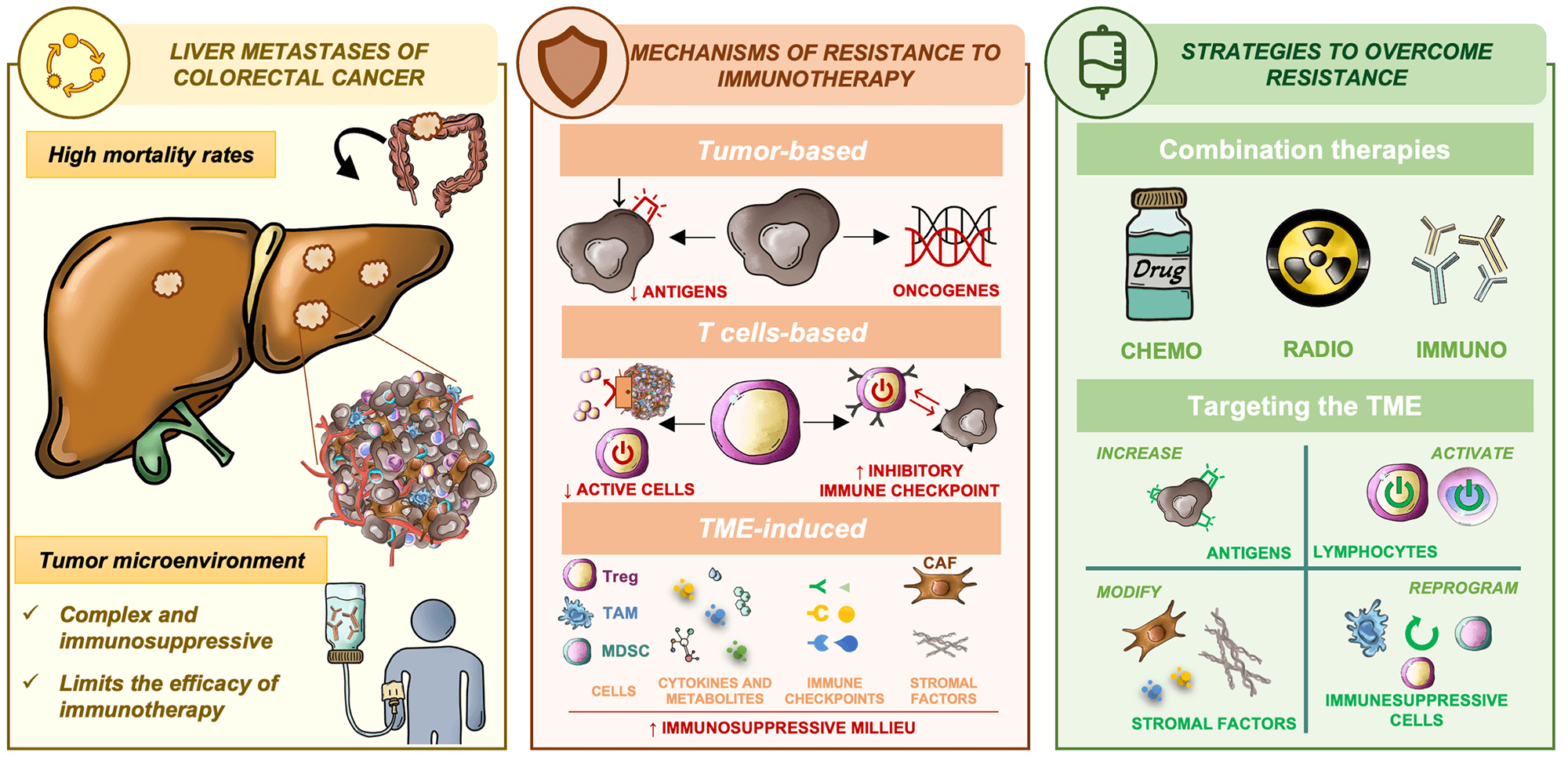
Colorectal cancer (CRC) is the second deadliest cancer worldwide, being the presence of metastasis, mainly in the liver, a major contributor to high mortality rates in affected patients. The tumor microenvironment (TME)—comprised of interacting endothelial, stromal, and immune cells—plays a critical role in creating a supportive niche for tumor cell colonization and immune evasion and, thus, the establishment of metastases. The liver’s intrinsic nature further facilitates the development of immune tolerance, mediated by regulatory T cells, myeloid-derived suppressor cells, and soluble factors such as anti-inflammatory cytokines, which together dampen antitumor immune responses. This immunosuppressive milieu contributes significantly to resistance to immune checkpoint inhibitors, limiting the efficacy of immunotherapy in metastatic CRC. Deciphering the complex crosstalk between metastatic CRC cells and TME within the liver is essential for developing novel, effective immunotherapeutic approaches. Several strategies to overcome this lack of response are under research, including combination therapies, novel compounds, and approaches that target TME components. The scope of this review is to synthesize recent advances in the characterization of the hepatic metastatic microenvironment and emerging therapeutic approaches aimed at overcoming immune resistance in CRC liver metastases.Graphic Abstract
Keywords
Cite This Article
 Copyright © 2026 The Author(s). Published by Tech Science Press.
This work is licensed under a Creative Commons Attribution 4.0 International License , which permits unrestricted use, distribution, and reproduction in any medium, provided the original work is properly cited.
 Downloads
 Citation Tools
