
 Login
Login Register
 Submit a Paper
 Propose a Special lssue
 Open Access
ARTICLE

Effect of Supplementation Time and Selenium Chemical Form on the Efficiency of Dandelion Biofortification
1 Federal Scientific Vegetable Center, Selectsionnaya 14, VNIISSOK, Odintsovo District, Moscow, 143072, Russia
2 Medical Faculty, Department of General and Clinical Pharmacology, Penza State University, Penza, 440026, Russia
3 Institute of Living Systems, Immanuel Kant Baltic Federal University, Kaliningrad, 236040, Russia
4 Department of Horticulture, Faculty of Biotechnology and Horticulture, University of Agriculture, Krakow, 31-120, Poland
5 Department of Food Technologies, ‘Ion Ionescu de la Brad’ Iasi University of Life Sciences, Iasi, 700490, Romania
6 Department of Agricultural Sciences, University of Naples Federico II, Portici, Naples, 80055, Italy
* Corresponding Author: Nadezhda Golubkina. Email:
Phyton-International Journal of Experimental Botany 2025, 94(12), 3861-3877. https://doi.org/10.32604/phyton.2025.070988
Received 29 July 2025; Accepted 13 November 2025; Issue published 29 December 2025
 View Full Text
 Download PDF
Abstract
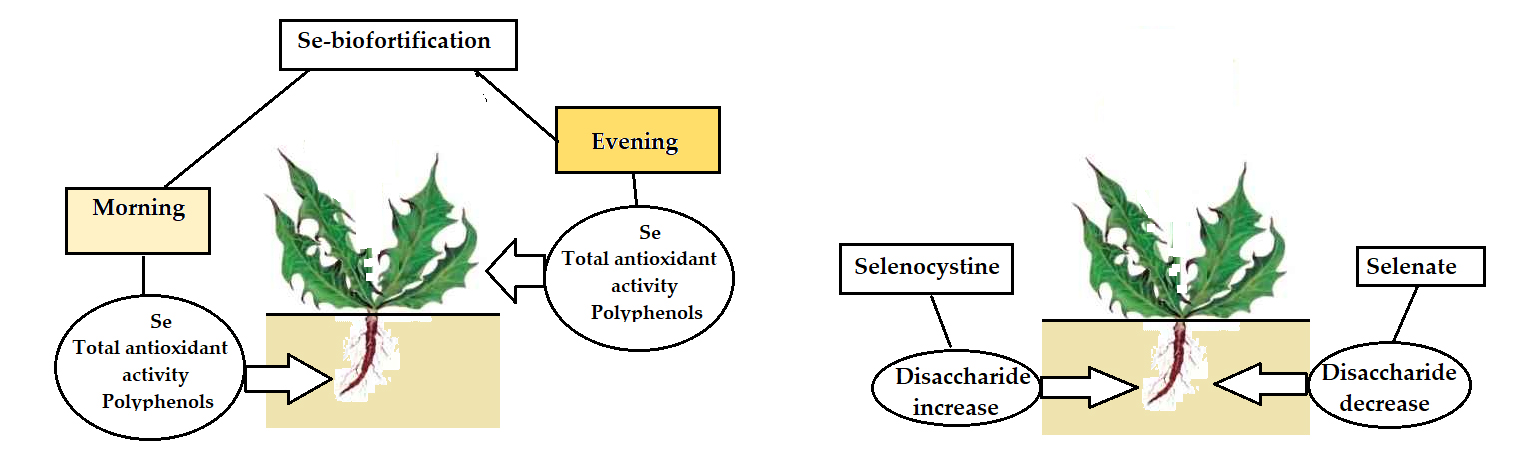
Circadian biorhythms are fundamental in plant adaptability and development. To reveal the effect of organic and inorganic forms of Se, foliar treatments of dandelion with 0.26 mM Se solutions were practiced in two contrasting day times: in the morning with the highest levels of leaf Se and polyphenol (TP) and the lowest dry matter, and in the evening with the opposite characteristics. Compared to the control, the morning Se supply demonstrated a higher increase of root biomass (1.27–1.37 times), Se (1.82–2.85 times), TP content (1.42–1.44 times), and antioxidant activity (AOA) (1.47–1.48 times) than the evening treatment. The latter did not affect root biomass and TP levels, but increased Se (1.38–2.57 times) and AOA (1.47–1.48 times). Contrary, compared to control, the evening Se supply improved leaf parameters more significantly than the morning treatment: AOA (1.22–1.25 vs. 1.12–1.17), TP (1.29–1.33 vs. 1.10–1.25), and Se (7.03–8.58 vs. 5.32–7.19). Similar photosynthetic pigment increase was recorded under organic and inorganic Se supply and between morning and evening treatments. Contrasting trends in root disaccharide accumulation under Se supply were recorded between morning and evening treatments, with a significant decrease of the mentioned parameter in the former case (1.27–1.15 times) and an increase in the latter (1.11–1.31 times). Contrary to other dandelion characteristics, only disaccharide root levels demonstrated higher changes under selenocystine supply, compared to selenate. The revealed phenomenon indicates the differences in root/leaf biochemical profile response to the time of Se supplementation and may become the basis of targeted production of functional food products with improved yield and nutritional value.Graphic Abstract
Keywords
Cite This Article
 Copyright © 2025 The Author(s). Published by Tech Science Press.
This work is licensed under a Creative Commons Attribution 4.0 International License , which permits unrestricted use, distribution, and reproduction in any medium, provided the original work is properly cited.
 Downloads
 Citation Tools
