
 Login
Login Register
 Submit a Paper
 Propose a Special lssue
 Open Access
REVIEW

Multi-Omics Integration for Abiotic Stress Acclimation in Tropical and Underutilized Plants
1 Department of Plant Pathology, University of Agriculture, Faisalabad, 38000, Pakistan
2 Institute of Systems Biology (INBIOSIS), Universiti Kebangsaan Malaysia, UKM, Bangi, 43600, Selangor, Malaysia
* Corresponding Author: Hoe-Han Goh. Email:
(This article belongs to the Special Issue: Multi-Omics Insights into Plant Acclimation to Environmental Stress)
Phyton-International Journal of Experimental Botany 2026, 95(6), 3 https://doi.org/10.32604/phyton.2026.084657
Received 27 April 2026; Accepted 04 June 2026; Issue published 29 June 2026
 View Full Text
 Download PDF
Abstract
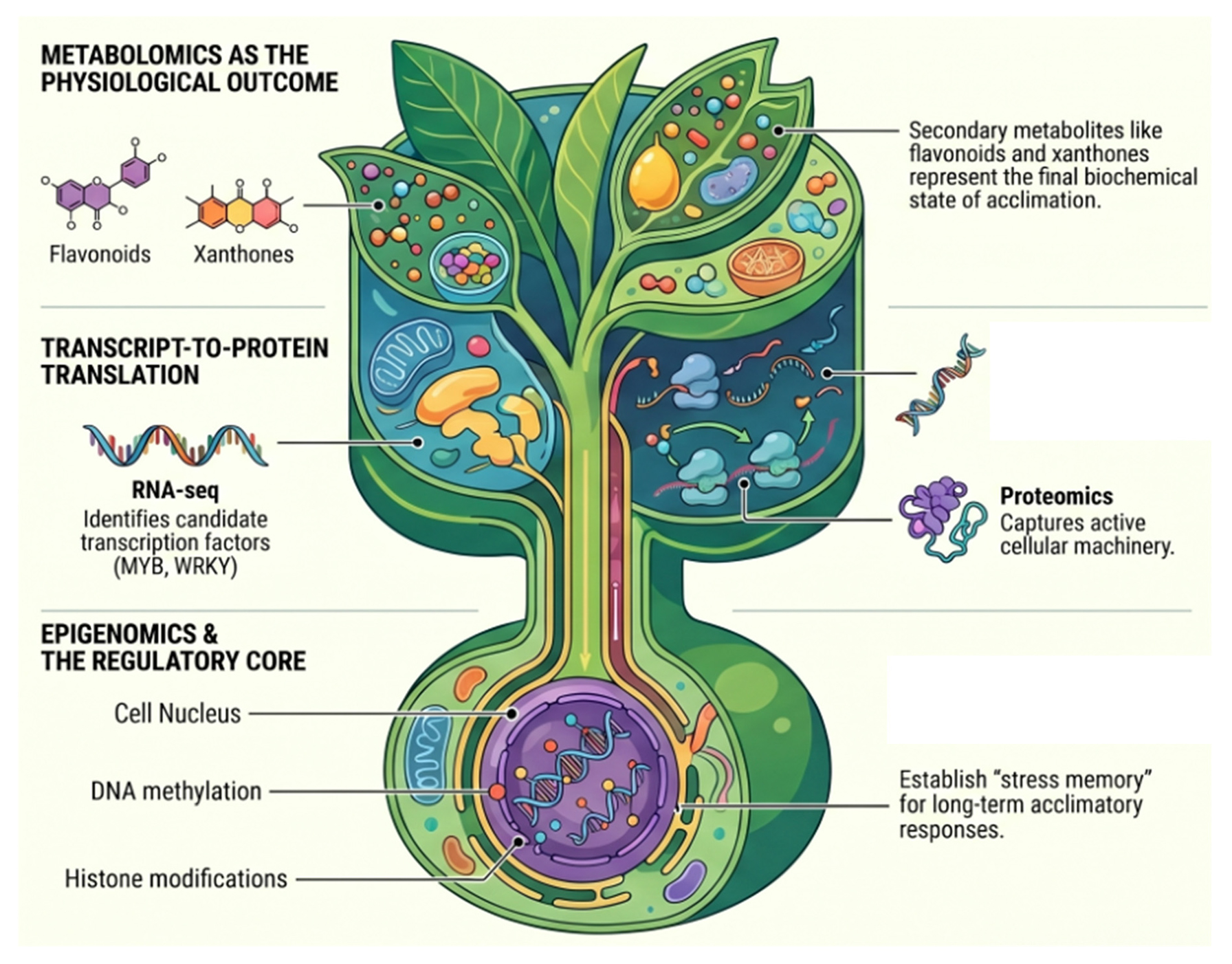
Abiotic stresses particularly drought, salinity, and temperature extremes increasingly threaten crop stability in tropical environments where combinatorial stress events are intensifying under climate change. Despite growing omics capacity, current multi-omics syntheses of plant stress acclimation remain dominated by model species and major crops, leaving tropical and underutilized plants underrepresented in comparative stress biology. This review examines how transcriptomics, proteomics, metabolomics, epigenomics, and integrative multi-omics frameworks have been applied to abiotic stress acclimation in selected tropical and underutilized plants, including banana, cassava, cacao, oil palm, papaya, Garcinia, coconut, mango, Avicennia marina, and tropical millets. We show that transcriptomics has provided the foundation for stress-response characterization in these species, but that proteomics and metabolomics reveal acclimation processes including protein-level buffering, osmolyte accumulation, and specialized-metabolite remodeling not captured by transcript profiles alone. Multi-omics integration strengthens candidate prioritization by identifying molecular convergence across layers, though most regulatory candidates in tropical systems remain associative and require functional validation. Conserved acclimation mechanisms include ABA-responsive transcription factor induction, ROS-scavenging remodeling, heat shock protein accumulation, and osmolyte biosynthesis, while lineage-specific responses highlight additional biochemical diversity unique to tropical species. Key bottleneck including complete reference genomes, limited metabolite annotation, inconsistent phenotyping, and poor cross-study comparability continue to constrain mechanistic interpretation. Priority future directions include pangenome resource development, single-cell and spatial profiling, machine-learning-assisted integration, and validation-focused experimental design. By placing tropical and underutilized plants more centrally within plant stress biology, this review advocates a broader, more inclusive framework for understanding acclimation under intensifying global change.Graphic Abstract
Keywords
Cite This Article
 Copyright © 2026 The Author(s). Published by Tech Science Press.
This work is licensed under a Creative Commons Attribution 4.0 International License , which permits unrestricted use, distribution, and reproduction in any medium, provided the original work is properly cited.
 Downloads
 Citation Tools
