
 Login
Login Register
 Submit a Paper
 Propose a Special lssue
 Open Access
ARTICLE

Antiglycation, Antioxidant, and Antidiabetic Effects of Ibervillea sonorae (Wereke) in a Diabetic Zebrafish Model
1 División de Biología Molecular, Instituto Potosino de Investigación Científica y Tecnológica, Camino a la Presa San José 2055, Col. Lomas 4 Sección, San Luis Potosí, México
2 Universidad Intercultural de San Luis Potosí (UICSLP), Unidad Académica Villa de Reyes, Avenida Universidad No. 29, Col La Paz, San Luis Potosí, México
3 División de Materiales Avanzados, Instituto Potosino de Investigación Científica y Tecnológica-SECIHTI, Camino a la Presa San José 2055, Col. Lomas 4 Sección, San Luis Potosí, México
* Corresponding Author: Alethia Muñiz-Ramirez. Email:
(This article belongs to the Special Issue: Bioactive Natural Products from Medicinal Plants: Phytochemical and Pharmacological Studies)
Phyton-International Journal of Experimental Botany 2026, 95(8), 6 https://doi.org/10.32604/phyton.2026.085201
Received 07 May 2026; Accepted 06 July 2026; Issue published 28 August 2026
 View Full Text
 Download PDF
Abstract
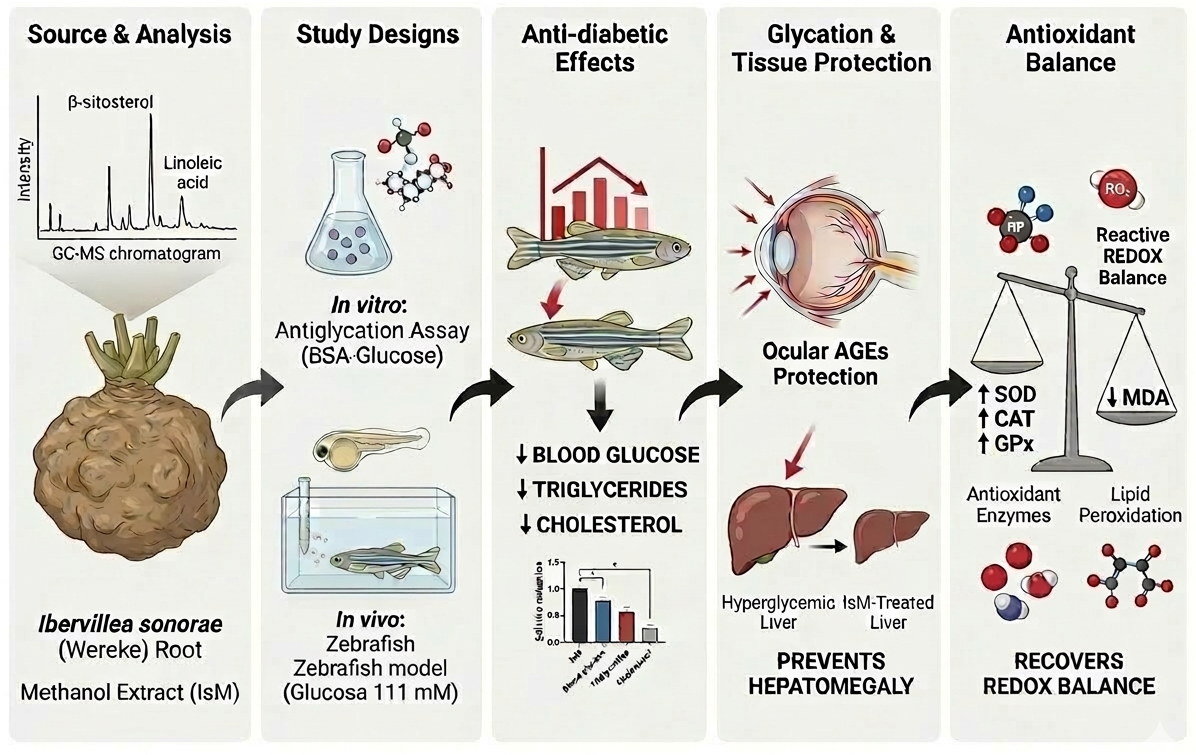
Diabetes mellitus is a metabolic disorder characterized by chronic hyperglycemia, oxidative stress, and the formation of advanced glycation end products (AGEs). This study examined the antiglycation, antioxidant, and antidiabetic properties of the methanolic extract of Ibervillea sonorae (IsM). Antiglycation activity was assessed in vitro using a bovine serum albumin–glucose model, and the antidiabetic effects were evaluated using a zebrafish model of experimentally induced hyperglycemia. Gas chromatography–mass spectrometry (GC–MS) analysis revealed several metabolites, including fatty acids and phytosterols. The extract significantly inhibited AGEs formation in vitro and reduced AGEs accumulation in the ocular tissue of diabetic zebrafish. In vivo treatment significantly decreased blood glucose, triglyceride, and cholesterol levels compared to diabetic controls. IsM also modulated oxidative stress by increasing reduced glutathione (GSH) levels and the activity of antioxidant enzymes (GPx, SOD, and CAT), while decreasing malondialdehyde levels in blood and gill tissues. These results suggest that the extract has protective effects through modulation of oxidative stress and inhibition of protein glycation. While these results demonstrate the therapeutic potential of Ibervillea sonorae, additional research is necessary to isolate the bioactive compounds and elucidate the molecular mechanisms underlying the observed biological effects.Graphic Abstract
Keywords
Cite This Article
 Copyright © 2026 The Author(s). Published by Tech Science Press.
This work is licensed under a Creative Commons Attribution 4.0 International License , which permits unrestricted use, distribution, and reproduction in any medium, provided the original work is properly cited.
 Downloads
 Citation Tools
