
 Login
Login Register
 Submit a Paper
 Propose a Special lssue
 Open Access
ARTICLE

Antiglycation, Antioxidant, and Antidiabetic Effects of Ibervillea sonorae (Wereke) in a Diabetic Zebrafish Model
1 División de Biología Molecular, Instituto Potosino de Investigación Científica y Tecnológica, Camino a la Presa San José 2055, Col. Lomas 4 Sección, San Luis Potosí, México
2 Universidad Intercultural de San Luis Potosí (UICSLP), Unidad Académica Villa de Reyes, Avenida Universidad No. 29, Col La Paz, San Luis Potosí, México
3 División de Materiales Avanzados, Instituto Potosino de Investigación Científica y Tecnológica-SECIHTI, Camino a la Presa San José 2055, Col. Lomas 4 Sección, San Luis Potosí, México
* Corresponding Author: Alethia Muñiz-Ramirez. Email:
(This article belongs to the Special Issue: Bioactive Natural Products from Medicinal Plants: Phytochemical and Pharmacological Studies)
Phyton-International Journal of Experimental Botany 2026, 95(8), 6 https://doi.org/10.32604/phyton.2026.085201
Received 07 May 2026; Accepted 06 July 2026; Issue published 28 August 2026
 View Full Text
 Download PDF
Abstract
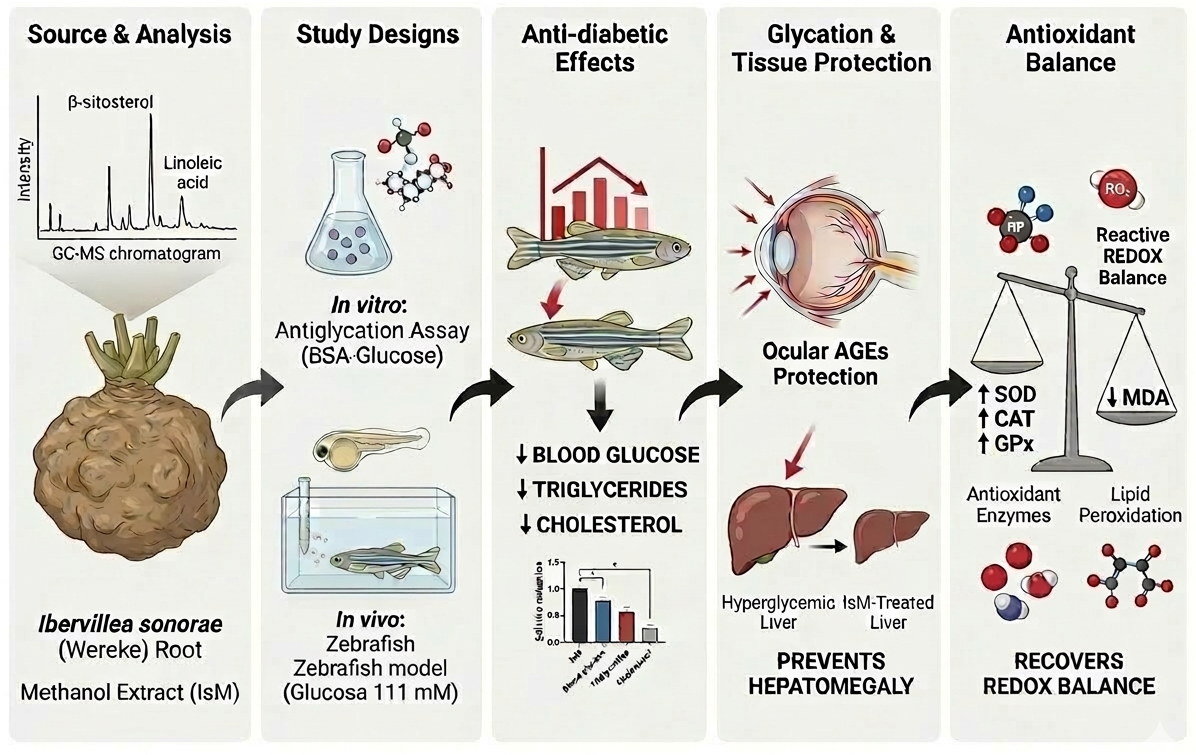
Diabetes mellitus is a metabolic disorder characterized by chronic hyperglycemia, oxidative stress, and the formation of advanced glycation end products (AGEs). This study examined the antiglycation, antioxidant, and antidiabetic properties of the methanolic extract of Ibervillea sonorae (IsM). Antiglycation activity was assessed in vitro using a bovine serum albumin–glucose model, and the antidiabetic effects were evaluated using a zebrafish model of experimentally induced hyperglycemia. Gas chromatography–mass spectrometry (GC–MS) analysis revealed several metabolites, including fatty acids and phytosterols. The extract significantly inhibited AGEs formation in vitro and reduced AGEs accumulation in the ocular tissue of diabetic zebrafish. In vivo treatment significantly decreased blood glucose, triglyceride, and cholesterol levels compared to diabetic controls. IsM also modulated oxidative stress by increasing reduced glutathione (GSH) levels and the activity of antioxidant enzymes (GPx, SOD, and CAT), while decreasing malondialdehyde levels in blood and gill tissues. These results suggest that the extract has protective effects through modulation of oxidative stress and inhibition of protein glycation. While these results demonstrate the therapeutic potential of Ibervillea sonorae, additional research is necessary to isolate the bioactive compounds and elucidate the molecular mechanisms underlying the observed biological effects.Graphic Abstract
Keywords
Type 2 diabetes mellitus (T2DM), which accounts for about 90% of diabetes cases worldwide, is characterized by chronic hyperglycemia resulting from impaired insulin secretion and/or insulin resistance. Persistent hyperglycemia plays a central role in the development of metabolic and vascular complications associated with diabetes, including retinopathy, nephropathy, and cardiovascular disease [1].
One of the major biochemical consequences of chronic hyperglycemia is the non-enzymatic glycation of proteins, which leads to the formation of advanced glycation end products (AGEs). AGEs are key mediators in the pathogenesis of T2DM and its complications. They act through pathways such as the AGE–RAGE axis, which promotes oxidative stress and tissue damage [2]. AGEs alter protein structure and function, accumulating preferentially in long-lived proteins such as collagen. This accumulation has been strongly associated with the progression of diabetic complications, particularly diabetic retinopathy, where AGEs deposition contributes to vascular stiffness and tissue damage [3,4]. Recent evidence indicates that dietary AGEs contribute to systemic AGEs accumulation and inflammation, further exacerbating metabolic dysfunction in diabetes [5].
In addition to glycation, T2DM is commonly accompanied by dyslipidemia, which is characterized by elevated triglycerides and increased LDL cholesterol. This atherogenic lipid profile significantly increases the risk of cardiovascular disease, which represents one of the leading causes of mortality among individuals with diabetes [6]. Therefore, effective therapeutic strategies should focus not only on glycemic control but also on targeting associated metabolic alterations, including lipid imbalance and AGEs formation.
Oxidative stress is a key factor linking chronic hyperglycemia with the progression of diabetic complications by promoting reactive oxygen species (ROS) production, impairing insulin signaling, and accelerating AGEs formation. Consequently, compounds that can modulate both oxidative stress and glucose metabolism simultaneously have attracted considerable interest as complementary therapeutic agents for managing metabolic disorders. In recent years, plant-derived secondary metabolites have emerged as promising multifunctional bioactive compounds due to their antioxidant, enzyme-inhibitory, and metabolic regulatory properties. This supports their potential application as functional ingredients and natural alternatives for managing diabetes [7,8]. Therefore, medicinal plants with combined antioxidants and antihyperglycemic activities are valuable sources for discovering novel bioactive compounds with therapeutic potential.
For a long time, traditional medicine has explored plant-derived products for managing metabolic disorders. In Mexico, around 800 plant species are traditionally used for their hypoglycemic properties, though only a few of these have been scientifically validated [9,10]. One such species is Ibervillea sonorae (Cucurbitaceae), a climbing plant commonly known as “wereke” or “güereque”. It is native to the semi-arid regions of Mexico and the southern United States, and it has been traditionally used to treat diabetes, inflammation, and gastric disorders [11,12].
Previous studies have demonstrated the hypoglycemic activity of aqueous and organic extracts of I. sonorae in both in vitro and in vivo models. Secondary metabolites such as monoglycerides and fatty acids have been proposed as contributors to this activity [13,14]. Despite these findings, however, little is known about the effect of the methanolic extract of I. sonorae on protein glycation, AGEs formation, and lipid metabolism under diabetic conditions, especially when using integrative experimental models.
The zebrafish (Danio rerio) is a robust and reproducible model for studying metabolic disorders. Its physiological similarities to mammals, rapid development, and suitability for in vivo metabolic and toxicological assessments make it a valuable model for type 2 diabetes research. This model enables the evaluation of glycemic control, lipid metabolism, and tissue-level alterations associated with diabetes. It is widely recognized as a valuable model for type 2 diabetes research because of its conserved metabolic pathways and ability to evaluate the effects of interventions that modulate glycemia and lipid metabolism in vivo [15].
The aim of this study was to evaluate the antiglycation, antioxidant, hypoglycemic, and hypolipidemic activities of the methanolic extract of Ibervillea sonorae. This study is the first to report its effects on advanced glycation end products (AGEs) formation and oxidative stress biomarkers in a glucose-induced diabetic zebrafish model.
2.1 Preparation of the Raw Material and Obtaining the Methanolic Extract of Ibervillea sonorae
Specimens of Ibervillea sonorae were purchased from a local market in San Luis Potosí, Mexico, and identified by experts at the Universidad Autónoma Metropolitana herbarium (voucher number 890152). The tuberous roots were cut into thin pieces and dried in an airflow oven with 80% ventilation at a temperature of 36°C. After drying (to 6.5 kg), the material was ground with a hand mill and macerated with 10 L of methanol. The methanolic extract of I. sonorae (IsM) was concentrated using a rotary evaporator under reduced pressure to completely remove the solvent. This process yielded 700 g of dry extract, which equates to 10.77%, w/w, based on the dried plant material. The dry extract was then stored in an amber glass container at 4°C until further use.
2.2 GC-MS Analysis of the Methanolic Extract of Ibervillea sonorae
The samples were analyzed using a gas chromatograph coupled with a 7820A/5977E mass spectrometry detector system (Agilent Technologies) with a 7683 series automated injector (Agilent Technologies) and an HP5-MS capillary column (30 m long, 0.25 mm in diameter, and with a film thickness of 0.25 μm). A 2 μL aliquot of the methanolic extract was injected directly into the GC–MS system without derivatization. The injector temperature was 250°C in splitless mode. Ultrapure helium was used as the gas carrier at a flow rate of 1 mL/min. The temperature program began with an initial temperature of 50°C for one minute, followed by an increase of 30°C/min to 280°C. Then, it was increased at a rate of 15°C/min to 300°C and was held for four minutes. The ionization potential was 70 eV and a scan function with a range of 35–400 m/z was used for identification. The compounds were identified by comparing their mass spectra with those of the NIST 14 library (Gaithersburg, MD, USA).
2.3 In Vitro Evaluation of AGEs Formation Using the BSA/Glucose Model
Glycation of bovine serum albumin (BSA) was performed according to the method of Pérez et al. [16], with specific modifications. We tested different final concentrations of the methanolic extract of Ibervillea sonorae (IsM): 125, 180, and 250 μg/mL. The samples were dissolved in dimethyl sulfoxide (DMSO), and then 10 mg/mL BSA, 1.1 M glucose, 0.1 M phosphate buffer (pH 7.4), and 0.2% sodium azide were added. A control containing DMSO, BSA, glucose, phosphate buffer, and sodium azide, but no plant extract was included in all experiments. The solutions were then incubated at 37°C for one, two, three, and four weeks. Percent inhibition was calculated as follows:
The formation of glycated albumin was measured weekly using a fluorometer (DTX880, Beckman Coulter) with excitation and emission wavelengths of 360 and 430 nm, respectively. Aminoguanidine (10 mM) was used as the positive control. All assays were performed in triplicate.
2.4 In Vivo Toxicity Evaluation of the Methanolic Extract of Ibervillea sonorae
Adult zebrafish (Danio rerio) of both sexes were used in this study. Toxicity was assessed using a semi-static method based on Organization for Economic Cooperation and Development (OECD) guidelines 203 (Fish, Acute Toxicity Test) [17,18]. The fish were divided into five experimental groups: Group 1: Control (no extract), Group 2: Fish treated with 30 mg/L IsM, Group 3: Fish treated with 60 mg/L IsM, Group 4: Fish treated with 90 mg/L IsM, Group 5: Fish treated with 3,4-dichloroaniline (positive control).
Each group consisted of ten fish maintained in six-liter tanks at 26°C with constant aeration and a 12 h light/12 h dark photoperiod. The fish were not fed during the 96-h exposure period and test solutions were completely renewed every 24 h for 4 days. Parameters such as behavior, swimming activity, gill movement and mortality were recorded daily.
2.5 Experimental Induction of Hyperglycemia in Zebrafish
Adult zebrafish were used to induce hyperglycemia, and diabetes was induced by exposing them to glucose. The fish were kept in 50-L aquariums at a temperature of 26°C, with constant aeration and a 12 h light/12 h dark photoperiod. Glucose was added to achieve a final concentration of 111 mM, and the fish were exposed to these conditions for 14 days. These concentrations and exposure periods were selected based on a previously validated zebrafish model of glucose-induced hyperglycemia that consistently produces sustained hyperglycemia without compromising animal survival. At the end of the induction period, a random sample of fish had their blood glucose levels were measured using a glucometer to confirm the hyperglycemic state of the induced group [19]. The fish were then sacrificed to collect complete blood samples.
2.6 In Vivo Evaluation of the Hypoglycemic and Antihyperlipidemic Potential of the Methanolic Extract of Ibervillea sonorae
Fifteen diabetic zebrafish per group were treated as follows for 14 days: Group 1: Healthy control, Group 2: Diabetic control, group 3: Pharmacological control (5 mg/L glibenclamide), Group 4: Fish treated with 30 mg/L IsM, Group 5: Fish treated with 60 mg/L IsM, Group 6: Fish treated with 90 mg/L IsM. The concentrations selected for the experiments (30, 60, and 90 mg/L) were based on a preliminary toxicity assessment, in which no mortality or behavioral alterations were observed. This allowed for the evaluation of biological activity under non-toxic exposure conditions. For biochemical analyses, each experimental group was subdivided into three independent sets of five fish (n = 5 per endpoint). These sets were used separately for blood glucose, cholesterol, and triglyceride determinations.
After the treatment period, the fish were anesthetized in 4°C water. An incision was made between the anal and caudal fins to collect a drop of blood. Glucose, cholesterol and triglyceride levels were measured using Accu-Chek Active and Accutrend Plus devices.
2.7 Evaluation of the Antiglycation Potential of the Methanolic Extract of Ibervillea sonorae in a Diabetic Zebrafish Model
Sacrificed zebrafish from each experimental group were processed to assess advanced glycation end product (AGEs) formation. The eyes were removed from the specimens and placed in microcentrifuge tubes containing 1 mL of phosphate buffer (pH 7.0). The eyes were then homogenized using a mortar, and the resulting suspension was centrifuged at 9000 rpm for 15 min. Then, the aqueous phase was then transferred to a 96-well plate. AGEs formation was measured using a fluorometer (DTX880, Beckman Coulter) with excitation and emission wavelengths of 360 and 430 nm, respectively. Percent inhibition was calculated as follows:
The AGEs levels measured in all experimental groups were expressed as a percentage of inhibition relative to the diabetic control. Therefore, the healthy control represents the baseline AGEs level under normoglycemic conditions, not an inhibitory effect induced by experimentation.
2.8 Determination of Antioxidant Parameters and Lipid Peroxidation in Blood and Gill Tissue
Antioxidant parameters were evaluated to determine the antioxidant response and the degree of oxidative damage induced by hyperglycemia in the zebrafish model. Reduced glutathione (GSH), glutathione peroxidase (GPx), superoxide dismutase (SOD), catalase (CAT), and malondialdehyde (MDA) levels were measured in blood and gill tissue samples.
The gills were extracted immediately after euthanasia from the same experimental groups in which the blood glucose levels had previously been determined. Five fish per experimental group (n = 5) were used for the enzymatic analysis, with gills collected individually from each fish. Each sample was processed and analyzed independently, and enzymatic determinations were performed in quintuplicate.
The gill tissue was homogenized in potassium chloride buffer solution (140 mM KCl) at a ratio of 0.1 g of tissue to 0.9 mL of buffer solution. Homogenization was performed using a fixed tissue-to-buffer ratio to ensure comparability between samples. The homogenates were then centrifuged at 7000 rpm for five minutes at 4°C, and the supernatant was collected for biochemical analyses.
Blood samples were collected immediately after euthanasia and processed under equivalent conditions to determine antioxidant parameters.
Total protein concentration was determined using the Bradford method (1976), with bovine serum albumin as the standard.
Glutathione (GSH), glutathione peroxidase (GPx), superoxide dismutase (SOD), and malondialdehyde (MDA) levels were determined using commercial kits (Otto Scientific, Turkey), while catalase (CAT) activity was measured using a commercial kit (Elabscience, USA), following the manufacturers’ instructions. The results were expressed as μmol/L for GSH and MDA and as U/mL for the enzymatic activities (GPx, SOD, and CAT) in the analyzed supernatant [20].
Additionally, the livers of the same fish were extracted for subsequent analysis.
The results were expressed as the mean ± standard deviation (SD). One-way analysis of variance (ANOVA) was performed, followed by a Dunnett’s post hoc test, to compare the experimental groups with the diabetic control group. Statistical significance was set at p < 0.05.
3.1 GC-MS Analysis of the Methanolic Extract of Ibervillea sonorae
Fig. 1 shows the gas chromatography-mass spectrometry (GC-MS) spectrum of the methanolic extract of Ibervillea sonorae (IsM). Five signals corresponding to secondary metabolites previously reported to have antidiabetic activity were identified in the spectrum.

Figure 1: Gas chromatography–mass spectrometry (GC–MS) chromatogram of the methanolic extract of Ibervillea sonorae (IsM).
Table 1 lists these secondary metabolites along with their reported antidiabetic properties from previous studies.
Table 1: Tentatively identified secondary metabolites detected by GC–MS in the methanolic extract of Ibervillea sonorae, along with their previously reported biological activities.
| Peak | Retention Time (min) | Compound Name | NIST Spectral Similarity (%) | Reported Biological Activities in the Literature | Ref |
|---|---|---|---|---|---|
| 1 | 7.39 | 9,12-octadecadienoic acid (linoleic acid) | 31 | Antihyperglycemic and antioxidant activity | [21,22] |
| 2 | 7.41 | 9,12,15-octadecatrienoic acid | 20 | Decrease in total cholesterol and triglycerides | [23,24] |
| 3 | 7.52 | trans-13-octadecenoic acid | 25 | Antioxidant and anti-inflammatory potential | [25,26] |
| 4 | 7.58 | octadecanoic acid | 52 | Decreases serum glucose concentrations | [27] |
| 5 | 11.23 | β-sitosterol | 46 | Antioxidant activity | [28] |
The main peaks were tentatively assigned to secondary metabolites that have been reported to exhibit antidiabetic, antioxidant, and hypolipidemic activities, as determined by comparison with the NIST mass spectral library. However, their presence in the present extract does not imply that they are solely responsible for the observed biological effects.
3.2 In Vivo Toxicity Evaluation of the Methanolic Extract of Ibervillea sonorae
The in vivo toxicity of the methanolic extract of Ibervillea sonorae (IsM) was evaluated in zebrafish at concentrations of 30, 60, and 90 mg/L. At concentrations of 60 and 90 mg/L, the fish exhibited reduced swimming activity during the first hour of the experiment and remained at the bottom of the tank. They later resumed active swimming throughout the tank, similar to the control group. At the end of the experimental period (four days), 100% survival was observed at all tested concentrations. In contrast, the positive control group treated with 3,4-dichloroaniline exhibited progressive mortality: five fish died on day one, four on day two, and one on day three, resulting in 100% mortality.
3.3 In Vitro Evaluation of AGEs Formation Using the BSA/Glucose Model
The effect of IsM on the glycation of bovine serum albumin (BSA) was evaluated in vitro over a four-week period (Fig. 2). During the first week, the 180 μg/mL and 250 μg/mL concentrations of IsM showed significant inhibition of glycation, resulting in inhibition of 42% and 35%, respectively, compared to the positive control. Subsequent weeks revealed a decreasing trend in advanced glycation end product (AGEs) formation in the presence of the extract, particularly at the 180 and 250 μg/mL concentrations.

Figure 2: The inhibition of advanced glycation end product (AGEs) formation was evaluated using the bovine serum albumin (BSA)/glucose model in the presence of the methanolic extract of Ibervillea sonorae (IsM). The BSA was incubated with glucose for up to four weeks, either with or without IsM at different concentrations. The data are expressed as the mean ± SD (n = 3) and were analyzed using a one-way analysis of variance (ANOVA). Asterisks indicate significant differences compared to the positive control (p < 0.05).
The inhibition percentages achieved with 180 μg/mL of IsM were 42%, 44%, 47%, and 61% in weeks 1, 2, 3, and 4, respectively. For the 250 μg/mL concentration, the values were 35%, 37%, 43%, and 59% during the same period. The lowest IsM concentration (125 μg/mL) exhibited the least activity, with inhibition percentages of 2%, 28%, 20%, and 37% in weeks 1, 2, 3, and 4, respectively. The pharmacological control (aminoguanidine) inhibited AGEs formation by 10%, 16%, 47%, and 58% over the four-week incubation period. The higher inhibition observed at 180 μg/mL compared to 250 μg/mL suggests a nonlinear concentration–response pattern. This behavior may be related to the extract’s complex composition, possible interactions among its constituents, or interference of its components with fluorescence-based AGEs detection.
3.4 In Vivo Evaluation of the Hypoglycemic and Antihyperlipidemic Potential of the Methanolic Extract of Ibervillea sonorae
Fig. 3a illustrates the blood glucose levels of the zebrafish groups treated with different concentrations of the methanolic extract of Ibervillea sonorae (IsM). The healthy control group had an average blood glucose level of 62 mg/dL. In contrast, the untreated diabetic group had a significant increase in blood glucose levels, reaching 186.67 mg/dL by the end of the experiment. The groups treated with IsM at concentrations of 30, 60, and 90 mg/L recorded blood glucose levels of 43.6, 52.6, and 66.6 mg/dL, respectively. The group treated with the pharmacological control, glibenclamide, showed a blood glucose level of 62 mg/dL, which was comparable to that of the healthy control group. The 30 mg/L treatment produced blood glucose levels below those of the healthy control group. However, no behavioral alterations or signs of toxicity were observed at this concentration, suggesting that this response was not associated with overt adverse effects. Further studies are required to determine whether this reduction represents a physiologically relevant hypoglycemic effect.
Fig. 3b shows the triglyceride levels in groups treated with IsM at different concentrations. The diabetic group had higher triglyceride levels (353.2 mg/dL) than the healthy control group (159.4 mg/dL). However, administering IsM at concentrations of 60 and 90 mg/L significantly reduced triglyceride levels to 102.5 mg/dL and 135.83 mg/dL, respectively.
Fig. 3c shows the results regarding cholesterol levels. The diabetic group showed a significant increase in cholesterol, reaching 421.25 mg/dL compared to the healthy control group, which had levels of 231.6 mg/dL. Groups treated with IsM at concentrations of 30, 60, and 90 mg/L had blood cholesterol levels of 143.2 mg/dL, 143 mg/dL, and 165 mg/dL, respectively, all of which were statistically significant.

Figure 3: Effects of the methanolic extract of Ibervillea sonorae on (a) blood glucose, (b) triglyceride, and (c) cholesterol levels in a diabetic zebrafish model. Each point represents an individual fish (n = 5), and horizontal lines indicate mean values. Data were analyzed by one-way ANOVA. The asterisks represent the level of significance. (**p < 0.005; ***p < 0.0005; ****p < 0.0001).
3.5 In Vivo Antiglycation Assay
Advanced glycation end products (AGEs) were quantified in the in vivo model by removing the eyes of individuals from all treatment groups. The methanolic extract inhibited AGEs formation by approximately 20% at concentrations of 30 and 60 mg/L, which is comparable to the level of inhibition observed in the pharmacological control group. Greater inhibition (34.25%) occurred at 90 mg/L; this was the only treatment that differed significantly from the diabetic control group (Fig. 4).

Figure 4: Percentage of inhibition of advanced glycation end products formation in a diabetic zebrafish model following treatment with the methanolic extract of Ibervillea sonorae. Data are expressed as mean ± SD (n = 5). Percentage inhibition was calculated relative to the diabetic control. The healthy control group represents basal AGEs levels under normoglycemic conditions.
3.6 Effect of the Methanolic Extract of Ibervillea sonorae on Antioxidant Enzyme Activity in Blood and Gill Tissue
To evaluate the effect of IsM on oxidative stress associated with hyperglycemia, antioxidant biomarkers were analyzed in blood and gills. These biomarkers included reduced glutathione (GSH) and the activity of antioxidant enzymes such as glutathione peroxidase (GPx), superoxide dismutase (SOD), and catalase (CAT). We also examined malondialdehyde (MDA) levels as an indicator of lipid peroxidation.
3.7 Antioxidant Biomarkers in Blood
In the blood, the diabetic control group showed a decrease in antioxidant defenses compared with the healthy control group. Glutathione (GSH) levels decreased from 180 μmol/L in the healthy control group to 95 μmol/L in the diabetic control group. Meanwhile, treatment with IsM showed a progressive increase, reaching 177 μmol/L at the concentration of 90 mg/L (Fig. 5a).

Figure 5: Effect of Ibervillea sonorae methanolic extract on antioxidant biomarkers in blood of diabetic zebrafish. (a) GSH, (b) GPx, (c) SOD, (d) CAT and (e) MDA levels. Data are expressed as mean ± SD (n = 5). Statistical differences were analyzed using a one-way ANOVA followed by a Dunnett’s multiple comparison test using the diabetic control group as the reference (*p < 0.05).
A similar trend was observed for the antioxidant enzymes. GPx activity decreased from 500 U/mL in the healthy control group to 350 U/mL in the diabetic control group. Treatments with IsM, however, reached values of up to 483 U/mL (Fig. 5b). Similarly, SOD activity decreased from 300 U/mL in the healthy control group to 185 U/mL in the diabetic control group. Treatments with IsM reached 286 U/mL at the highest evaluated concentration (Fig. 5c). CAT activity also decreased in the diabetic control group (35 U/mL) compared to the healthy control group (60 U/mL). Treatments with IsM reached values of up to 55 U/mL (Fig. 5d).
In contrast, MDA levels increased in the diabetic control group (55 μmol/L) compared to the healthy control group (30 μmol/L). Treatment with IsM showed a progressive decrease in this lipid peroxidation marker, reaching 35 μmol/L at the concentration of 90 mg/L (Fig. 5e).
3.8 Antioxidant Biomarkers in Gills
A similar pattern was observed in gills. GSH levels decreased from 200 μmol/L in the healthy control to 125 μmol/L in the diabetic control, whereas treatments with IsM reached 195 μmol/L at 90 mg/L (Fig. 6a).

Figure 6: Effect of Ibervillea sonorae methanolic extract on antioxidant biomarkers in gills of diabetic zebrafish. (a) GSH, (b) GPx, (c) SOD, (d) CAT and (e) MDA levels. Data are expressed as mean ± SD (n = 5). Statistical differences were analyzed using one-way ANOVA followed by Dunnett’s multiple comparison test, with the diabetic control group serving as the reference (*p < 0.05).
Enzymatic activities also decreased in the diabetic control group. GPx decreased from 600 U/mL in the healthy control group to 410 U/mL in the diabetic control group. Treatments with IsM reached values of up to 583 U/mL (Fig. 6b). SOD activity was 350 U/mL in the healthy control group and 200 U/mL in the diabetic control group while treatment with IsM reached 348 U/mL (Fig. 6c). Similarly, CAT decreased from 60 U/mL in the healthy control group to 30 U/mL in the diabetic control group. Treatments with IsM reached values of up to 58 U/mL (Fig. 6d).
Finally, MDA levels were higher in the diabetic control group (55 μmol/L) than in the healthy control group (30 μmol/L). Treatments with IsM showed a progressive reduction in MDA levels, reaching 32 μmol/L at 90 mg/L (Fig. 6e).
3.9 Effect of Ibervillea sonorae Extract on Zebrafish Liver Size
In addition, a descriptive morphological assessment of liver size was performed on zebrafish from the different treatment groups using a Leica EZ4W stereoscope. The healthy control group (Fig. 7a) had an average liver size of 0.8 mm. In contrast, the diabetic control group (Fig. 7b) showed an increase in liver size, reaching an average of 1.2 mm—approximately a 50% increase compared to the healthy control group.
The groups treated with IsM at different concentrations (Fig. 7c–f) had an average liver size comparable to that of the healthy control group (0.8 mm). These results imply that the methanolic extract of Ibervillea sonorae could mitigate diabetes-related liver enlargement. However, this observation should be interpreted as a complementary morphological assessment only, since no histopathological or inflammatory biomarker analyses were performed. Further studies are required to confirm these findings and elucidate the underlying mechanisms.

Figure 7: Effect of the methanolic extract of Ibervillea sonorae on liver size in a diabetic zebrafish model. (a) healthy control, (b) diabetic control, (c) pharmacological control (glibenclamide), (d) IsM 30 mg/L, (e) IsM 60 mg/L, (f) IsM 90 mg/L. Liver size was evaluated by stereomicroscopic observation. The images shown are representative of each experimental group and are intended to provide complementary morphological information.
One of the major therapeutic challenges in T2DM is preventing long-term complications associated with chronic hyperglycemia, particularly those related to protein glycation and the formation of advanced glycation end products (AGEs) [29]. This study examined the ability of the methanolic extract of Ibervillea sonorae (IsM) to inhibit non-enzymatic protein glycation in the BSA/glucose model. These results suggest that IsM may interfere with one or more stages of the glycation process, ultimately reducing AGEs formation [30,31].
The progressive reduction in AGEs formation observed during the incubation period indicates that IsM may act at both the early and late stages of glycation associated with the accumulation of these compounds. Since glycation reactions are promoted by oxidative processes, the observed antiglycation activity may be related to the antioxidant properties previously reported for methanolic extracts of I. sonorae, which could limit the generation of reactive oxygen species (ROS) and consequently reduce the formation of intermediate glycation products [32]. Additionally, recent studies have demonstrated that the AGE-RAGE interaction plays an important role in amplifying oxidative stress and cellular damage associated with diabetes [33].
The accumulation of AGEs has been implicated in several diabetic complications, including diabetic retinopathy, where glycation products progressively deposit in long-lived proteins present in ocular tissues [34]. In this context, the significant reduction in AGEs levels observed in the ocular tissue of diabetic zebrafish treated with IsM suggests that the extract may limit glycation-related tissue damage in vivo. This effect may be explained, at least in part, by reduced ROS production and subsequent inhibition of glycation reactions [13].
In addition to its antiglycation activity, IsM exhibited a significant hypoglycemic effect in the diabetic zebrafish model. Recent studies have shown that these models of diabetes represent a valuable in vivo platform for evaluating natural compounds with potential antidiabetic activity because they allow for the integrated analysis of metabolic and physiological alterations associated with hyperglycemia [35]. The glucose immersion model is one of the most well-established and extensively validated models for researching type 2 diabetes in zebrafish because it provides a simple, reproducible, and non-invasive approach to inducing sustained hyperglycemia and metabolic alterations under controlled experimental conditions. Previous studies have shown that glucose immersion not only increases blood glucose levels but also reduces insulin receptor expression and impairs the response to exogenous insulin. These effects reproduce key features associated with type 2 diabetes. Furthermore, the partial reversal of hyperglycemia by established antidiabetic drugs, such as metformin and glimepiride, validates its use as a preclinical screening platform. Other approaches, such as feeding a high-fat diet, CRISPR/Cas9-mediated gene editing, and targeted β-cell ablation, are also available. These approaches are particularly useful for investigating specific aspects of diabetes pathophysiology, such as obesity-associated metabolic syndrome, genetic susceptibility, and β-cell dysfunction. Therefore, each model offers complementary advantages depending on the biological question being addressed. While the glucose immersion model does not encompass every aspect of the complex pathophysiology of human type 2 diabetes, it reliably reproduces sustained hyperglycemia and associated metabolic alterations. This makes it a robust and widely accepted platform for mechanistic studies and the initial screening of plant-derived compounds with antihyperglycemic and antioxidant potential [36]. Consequently, the biological effects observed in the present study should be interpreted within the context of this validated experimental model.
The results obtained in this study are consistent with previous reports describing hypoglycemic activity in I. sonorae extracts [12,37,38]. In this regard, it has been proposed that compounds present in Ibervillea extracts may enhance glucose uptake by modulating insulin-related signaling pathways [14,39]. While the antidiabetic properties of Ibervillea sonorae have been previously reported in mammalian models, this study expands the available biological evidence by demonstrating its antiglycation activity, as well as its ability to modulate oxidative stress and metabolic biomarkers in a glucose-induced zebrafish model. This provides additional insight into the pharmacological potential of this medicinal species.
Consistent with the hypoglycemic effect, treatment with IsM produced significant reductions in triglyceride and cholesterol levels. Alterations in lipid metabolism are common under conditions of hyperglycemia and insulin resistance, contributing to the development of metabolic complications associated with diabetes. Studies conducted in diabetic zebrafish models have reported similar improvements in lipid profiles following treatment with plant-derived extracts. These findings support the usefulness of this model for evaluating compounds with potential hypolipidemic activity [40] and are consistent with previous studies conducted with extracts of I. sonorae [13,41]. Furthermore, studies on Momordica charantia, a species belonging to the same botanical family, suggest that pancreatic lipase inhibition could be a shared mechanism that contributes to reduced lipid absorption and, consequently, to lower triglyceride and cholesterol levels [42].
An important finding of this study was the modulation of oxidative stress biomarkers in the blood and gills. Chronic hyperglycemia promotes the excessive production of reactive oxygen species (ROS), disrupting cellular redox balance and contributing to tissue damage associated with diabetes [43]. In this study, treatment with IsM promoted recovery of the antioxidant defense system, as evidenced by increased GSH levels and enhanced activity of antioxidant enzymes such as GPx, SOD, and CAT. There was also a decrease in MDA levels, which are a marker of lipid peroxidation. These results suggest that the extract may help restore the redox balance that is disrupted under diabetic conditions.
The GC-MS analysis provided a preliminary qualitative phytochemical profile of the methanolic extract, and the detected compounds were tentatively identified by comparison with the NIST library. The absence of cucurbitacins may reflect GC–MS’s limitations in analyzing low-volatility triterpenoids. Therefore, complementary liquid chromatography (LC)-based analyses would provide a more comprehensive phytochemical characterization of Ibervillea sonorae.
The antioxidant and metabolic effects observed in this study may be associated with the phytochemical profile identified by GC-MS analysis. The detected metabolites included fatty acids such as 9,12-octadecadienoic acid and 9,12,15-octadecatrienoic acid, and sterols such as β-sitosterol. These compounds have been previously associated with antioxidant, hypoglycemic, and hypolipidemic activities. Unsaturated fatty acids have been reported to modulate oxidative stress by improving cellular redox balance and reducing lipid peroxidation. Phytosterols such as β-sitosterol have been associated with improved glucose metabolism and lipid regulation. These mechanisms may contribute to the restoration of antioxidant defenses observed in the present study, including increased GSH levels and enhanced of GPx, SOD, and CAT activity, and reduced MDA levels. Therefore, the combined presence of these metabolites in the extract may explain the hypoglycemic, hypolipidemic, and antioxidant effects observed in the diabetic zebrafish model.
Finally, evaluating liver size provided additional evidence of the systemic effects of IsM treatment. Diabetic zebrafish exhibited hepatomegaly, while fish treated with the extract had liver sizes similar to those of the healthy control group. Liver enlargement is commonly associated with metabolic disturbances such as lipid accumulation and insulin resistance during the progression of diabetes. Thus, the normalization of liver size observed in treated fish may reflect improved metabolic homeostasis. Though this assessment was preliminary and descriptive, the results imply that IsM may attenuate diabetes-associated changes in gross liver size. However, these observations should be interpreted with caution. Further studies are required to confirm and characterize the underlying hepatic changes, including histopathological evaluation, lipid staining, and inflammatory biomarker analyses.
Overall, the results of this study demonstrate that the methanolic extract of Ibervillea sonorae exhibits significant biological activity in a diabetic zebrafish model. This is evidenced by its ability to inhibit protein glycation, improve glycemic and lipid parameters, modulate oxidative stress, and reduce diabetes-associated changes in gross liver size. These findings support the potential of I. sonorae as a source of bioactive compounds with possible applications in managing metabolic alterations related to diabetes, within the limits of this glucose-induced zebrafish model. However, due to the complex nature of the plant extract, further studies are required to isolate and characterize the compounds responsible for the observed effects, as well as to investigate the metabolic pathways involved.
Acknowledgement:
Funding Statement: The authors received no specific funding for this study.
Author Contributions: Alethia Muñiz-Ramirez: Conceptualization, Supervision, Study design, Investigation, Methodology and Writing—review and editing. Leonardo Daniel Villalana Alvarez: Investigation, Methodology and Writing—original draft preparation. Abraham Heriberto García-Campoy: Data analysis, Data curation and interpretation, Experimental work, Writing—review and editing. All authors reviewed and approved the final version of the manuscript.
Availability of Data and Materials: The data that support the findings of this study are available from the Corresponding Author, Alethia Muñiz-Ramirez, upon reasonable request.
Ethics Approval: The animal experiments were approved by the Ethics Committee of the Instituto Potosino de Investigación Científica y Tecnológica (Approval number #11/2020).
Conflicts of Interest: The authors declare no conflicts of interest.
References
1. International Diabetes Federation . Diabetes atlas. 11th ed. 2025 [cited 2026 Jan 1]. Available from: https://diabetesatlas.org/es/resources/idf-diabetes-atlas-2025/. [Google Scholar]
2. Khalid M , Petroianu G , Adem A . Advanced glycation end products and diabetes mellitus: Mechanisms and perspectives. Biomolecules. 2022; 12( 4): 542. doi:10.3390/biom12040542. [Google Scholar] [CrossRef]
3. Joglekar MM , Bavkar LN , Sistla S , Arvindekar AU . Effective inhibition of protein glycation by combinatorial usage of limonene and aminoguanidine through differential and synergistic mechanisms. Int J Biol Macromol. 2017; 99: 563– 9. doi:10.1016/j.ijbiomac.2017.02.104. [Google Scholar] [CrossRef]
4. Sharma Y , Saxena S , Mishra A , Saxena A , Natu SM . Advanced glycation end products and diabetic retinopathy. J Ocul Biol Dis Inform. 2012; 5( 3): 63– 9. doi:10.1007/s12177-013-9104-7. [Google Scholar] [CrossRef]
5. Tian Z , Chen S , Shi Y , Wang P , Wu Y , Li G . Dietary advanced glycation end products (dAGEs): An insight between modern diet and health. Food Chem. 2023; 415: 135735. doi:10.1016/j.foodchem.2023.135735. [Google Scholar] [CrossRef]
6. Akkus G . Current perspectives of diabetic dyslipidemia and treatment modalities. Curr Med Chem. 2025; 32( 32): 6988– 98. doi:10.2174/0109298673336501241001093417. [Google Scholar] [CrossRef]
7. Shu P , Zou W , Meng Y , He J , Guo T , Fan X , et al. Ultrasound-assisted combined with natural deep eutectic solvents for complanatoside A extraction: Optimization, identification, and bioactivity evaluation. Ind Crops Prod. 2026; 242: 122910. doi:10.1016/j.indcrop.2026.122910. [Google Scholar] [CrossRef]
8. Shu P , Liu S , Wang N , Fan S , Meng Y , Fan X , et al. Efficient extraction of flavonoids from Cercis chinensis bark using ultrasound-assisted deep eutectic solvents: Process optimization, characterization, kinetic studies, antioxidant and enzyme inhibition activities. Ind Crops Prod. 2026; 239: 122536. doi:10.1016/j.indcrop.2025.122536. [Google Scholar] [CrossRef]
9. Andrade-Cetto A , Heinrich M . Mexican plants with hypoglycaemic effect used in the treatment of diabetes. J Ethnopharmacol. 2005; 99( 3): 325– 48. doi:10.1016/j.jep.2005.04.019. [Google Scholar] [CrossRef]
10. Escandón-Rivera SM , Mata R , Andrade-Cetto A . Molecules isolated from Mexican hypoglycemic plants: A review. Molecules. 2020; 25( 18): 4145. doi:10.3390/molecules25184145. [Google Scholar] [CrossRef]
11. Vidal-Gutiérrez M , Torres-Moreno H , Hernández-Gutiérrez S , Velazquez C , Robles-Zepeda RE , Vilegas W . Antiproliferative activity of standardized phytopreparations from Ibervillea sonorae (S. Watson) Greene. Steroids. 2021; 169: 108824. doi:10.1016/j.steroids.2021.108824. [Google Scholar] [CrossRef]
12. Hernández-Galicia E , Calzada F , Roman-Ramos R , Alarcón-Aguilar FJ . Monoglycerides and fatty acids from Ibervillea sonorae root: Isolation and hypoglycemic activity. Planta Med. 2007; 73( 3): 236– 40. doi:10.1055/s-2007-967117. [Google Scholar] [CrossRef]
13. Rivera-Ramírez F , Escalona-Cardoso GN , Garduño-Siciliano L , Galaviz-Hernández C , Paniagua-Castro N . Antiobesity and hypoglycaemic effects of aqueous extract of Ibervillea sonorae in mice fed a high-fat diet with fructose. J Biomed Biotechnol. 2011; 2011: 968984. doi:10.1155/2011/968984. [Google Scholar] [CrossRef]
14. Zapata-Bustos R , Alonso-Castro ÁJ , Gómez-Sánchez M , Salazar-Olivo LA . Ibervillea sonorae (Cucurbitaceae) induces the glucose uptake in human adipocytes by activating a PI3K-independent pathway. J Ethnopharmacol. 2014; 152( 3): 546– 52. doi:10.1016/j.jep.2014.01.041. [Google Scholar] [CrossRef]
15. Sanni O , Fasemore T , Nkomozepi P . Non-genetic-induced zebrafish model for type 2 diabetes with emphasis on tools in model validation. Int J Mol Sci. 2024; 25( 1): 240. doi:10.3390/ijms25010240. [Google Scholar] [CrossRef]
16. Perez-Gutierrez RM , Muñiz-Ramirez A , Anaya-Sosa I , Cruz-Victoria T , Mota-Flores JM . Inhibitory activities of guaianolides from the seeds of Byrsonima crassifolia against protein glycation in vitro. Med Chem. 2015; 5( 5): 217– 25. doi:10.4172/2161-0444.1000267. [Google Scholar] [CrossRef]
17. Organization for Economic Co-Operation and Development . Fish acute toxicity test. OECD Guideline for testing of chemicals. Paris, France: OECD Publishing; 1981. [Google Scholar]
18. Organization for Economic Co-Operation and Development . Guideline for testing of chemicals. Paris, France: OECD Publishing; 1998. [Google Scholar]
19. Garcia Campoy AH , Perez Gutierrez RM , Manriquez-Alvirde G , Muñiz Ramirez A . Protection of silver nanoparticles using Eysenhardtia polystachya in peroxide-induced pancreatic β-Cell damage and their antidiabetic properties in zebrafish. Int J Nanomed. 2018; 13: 2601– 12. doi:10.2147/IJN.S163714. [Google Scholar] [CrossRef]
20. Benzer S , Yüce PA , Günal AÇ , Benzer R , Gül G . Integrated biomarker response-based investigation of oxidative stress in Hemolymph, gills, and digestive glands of freshwater mussels (Unio delicatus) exposed to Etoxazole. Pestic Biochem Physiol. 2025; 215: 106695. doi:10.1016/j.pestbp.2025.106695. [Google Scholar] [CrossRef]
21. Hamilton JS , Klett EL . Linoleic acid and the regulation of glucose homeostasis: A review of the evidence. Prostaglandins Leukot Essent Fat Acids. 2021; 175: 102366. doi:10.1016/j.plefa.2021.102366. [Google Scholar] [CrossRef]
22. Najafi F , Kavoosi G , Siahbalaei R , Kariminia A . Anti-oxidative and anti-hyperglycemic properties of Agastache foeniculum essential oil and oily fraction in hyperglycemia-stimulated and lipopolysaccharide-stimulated macrophage cells: In vitro and in silico studies. J Ethnopharmacol. 2022; 284: 114814. doi:10.1016/j.jep.2021.114814. [Google Scholar] [CrossRef]
23. Kim DH , Yoo TH , Lee SH , Kang HY , Nam BY , Kwak SJ , et al. Gamma linolenic acid exerts anti-inflammatory and anti-fibrotic effects in diabetic nephropathy. Yonsei Med J. 2012; 53( 6): 1165– 75. doi:10.3349/ymj.2012.53.6.1165. [Google Scholar] [CrossRef]
24. Umesha SS , Naidu KA . Vegetable oil blends with α-linolenic acid rich Garden cress oil modulate lipid metabolism in experimental rats. Food Chem. 2012; 135( 4): 2845– 51. doi:10.1016/j.foodchem.2012.05.118. [Google Scholar] [CrossRef]
25. Khan MS , Uzair M , Hanif M , Jabeen M , Chaudhary BA . Anti-inflammatory potential of spectroscopically analyzed trans-13-octadecenoic acid of Yucca elephantipes Regel roots: In-vitro and in-vivo analysis. Pak J Pharm Sci. 2022; 35( 6): 1549– 56. doi:10.36721/PJPS.2022.35.6.REG.1549-1556.1. [Google Scholar] [CrossRef]
26. Akinrinde AS , Adekanmbi AO , Olojo FO . Nigella sativa oil protects against cadmium-induced intestinal toxicity via promotion of anti-inflammatory mechanisms, mucin expression and microbiota integrity. Avicenna J Phytomed. 2022; 12( 3): 241– 56. doi:10.22038/AJP.2021.18774. [Google Scholar] [CrossRef]
27. El Barky AR , Hussein SA , Alm-Eldeen AA , Hafez YA , Mohamed TM . Anti-diabetic activity of Holothuria thomasi saponin. Biomed Pharmacother. 2016; 84: 1472– 87. doi:10.1016/j.biopha.2016.10.002. [Google Scholar] [CrossRef]
28. Gyesi JN , Opoku R , Borquaye LS . Chemical composition, total phenolic content, and antioxidant activities of the essential oils of the leaves and fruit pulp of Annona muricata L. (soursop) from Ghana. Biochem Res Int. 2019; 2019: 4164576. doi:10.1155/2019/4164576. [Google Scholar] [CrossRef]
29. Muñiz-Ramirez A , Perez RM , Garcia E , Garcia FE . Antidiabetic activity of Aloe vera leaves. Evid Based Complement Altern Med. 2020; 2020: 6371201. doi:10.1155/2020/6371201. [Google Scholar] [CrossRef]
30. Yamagishi SI , Nakamura K , Imaizumi T . Advanced glycation end products (AGEs) and diabetic vascular complications. Curr Diabetes Rev. 2005; 1( 1): 93– 106. doi:10.2174/1573399052952631. [Google Scholar] [CrossRef]
31. Díaz-Casasola L , Luna-Pichardo D . Productos finales de glicación avanzada en la enfermedad cardiovascular como complicación de la diabetes. Rev Med Investig. 2016; 4( 1): 52– 7. doi:10.1016/j.mei.2016.02.002. [Google Scholar] [CrossRef]
32. Torres-Moreno H , López-Romero JC , Vázquez-Solorio JY , Velázquez-Contreras CA , Garibay-Escobar A , Díaz-López R , et al. Antioxidant, anti-inflammatory and antiproliferative properties of Ibervillea sonorae. S Afr J Bot. 2019; 125: 207– 13. doi:10.1016/j.sajb.2019.07.029. [Google Scholar] [CrossRef]
33. Chen Y , Meng Z , Li Y , Liu S , Hu P , Luo E . Advanced glycation end products and reactive oxygen species: Uncovering the potential role of ferroptosis in diabetic complications. Mol Med. 2024; 30( 1): 141. doi:10.1186/s10020-024-00905-9. [Google Scholar] [CrossRef]
34. Stitt AW . The Maillard reaction in eye diseases. Ann N Y Acad Sci. 2005; 1043: 582– 97. doi:10.1196/annals.1338.066. [Google Scholar] [CrossRef]
35. Zhang L , Deng M , Wang SY , Ding Q , Liu JH , Xie X , et al. Mitigation of Paeoniae Radix Alba extracts on H2O2-induced oxidative damage in HepG2 cells and hyperglycemia in zebrafish, and identification of phytochemical constituents. Front Nutr. 2023; 10: 1135759. doi:10.3389/fnut.2023.1135759. [Google Scholar] [CrossRef]
36. Huang J , Chen YL . Zebrafish as a preclinical model for diabetes mellitus and its complications: From monogenic to gestational diabetes and beyond. World J Diabetes. 2025; 16( 5): 100574. doi:10.4239/wjd.v16.i5.100574. [Google Scholar] [CrossRef]
37. Alarcon-Aguilar FJ , Campos-Sepulveda AE , Xolalpa-Molina S , Hernandez-Galicia E , Roman-Ramos R . Hypoglycaemic activity of Ibervillea sonorae roots in healthy and diabetic mice and rats. Pharm Biol. 2002; 40( 8): 570– 5. doi:10.1076/phbi.40.8.570.14652. [Google Scholar] [CrossRef]
38. Alarcon-Aguilar FJ , Calzada-Bermejo F , Hernandez-Galicia E , Ruiz-Angeles C , Roman-Ramos R . Acute and chronic hypoglycemic effect of Ibervillea sonorae root extracts-II. J Ethnopharmacol. 2005; 97( 3): 447– 52. doi:10.1016/j.jep.2004.11.035. [Google Scholar] [CrossRef]
39. Semotiuk AJ , Hernández-Romano EF , Colunga-García-Marín P , Salazar-Olivo LA , Ezcurra E . The mechanisms of the myth: Ibervillea sonorae inhibits α-glucosidase and stimulates the secretion of insulin in vitro. J Herb Med. 2020; 23: 100354. doi:10.1016/j.hermed.2020.100354. [Google Scholar] [CrossRef]
40. Liu Y , Zhu D , Liu J , Sun X , Gao F , Duan H , et al. Pediococcus pentosaceus PR-1 modulates high-fat-diet-induced alterations in gut microbiota, inflammation, and lipid metabolism in zebrafish. Front Nutr. 2023; 10: 1087703. doi:10.3389/fnut.2023.1087703. [Google Scholar] [CrossRef]
41. Huerta-Reyes M , Tavera-Hernández R , Alvarado-Sansininea JJ , Jiménez-Estrada M . Selected species of the Cucurbitaceae family used in Mexico for the treatment of diabetes mellitus. Molecules. 2022; 27( 11): 3440. doi:10.3390/molecules27113440. [Google Scholar] [CrossRef]
42. Oishi Y , Sakamoto T , Udagawa H , Taniguchi H , Kobayashi-Hattori K , Ozawa Y , et al. Inhibition of increases in blood glucose and serum neutral fat by Momordica charantia saponin fraction. Biosci Biotechnol Biochem. 2007; 71( 3): 735– 40. doi:10.1271/bbb.60570. [Google Scholar] [CrossRef]
43. Forbes JM , Cooper ME . Mechanisms of diabetic complications. Physiol Rev. 2013; 93( 1): 137– 88. doi:10.1152/physrev.00045.2011. [Google Scholar] [CrossRef]
Cite This Article
 Copyright © 2026 The Author(s). Published by Tech Science Press.
This work is licensed under a Creative Commons Attribution 4.0 International License , which permits unrestricted use, distribution, and reproduction in any medium, provided the original work is properly cited.
 Downloads
 Citation Tools
