Hydrodynamic Intensification in Wastewater Treatment: A Critical Review of Atomization, Cavitation, and Pulsed Jets from Multiscale Mechanistic Perspectives
Wensheng Li1, Zeyang Zhang1, Xinjie Chai2, Facheng Qiu1,*
1 College of Chemistry and Chemical Engineering, Chongqing University of Technology, Chongqing, China
2 Huahong Integrated Circuit (Chengdu) Co., Ltd., Chongqing, China
* Corresponding Author: Facheng Qiu. Email: 
(This article belongs to the Special Issue: Advances in Heat and Mass Transfer for Enhanced Solar Desalination Technologies)
Frontiers in Heat and Mass Transfer https://doi.org/10.32604/fhmt.2026.080472
Received 10 February 2026; Accepted 08 May 2026; Published online 02 June 2026
Abstract
Hydrodynamic jet technologies have emerged as a promising approach for advanced wastewater treatment, offering engineering advantages through operational efficiency and system simplicity. As a critical review, this work examines three major hydrodynamic approaches—atomized jets, cavitation jets, and pulsed-jet systems—and analyzes their degradation mechanisms and practical applications in pollutant abatement. By systematically evaluating current research trends, this review elucidates the synergistic interplay between hydrodynamic effects, including turbulent shear, microbubble implosion, and reactive radical generation, and contaminant-decomposition pathways. Quantitative evidence from the reviewed literature further reveals significant performance enhancements achieved by these technologies. Optimized cavitating jets (e.g., at an inlet pressure of 10 MPa) coupled with synergistic advanced oxidation processes, such as UV/Fenton, can achieve chemical oxygen demand (COD) removal rates of nearly 80% (up to 79.92%) in refractory antibiotic wastewater. Similarly, the integration of ultrasonic atomization with modified photocatalysis (e.g., Ag/CB-TiO2) increases the degradation efficiency of hydrophobic organics from 40% to 65%. Furthermore, the application of high-pressure jets in conventional activated sludge processes demonstrates notable cost-effectiveness by reducing waste activated sludge by 65% and decreasing aeration airflow rates by 35% through enhanced microbubble oxygenation. The review further discusses innovative applications of these hydrodynamic technologies, including: (1) design optimization of reactor configurations for specific pollutant categories (persistent organics, bio-recalcitrant compounds, and micropollutants); (2) performance benchmarking against conventional treatment modalities; and (3) development of hybrid systems integrating hydrodynamic cavitation with complementary processes, such as advanced oxidation, catalytic treatment, and biological augmentation. By synthesizing cross-disciplinary insights from environmental engineering, fluid dynamics, and process intensification research, this work provides a foundational framework for the design of next-generation wastewater treatment systems.
Graphical Abstract
Keywords
Water jet; process intensification; wastewater treatment; hybrid treatment systems; reactor design
 Open Access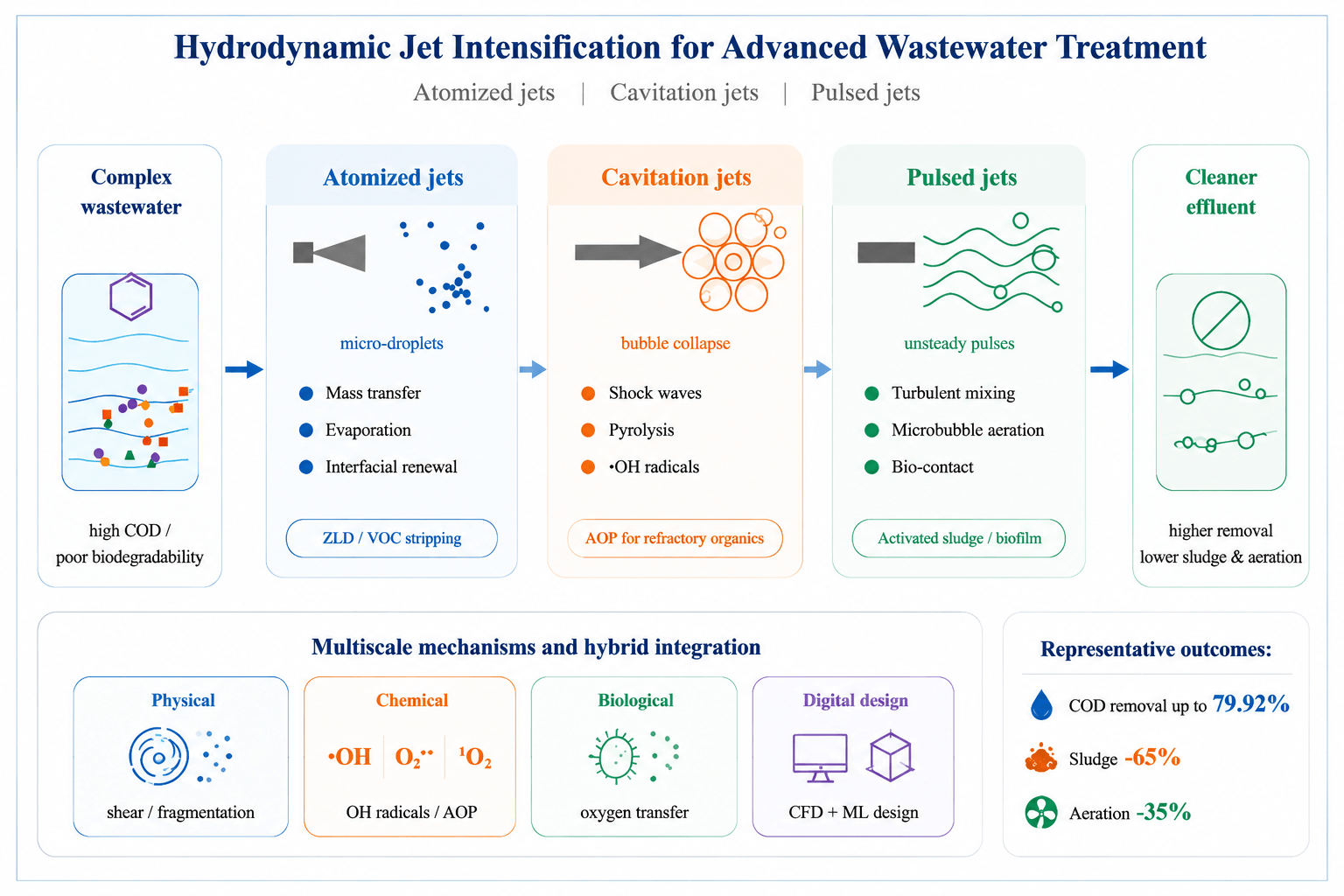

 Login
Login Register
 Submit a Paper
 Propose a Special lssue
 Download PDF
 Downloads
 Citation Tools
