Partial Oxidation of Diacrylates to Produce Epoxy-Acrylate Hybrid Monomers: Precursors for Ambient-Curable Polymeric Epoxy Resins
Bungo Ochiai*, Yuji Kamachi, Yoshimasa Matsumura#
Graduate School of Science and Engineering, Yamagata University, Yonezawa, Japan
* Corresponding Author: Bungo Ochiai. Email: 
# Present address: Faculty of Engineering, Osaka Institute of Technology, Osaka, Japan
Journal of Polymer Materials https://doi.org/10.32604/jpm.2026.078288
Received 28 December 2025; Accepted 14 April 2026; Published online 29 May 2026
Abstract
Epoxy-acrylate hybrid systems are extensively employed in adhesives, coatings, and composites; however, conventional formulations often rely on toxic monomers such as glycidyl methacrylate (GMA). This study introduces a sequentially curable epoxy-acrylate hybrid system based on novel hybrid monomers containing both glycidate and acrylate groups, synthesized via the partial oxidation of a diacrylate. Radical polymerization of monomers with a glycidate content exceeding 80% yielded viscous prepolymers consisting of epoxy-functionalized polymers and residual low-molecular-weight glycidates. These prepolymers were subsequently cured with amines at ambient temperature to form crosslinked networks. The gel fraction exceeded 90% when cured with diethylenetriamine, demonstrating efficient curing. The resulting cured materials exhibited significantly enhanced lap-shear adhesion strength (>1.6 MPa) compared to those obtained from monomeric analogs (<1.14 MPa). This improvement is attributed to the synergistic effects of polar ester groups, flexible polymeric spacers, and a loose network structure resulting from the reduced nucleophilicity of γ-keto secondary amine intermediates, as supported by density-functional-theory calculations. This two-stage curing approach provides a GMA-free, ambient-curable polymeric epoxy resins, offering a safer and more versatile strategy for the molecular design of high-performance hybrid materials.
Graphical Abstract
Keywords
Epoxy; acrylate; glycidate; crosslink; adhesion; DFT calculation
 Open Access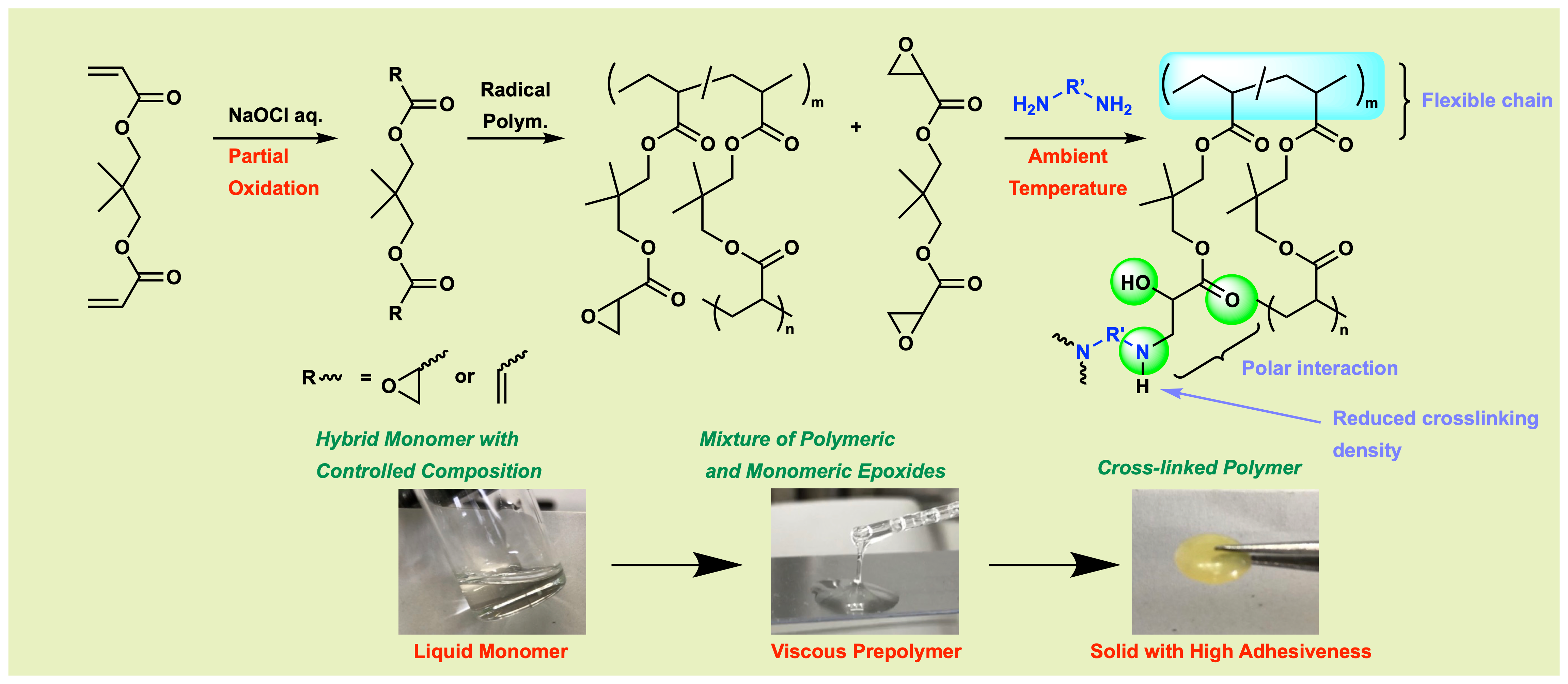

 Login
Login Register
 Submit a Paper
 Propose a Special lssue
 Download PDF
 Supplementary Material File
 Downloads
 Citation Tools
