Home / Journals / JPM / Vol.42, No.3, 2025
Special Issues
cover

On the Cover

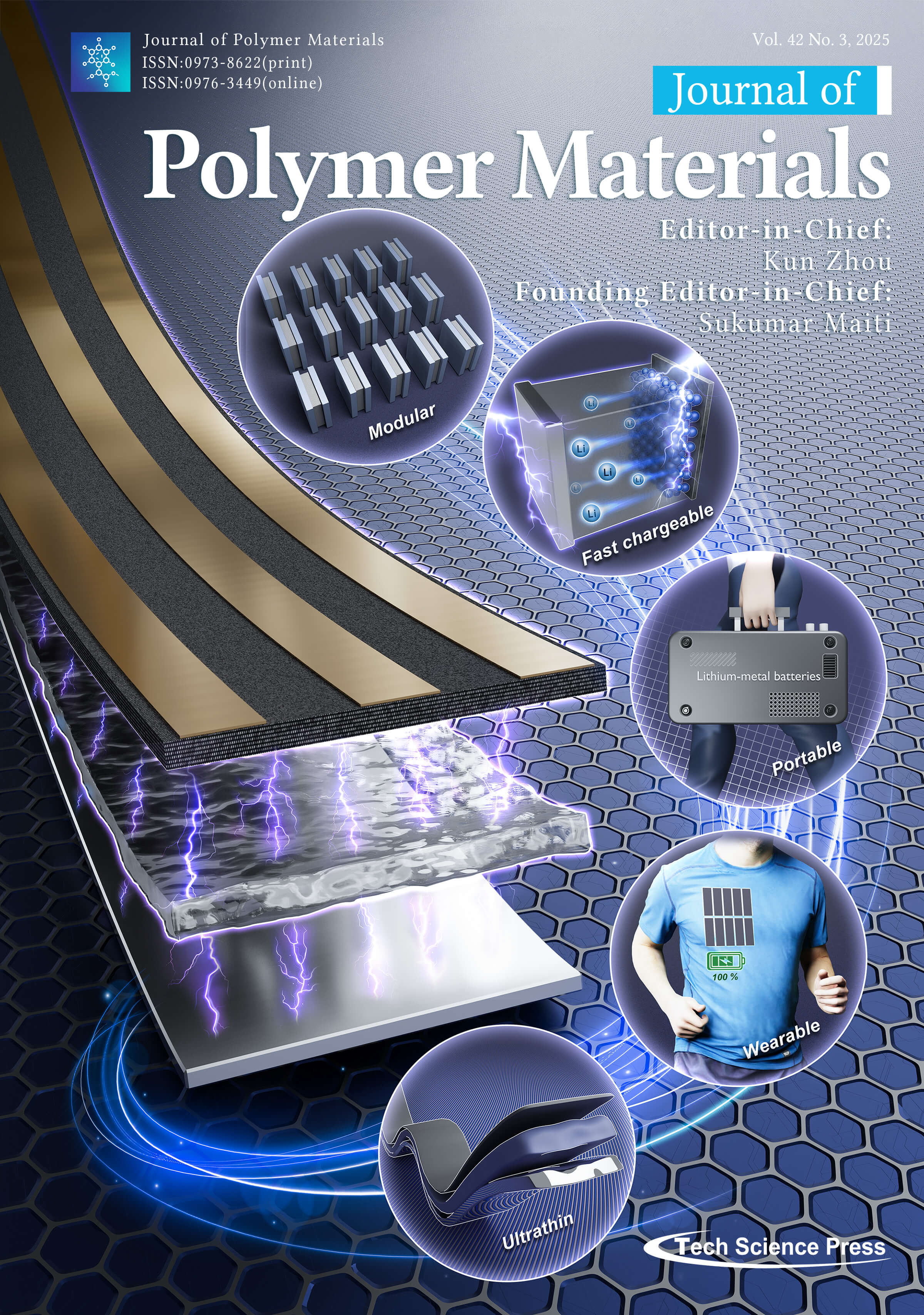
Driven by wearable technology, flexible energy storage requires safe and high-performance power sources. The solid-state electrolytes offer enhanced safety over conventional liquid electrolytes, but their thickness poses challenges, including energy density and device volume. This mini-review highlights recent advances in ultrathin solid- and gel-based polymer electrolytes, covering preparation methods, advantages, limitations, and key properties such as energy density, interfacial stability, mechanical strength, and ion transport. In this way, it is hoping to inspire further development of ultrathin electrolytes for high-energy-density batteries and ultimately pave the way for realizing superior rechargeable batteries.

View this paper

  • Open AccessOpen Access

    REVIEW

    Design Principles of Ultrathin Polymer-Based Electrolyte for Lithium-Metal Batteries

    Xinyuan Shan1,2, Yuan Wei1, Jiayao Chen1,*, Peng-Fei Cao1,*
    Journal of Polymer Materials, Vol.42, No.3, pp. 571-586, 2025, DOI:10.32604/jpm.2025.068907 - 30 September 2025
    Abstract In recent years, ultrathin polymer-based electrolytes (UPEs) have emerged as a promising strategy to enhance the energy density of rechargeable batteries for wearable devices by minimizing electrolyte volume, demonstrating higher ionic conductance and lower internal resistance, and more compact battery stacking compared to conventional thick polymer-based electrolyte. This mini review systematically summarizes recent advances in ultrathin solid-state and gel-state electrolytes, focusing on their preparation strategies, advantages, and disadvantages, where the energy density, interfacial stability, mechanical properties, and ion-transport mechanisms are also analyzed for understanding the UPE application. Moreover, the challenges such as dendrite penetration and More >

  • Open AccessOpen Access

    REVIEW

    A Minireview on Comprehensive Application of Hydrogels Used as Electrolytes in Flexible Zinc-Air Batteries

    Yinglai Tang, Jiale Xie, Yujie Chen, Xingxu Liu, Xiaomin Kang*
    Journal of Polymer Materials, Vol.42, No.3, pp. 587-619, 2025, DOI:10.32604/jpm.2025.067647 - 30 September 2025
    Abstract With the rapid development of flexible and wearable electronic devices, the demand for flexible power sources with high energy density and long service life is imminent. Zinc-air batteries have long been regarded as an important development direction in the future due to their high safety, environmental efficiency, abundant reserves and low cost. However, problems such as zinc dendrite growth, corrosion, by-product generation, hydrogen evolution and leakage, and evaporation of electrolyte affect the commercialization of zinc-air batteries. In addition, currently widely used aqueous electrolytes lead to larger batteries, which is not conducive to the development of… More >

  • Open AccessOpen Access

    REVIEW

    A Comprehensive Study on Application and Prospect of Hydrogel Detection Methods

    Caixia Chen1, Pengyu Liu1, Changhua Wang1, Yanyan Xie1, Wei Wang1,*, Xiaomin Kang2,*
    Journal of Polymer Materials, Vol.42, No.3, pp. 621-660, 2025, DOI:10.32604/jpm.2025.068852 - 30 September 2025
    Abstract Due to their high water content, stimulus responsiveness, and biocompatibility, hydrogels, which are functional materials with a three-dimensional network structure, are widely applied in fields such as biomedicine, environmental monitoring, and flexible electronics. This paper provides a systematic review of hydrogel characterization methods and their applications, focusing on primary evaluation techniques for physical properties (e.g., mechanical strength, swelling behavior, and pore structure), chemical properties (e.g., composition, crosslink density, and degradation behavior), biocompatibility, and functional properties (e.g., drug release, environmental stimulus response, and conductivity). It analyzes the challenges currently faced by characterization methods, such as a More >

  • Open AccessOpen Access

    REVIEW

    Design of Nanostructured Surfaces and Hydrogel Coatings for Anti-Bacterial Adhesion

    Nanpu Cao1, Huan Luo1, Song Yue1, Yong Chen1, Mao Xu1, Pu Cao1, Tao Xin1, Hongying Luo1, Fa Zhang2,*
    Journal of Polymer Materials, Vol.42, No.3, pp. 661-675, 2025, DOI:10.32604/jpm.2025.067313 - 30 September 2025
    Abstract This review systematically summarizes recent advancements in the design of antibacterial hydrogels and the surface-related factors influencing microbial adhesion to polymeric materials. Hydrogels, characterized by their three-dimensional porous architecture and ultra-high water content, serve as ideal platforms for incorporating antibacterial agents (e.g., metal ions, natural polymers) through physical/chemical interactions, enabling sustained release and enhanced antibacterial efficacy. For traditional polymers, surface properties (e.g., roughness, charge, superhydrophobicity, free energy, nanoforce gradients) play critical roles in microbial adhesion. Modifying the surface properties of polymers through surface treatment can regulate antibacterial performance. In particular, by referencing the micro/nanostructures found More >

  • Open AccessOpen Access

    REVIEW

    A Review of PEO (Polyethylene Oxide) Assisted Electrospinning of Chitosan: Innovation, Production, and Application

    Md. Tanvir Raihan1, Md. Himel Mahmud2, Badhon Chandra Mazumder2, Md. Nazif Hasan Chowdhury3, Mohammad Tajul Islam1,*
    Journal of Polymer Materials, Vol.42, No.3, pp. 677-711, 2025, DOI:10.32604/jpm.2025.068356 - 30 September 2025
    Abstract Electrospinning has gained significant importance across various fields, including biomedicine, filtration, and packaging due to the control it provides over the properties of the resulting materials, such as fiber diameter and membrane thickness. Chitosan is a biopolymer that can be utilized with both natural and synthetic copolymers, owing to its therapeutic potential, biocompatibility, and biodegradability. However, producing electrospun chitosan is challenging due to its high solution viscosity, which often results in the formation of beads instead of uniform fibers. To address this issue, the spinnability of chitosan is significantly enhanced, and the production of continuous More >

  • Open AccessOpen Access

    ARTICLE

    Computational Study Analysis of Adsorption Behavior of MgFe2O4-Collagen Hydrogels with Spinal Cord Tissues

    Imandeena Sofileeya1,2, Surajudeen Sikiru1,2,*, Nur Hidayah Shahemi1, Niraj Kumar3, Mohd Muzamir Mahat1,*
    Journal of Polymer Materials, Vol.42, No.3, pp. 713-728, 2025, DOI:10.32604/jpm.2025.065378 - 30 September 2025
    (This article belongs to the Special Issue: Innovative Smart Polymeric Materials for Sustainable Energy Solutions: Bridging Advances in Energy and Biomedical Applications)
    Abstract Spinal cord injury presents a significant challenge in regenerative medicine due to the complex and delicate nature of neural tissue repair. This study aims to design a conductive hydrogel embedded with magnetic MgFe2O4 nanoparticles to establish a bioelectrically active and spatially stable microenvironment that promotes spinal cord regeneration through computational analysis (BIOVIA Materials Studio). Hydrogels, known for their biocompatibility and extracellular matrix-mimicking properties, support essential cellular behaviors such as adhesion, proliferation, and migration. The integration of MgFe2O4 nanoparticles imparts both electrical conductivity and magnetic responsiveness, enabling controlled transmission of electrical signals that are crucial for guiding… More >

  • Open AccessOpen Access

    ARTICLE

    Influence of LiCF3SO3 on the Conductivity and Other Characteristics of Methylcellulose/PVA Blend-Based Electrolytes

    Nurrul Asyiqin Shamsuri1, Zamil Khairuddin2, Muhamad Hafiz Hamsan3, Norhana Abdul Halim4, Mohd Fakhrul Zamani Kadir1,5, Muhammad Fadhlullah Shukur6,7,*
    Journal of Polymer Materials, Vol.42, No.3, pp. 729-742, 2025, DOI:10.32604/jpm.2025.069060 - 30 September 2025
    (This article belongs to the Special Issue: Innovative Smart Polymeric Materials for Sustainable Energy Solutions: Bridging Advances in Energy and Biomedical Applications)
    Abstract Polymeric materials have emerged as a promising alternative to electrolytic solutions in energy storage applications. However, high crystallinity and poor ionic conductivity are the main barriers restricting their daily application. In this study, we propose a polymer electrolyte system consisting of methylcellulose-polyvinyl alcohol (MC-PVA) blend as host material and lithium trifluoromethanesulfonate (LiCF3SO3) as dopant, which was prepared using the solution-casting method. The electrochemical impedance spectroscopy (EIS) analysis revealed a maximum conductivity of 5.42 × 10⁻⁶ S cm−1 with 40 wt.% LiCF3SO3. The key findings demonstrated that the variation in the dielectric loss (εi) and dielectric constant (εr) was… More >

  • Open AccessOpen Access

    ARTICLE

    Direct Production of Sorbitol-Plasticized Bioplastic Film from Gracilaria sp.

    Ahmad Faldo1, Labanta Marbun1, Hezekiah Lemuel Putra Zebua1, Fateha Fateha2, Rossy Choerun Nissa2, Yurin Karunia Apsha Albaina Iasya3, Riri Uswatun Annifah3, Amrul Amrul1, Yeyen Nurhamiyah2,*
    Journal of Polymer Materials, Vol.42, No.3, pp. 743-755, 2025, DOI:10.32604/jpm.2025.069981 - 30 September 2025
    (This article belongs to the Special Issue: Development and Application of Biodegradable Plastics)
    Abstract Conventional bioplastic production from seaweed often relies on extraction processes that are costly, time-consuming, and yield limited product. This study presents a direct fabrication method using Gracilaria sp., a red seaweed rich in polysaccharides, to produce bioplastic films without the need for extraction. Sorbitol was incorporated as a plasticizer at concentrations of 0%–10% (w/w) to modify film characteristics. Thermal analysis revealed improved stability at moderate sorbitol levels (5%–7%), while excessive plasticizer slightly reduced thermal resistance. Mechanical testing showed that sorbitol increased film flexibility and elongation at break, though tensile strength and stiffness declined. Tear strength followed More >

  • Open AccessOpen Access

    ARTICLE

    Application of a Hyperbranched Amide Polymer in High-Temperature Drilling Fluids: Inhibiting Barite Sag and Action Mechanisms

    Qiang Sun1,2,*, Zheng-Song Qiu1, Tie Geng2, Han-Yi Zhong1, Weili Liu2, Yu-Lin Tang2, Jin-Cheng Dong2
    Journal of Polymer Materials, Vol.42, No.3, pp. 757-772, 2025, DOI:10.32604/jpm.2025.069808 - 30 September 2025
    (This article belongs to the Special Issue: Advances in Functional Polymer Composites: Synthesis, Characterization and Applications)
    Abstract Addressing the critical challenges of viscosity loss and barite sag in synthetic-based drilling fluids (SBDFs) under high-temperature, high-pressure (HTHP) conditions, this study innovatively developed a hyperbranched amide polymer (SS-1) through a unique stepwise polycondensation strategy. By integrating dynamic ionic crosslinking for temperature-responsive rheology and rigid aromatic moieties ensuring thermal stability beyond 260°C, SS-1 achieves a molecular-level breakthrough. Performance evaluations demonstrate that adding merely 2.0 wt% SS-1 significantly enhances key properties of 210°C-aged SBDFs: plastic viscosity rises to 45 mPa·s, electrical stability (emulsion voltage) reaches 1426 V, and the sag factor declines to 0.509, outperforming conventional More >

  • Open AccessOpen Access

    ARTICLE

    Prediction and Validation of Mechanical Properties of Areca catechu/Tamarindus indica Fruit Fiber with Nano Coconut Shell Powder Reinforced Hybrid Composites

    Jeyapaul Angel Ida Chellam1, Bright Brailson Mansingh2, Daniel Stalin Alex3, Joseph Selvi Binoj4,*
    Journal of Polymer Materials, Vol.42, No.3, pp. 773-794, 2025, DOI:10.32604/jpm.2025.069295 - 30 September 2025
    Abstract Machine learning models can predict material properties quickly and accurately at a low computational cost. This study generated novel hybridized nanocomposites with unsaturated polyester resin as the matrix and Areca fruit husk fiber (AFHF), tamarind fruit fiber (TFF), and nano-sized coconut shell powder (NCSP). It is challenging to determine the optimal proportion of raw materials in this composite to achieve maximum mechanical properties. This task was accomplished with the help of ML techniques in this study. The tensile strength of the hybridized nanocomposite was increased by 134.06% compared to the neat unsaturated polyester resin at… More >

  • Open AccessOpen Access

    ARTICLE

    Bagasse Fibers Surface Heat Treatment and Its Effect on Mechanical Properties of Starch/Poly (Vinyl Alcohol) Composites

    Xiangyang Zhou1, Yashi Wang1, Min Xiao1,*, Jiajun Liu1,2, Jiahao Wen1, Haodong Shen3, Hucan Hong1
    Journal of Polymer Materials, Vol.42, No.3, pp. 795-810, 2025, DOI:10.32604/jpm.2025.068200 - 30 September 2025
    (This article belongs to the Special Issue: Advances in Polymer Materials: Multifunctional Design and Sustainable Applications)
    Abstract Sugarcane bagasse (SCB) is a promising natural fiber for bio-based composites, but its high moisture absorption and poor interfacial adhesion with polymer matrices limit mechanical performance. While chemical treatments have been extensively explored, limited research has addressed how thermal treatment alone alters the surface properties and reinforcing behavior of SCB fibers. This study aims to fill that gap by investigating the effects of heat treatment on SCB fiber structure and its performance in starch/poly (vinyl alcohol) (PVA) composites. Characterization techniques including Fourier transform infrared spectroscopy (FTIR), X-ray diffraction (XRD), X-ray photoelectron spectroscopy (XPS), and scanning… More >

  • Open AccessOpen Access

    ARTICLE

    Sustainable Removal of Cu2+ and Pb2+ Ions via Adsorption Using Polyvinyl Alcohol/Neem Leaf Extract/Chitosan (From Shrimp Shells) Composite Films

    Deepti Rekha Sahoo, Trinath Biswal*
    Journal of Polymer Materials, Vol.42, No.3, pp. 811-835, 2025, DOI:10.32604/jpm.2025.067022 - 30 September 2025
    (This article belongs to the Special Issue: Cellulose and Nanocellulose in Polymer Composites: Sustainable Engineering Approach)
    Abstract The purpose of this research work is to determine the removal efficiency of Cu2+ and Pb2+ ions using polyvinyl alcohol/neem leaf extract/chitosan (PVA/NLE/CS) composite films as adsorbent materials from an aqueous medium, with respect to pH, contact time, and adsorbent dosage. The synthesized composite material was characterized using Fourier Transform Infrared (FTIR) spectroscopy, thermogravimetric analysis-Derivative Thermogravimetry (TGA-DTG), X-ray diffraction (XRD), X-ray photoelectron spectroscopy (XPS), and scanning electron microscopy-Energy Dispersive X-ray Spectroscopy (SEM-EDX). The antibacterial activity and swelling response of the material were studied using suitable methodologies. The FTIR study confirmed the interactions among PVA, chitosan, and… More >

  • Open AccessOpen Access

    ARTICLE

    Acetylation of Corn Stalk (Zea mays) for Its Valorization

    Jhony César Muñoz Zambrano, Douglas Alexander Bermúdez Parrales, María Antonieta Riera*
    Journal of Polymer Materials, Vol.42, No.3, pp. 837-851, 2025, DOI:10.32604/jpm.2025.067277 - 30 September 2025
    (This article belongs to the Special Issue: Cellulose and Nanocellulose in Polymer Composites: Sustainable Engineering Approach)
    Abstract Agricultural waste is a potentially interesting resource due to the compounds present. In this study, cellulose was extracted from corn stalks (Zea mays) and subsequently converted into cellulose acetate (CA). Before the extraction process, the waste sample was characterized by pH, moisture, ash, protein content, total reducing sugars (TRS), carbohydrates, cellulose, hemicellulose, and lignin. Acid and alkaline hydrolysis were performed with different reagents, concentrations, and extraction times. Sulfuric acid (H2SO4) and acetic acid (CH3COOH) were used in the acid hydrolysis, while sodium hydroxide (NaOH) was used in the alkaline hydrolysis. Three concentrations (0.62, 1.25, 2.5)% and two… More >

  • Open AccessOpen Access

    ARTICLE

    The Impact of Caulerpa lentillifera Seaweed-Based Coatings on Physicochemical Characteristics and Shelf Longevity of Fruits and Vegetables

    Nuraqilah Syamimi Mat Jauilah1, Kobun Rovina2,*, Wahidatul Husna Zuldin3, Sarifah Supri1, Patricia Matanjun1, Luh Suriati4
    Journal of Polymer Materials, Vol.42, No.3, pp. 853-871, 2025, DOI:10.32604/jpm.2025.066751 - 30 September 2025
    (This article belongs to the Special Issue: Innovative Smart Polymeric Materials for Sustainable Energy Solutions: Bridging Advances in Energy and Biomedical Applications)
    Abstract Food breakdown during storage and transit greatly adds to worldwide food waste. Biodegradable edible coatings derived from natural sources provide a sustainable method to extend the shelf life and preserve the freshness of fresh fruit. This study explores the potential of the readily available and nutrient-rich seaweed, Caulerpa lentillifera, as a base material for edible coatings that can enhance the shelf life and maintain the physicochemical properties of fruits and vegetables. Caulerpa lentillifera, a marine macroalga renowned for its unique biochemical composition, presents a promising avenue for developing sustainable bio-coatings to improve the post-harvest quality of fresh… More >

  • Open AccessOpen Access

    ARTICLE

    Impact and Residual Flexural Properties of 3D Integrated Woven Spacer Composites

    Mahim Masfikun Hannan, Deng’an Cai*, Xinwei Wang
    Journal of Polymer Materials, Vol.42, No.3, pp. 873-891, 2025, DOI:10.32604/jpm.2025.064978 - 30 September 2025
    (This article belongs to the Special Issue: Damage and Fracture of Polymer Composites)
    Abstract This study investigates the low-velocity impact and post-impact flexural properties of 3D integrated woven spacer composites, focusing on their orthotropic behavior when tested along two principal directions, i.e., warp (X-type) and weft (Y-type) directions. The same composite material was tested in these orientations to evaluate the differences in impact resistance and residual bending strength. Specimens were fabricated via vacuum-assisted molding and tested at 2, 3, 5, and 7 J impact energies using an Instron Ceast 9350 drop-weight impact testing machine, in accordance with ASTM D7136. Post-impact flexural tests were performed using a four-point bending method… More >

Per Page:

Share Link