Guest Editor(s)
Dr. Akash Kumar Bhoi
Email: akash.bhoi@sitpune.edu.in
Affiliation: Symbiosis Institute of Technology (SIT), Symbiosis International (Deemed University), Pune, India
Homepage:
Research Interests: adaptive control and intelligent decision-making for personalized healthcare systems, soft computing techniques for healthcare automation and optimization, biomedical signal processing and adaptive monitoring systems

Dr. Paolo Barsocchi
Email: paolo.barsocchi@isti.cnr.it
Affiliation: Wireless Networks Laboratory, Institute of Information Science and Technologies (ISTI), National Research Council of Italy (CNR), Pisa, Italy
Homepage:
Research Interests: healthcare cyber-physical systems, digital twins, and internet of medical things (IoMT), AI-driven adaptive control and reinforcement learning in healthcare applications, multimodal signal, image, and sensor fusion for intelligent healthcare

Prof. Dr. Victor Hugo C. de Albuquerque
Email: victor.albuquerque@ieee.org
Affiliation: Department of Teleinformatics Engineering (DETI), Federal University of Ceará, Fortaleza, Brazil
Homepage:
Research Interests: biomedical engineering, medical data science, biomedical analytics, communication in healthcare

Prof. Dr. Mrinal Bachute
Email: mrinal.bachute@sitpune.edu.in
Affiliation: Symbiosis Institute of Technology (SIT), Symbiosis International (Deemed University), Pune, India
Homepage:
Research Interests: multimodal physiological signal acquisition, adaptive patient-specific health monitoring, soft-computing based decision support systems, personalized disease prediction and prognosis, edge AI-enabled healthcare platforms

Summary
The objective of this Special Issue is to bring together researchers, practitioners, and healthcare innovators working at the intersection of adaptive control, computational intelligence, and healthcare automation. Emphasis is placed on novel techniques, theoretical advances, and practical applications that employ adaptive and intelligent systems to improve healthcare decision-making, patient outcomes, robustness, and efficiency.
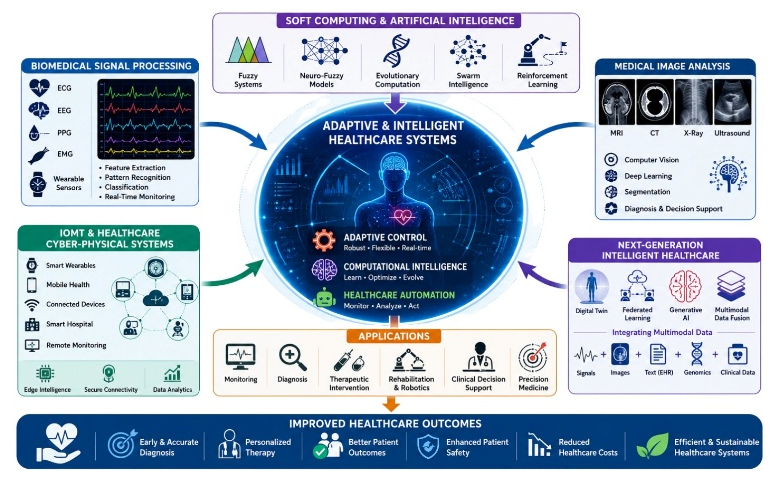
The focus is placed on soft computing methods, such as fuzzy systems, neuro-fuzzy models, evolutionary computation, swarm intelligence, reinforcement learning, and hybrid intelligent frameworks, which are capable of addressing the inherent uncertainty, non-linearity, and variability of healthcare environments. Contributions to the Special Issue are also welcomed in relation to biomedical signal analysis, medical image processing, computer vision, digital twins, the Internet of Medical Things (IoMT), healthcare cyber-physical systems, intelligent robotics, and precision medicine.
Original research articles, review papers, and application-oriented studies reporting novel adaptive control strategies for healthcare monitoring, diagnosis, therapeutic intervention, rehabilitation, and intelligent clinical decision support are welcomed. Contributions that are interdisciplinary in scope and integrate adaptive control with emerging technologies, including generative artificial intelligence, federated learning, edge intelligence, and multimodal data fusion, are particularly encouraged.
The issue is structured around the following thematic pillars:
• Adaptive Control for Intelligent Healthcare Systems: Adaptive control strategies for healthcare monitoring, diagnosis, treatment optimization, patient-specific modeling, and real-time decision support in dynamic healthcare environments.
• Reinforcement Learning and Adaptive Artificial Intelligence for Healthcare: Reinforcement learning, online learning, autonomous decision-making, adaptive treatment planning, personalized interventions, and intelligent healthcare agents support clinical decision-making and patient-centered care.
• Biomedical Signal Processing and Health Monitoring: Adaptive analysis of physiological signals, including ECG, EEG, EMG, and PPG, anomaly detection, disease prediction, remote monitoring, and wearable healthcare technologies for health monitoring and assessment.
• Medical Image Analysis and Computer Vision: Advanced image processing, computer-aided diagnosis, image segmentation, classification, multimodal imaging, explainable artificial intelligence, and vision-based healthcare applications constitute significant areas of scholarly inquiry.
• Internet of Medical Things (IoMT) and Healthcare Cyber-Physical Systems: Intelligent healthcare infrastructures, interconnected medical devices, edge-enabled healthcare systems, secure healthcare cyber-physical systems, and real-time automation in healthcare settings.
• Intelligent Clinical Decision Support Systems: adaptive expert systems, explainable and trustworthy artificial intelligence, uncertainty-aware decision-making, multimodal data fusion, and optimization of clinical workflows.
• Federated Learning, Edge Intelligence, and Distributed Healthcare AI: This domain encompasses privacy-preserving learning, decentralized intelligence, collaborative healthcare analytics, edge computing, and resource-efficient healthcare AI systems.
• Intelligent Robotics and Rehabilitation Technologies: Adaptive robotic systems, assistive technologies, rehabilitation robotics, human-robot interaction, and autonomous healthcare devices.
Graphic Abstract
Keywords
adaptive control, computational intelligence, healthcare automation, fuzzy systems, reinforcement learning, biomedical signal processing, medical image analysis, internet of medical things (IoMT), digital twins, federated learning, edge intelligence, intelligent clinical decision support, healthcare cyber-physical systems, precision medicine, generative AI for healthcare

 Login
Login Register
 Submit a Paper
 Propose a Special lssue