Guest Editor(s)
Prof. Dr. Gaurav Gupta
Email: gaurav@shooliniuniversity.com
Affiliation: Yogananda School of AI Computers and Data Science, Shoolini University, Solan, India
Homepage:
Research Interests: artificial intelligence in healthcare, precision medicine, medical imaging and diagnostics, federated learning, internet of medical things (IoMT), explainable AI, smart healthcare systems, cloud-edge computing, AI ethics and governance, digital health informatics

Assoc. Prof. Dr. Weiwei Jiang
Email: jww@bupt.edu.cn
Affiliation: School of Information and Communication Engineering, Beijing University of Posts and Telecommunications, Beijing, China
Homepage:
Research Interests: machine learning, deep learning, cloud computing, medical imaging, network security

Dr. Ankit Gupta
Email: ankit.gupta@vsb.cz
Affiliation: Biomedical Engineering Research Group, Technical University of Ostrava, Ostrava, Czech Republic
Homepage:
Research Interests: representation learning, signal processing, image processing, vital signs monitoring, machine learning, RPPG

Summary
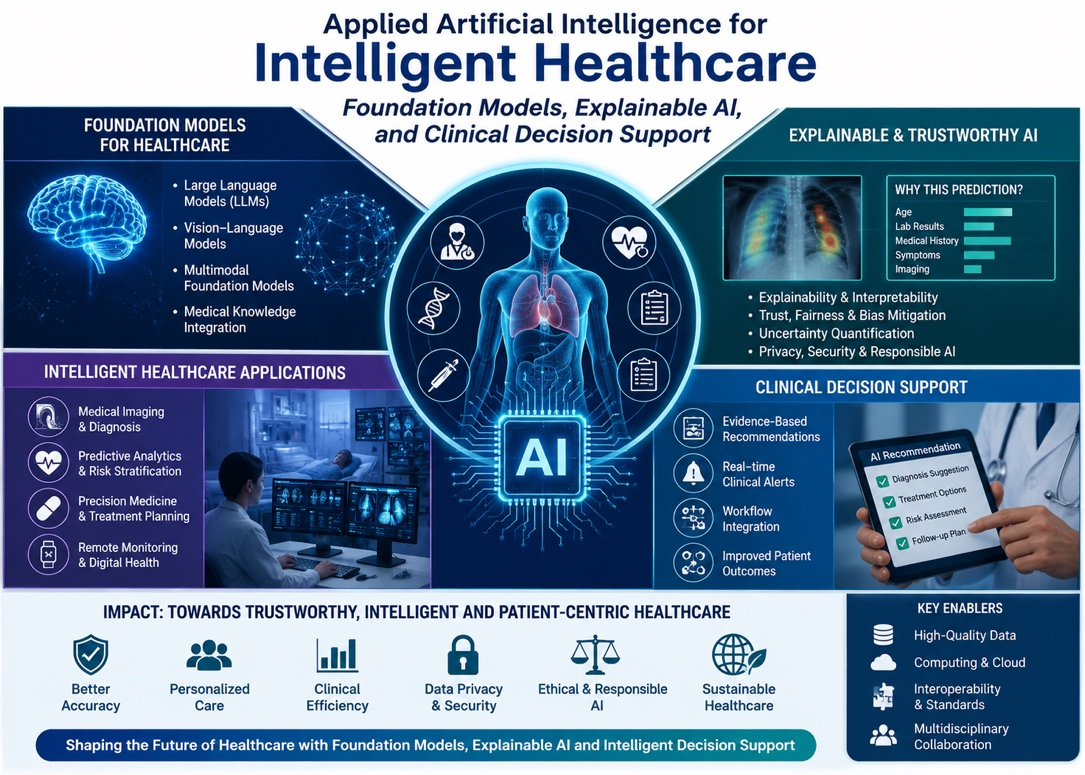
Artificial Intelligence (AI) is transforming modern healthcare by enabling intelligent diagnosis, personalized treatment, predictive analytics, and evidence-based clinical decision-making. Recent advances in foundation models, large language models (LLMs), multimodal learning, and explainable artificial intelligence (XAI) have significantly enhanced the ability of AI systems to analyze diverse healthcare data, including medical images, electronic health records, genomic data, clinical notes, and wearable sensor information. These technologies are paving the way for trustworthy clinical decision support systems that improve patient outcomes while increasing healthcare efficiency.
Despite these advances, the clinical adoption of AI remains challenging due to concerns regarding interpretability, robustness, fairness, privacy, regulatory compliance, and physician trust. Addressing these challenges requires the development of transparent, reliable, and clinically validated AI methodologies capable of supporting safe and ethical healthcare delivery.
This Special Issue aims to provide an interdisciplinary platform for researchers, clinicians, and industry experts to present innovative research on Applied Artificial Intelligence for Intelligent Healthcare, with a particular focus on foundation models, explainable AI, and clinical decision support systems. We welcome original research, reviews, and case studies covering trustworthy AI, multimodal learning, federated learning, medical imaging, natural language processing, predictive analytics, and intelligent healthcare systems. Emphasis will be placed on clinically relevant solutions demonstrating real-world deployment, measurable healthcare impact, and responsible AI practices that advance precision medicine, patient-centered care, and sustainable digital healthcare ecosystems.
Suggested Topics (including, but not limited to):
· Foundation Models for Healthcare Applications
· Large Language Models (LLMs) in Clinical Practice
· Vision-Language Models for Medical Imaging
· Explainable and Trustworthy AI in Healthcare
· Clinical Decision Support Systems
· AI-Assisted Disease Diagnosis and Prognosis
· Multimodal Learning for Medical Data Analysis
· Precision Medicine and Personalized Healthcare
· Medical Image Analysis and Computer-Aided Diagnosis
· Natural Language Processing for Electronic Health Records
· Federated Learning and Privacy-Preserving Healthcare AI
· AI for Digital Health and Remote Patient Monitoring
· Internet of Medical Things (IoMT) and Edge AI
· AI for Drug Discovery and Clinical Trials
· Predictive Analytics for Patient Risk Stratification
· AI for Cancer, Neurological, and Cardiovascular Diseases
· Foundation Models for Biomedical Data Integration
· Ethical, Fair, and Responsible AI in Healthcare
· Robust and Secure AI for Clinical Applications
· AI Governance, Validation, and Regulatory Compliance in Healthcare
Graphic Abstract
Keywords
applied artificial intelligence, intelligent healthcare, foundation models, large language models (LLMs), explainable artificial intelligence (XAI), clinical decision support systems (CDSS), medical image analysis, precision medicine, multimodal learning, federated learning, electronic health records (EHR) analytics, trustworthy AI, digital health, predictive healthcare analytics, responsible AI in healthcare

 Login
Login Register
 Submit a Paper
 Propose a Special lssue