Guest Editor(s)
Dr. Rajesh Kumar
Email: rajeshmahindru23@nitkkr.ac.in
Affiliation: Department of Electrical Engineering, National Institute of Technology Kurukshetra, Kurukshetra, India
Homepage:
Research Interests: adaptive control, artificial neural networks, soft computing, fuzzy systems, stability, optimization, modeling & identification of nonlinear systems

Prof. Dr. Smriti Srivastava
Email: smriti@nsut.ac.in
Affiliation: Department of Instrumentation & Control Engineering, Netaji Subhas University of Technology (NSUT), Sector-3, Dwarka, India
Homepage:
Research Interests: adaptive control, artificial neural networks, clustering, fuzzy systems, biometrics, modeling & identification of nonlinear systems

Summary
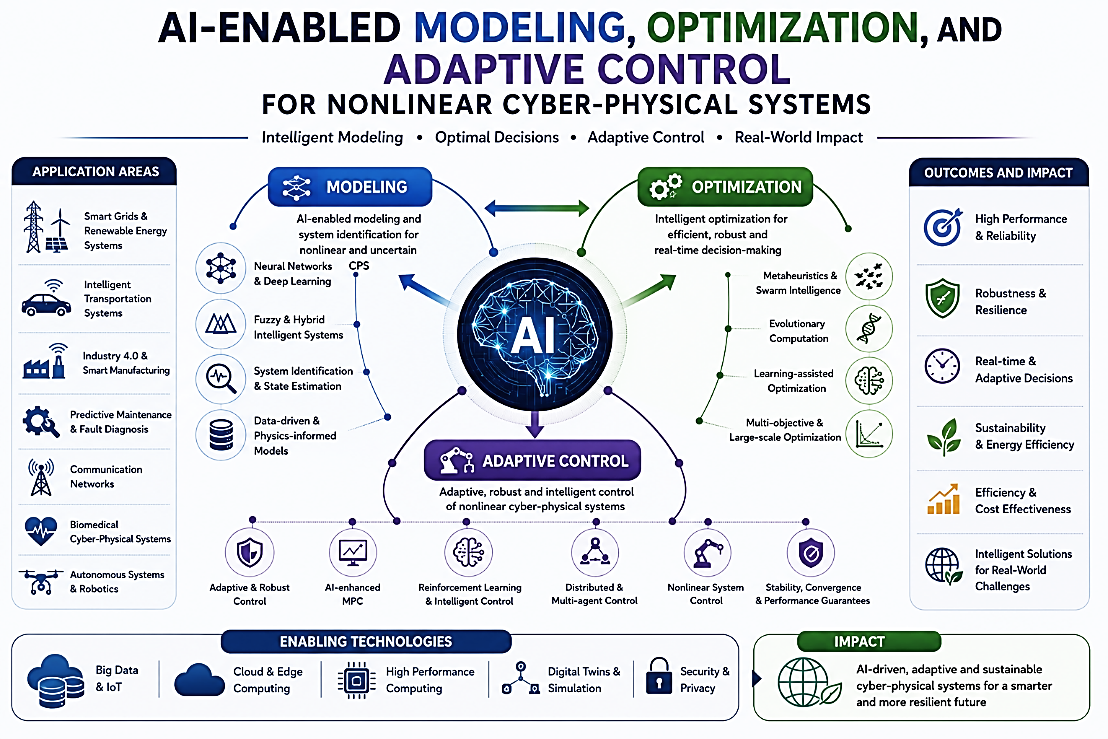
This Special Issue aims to highlight recent advances in AI-enabled modeling, optimization, and adaptive control for nonlinear cyber-physical systems. As modern engineering systems become increasingly interconnected, autonomous, and data-driven, there is a growing need for intelligent methodologies capable of accurately modeling complex dynamics, optimizing system performance, and ensuring reliable adaptive control under uncertainty. The Special Issue seeks to bring together cutting-edge research that integrates artificial intelligence, computational intelligence, machine learning, artificial neural networks, fuzzy systems, reinforcement learning, and advanced optimization techniques with modern control frameworks. Particular emphasis is placed on methodologies that enhance adaptability, stability, robustness, scalability, and computational efficiency while addressing the challenges posed by nonlinear, uncertain, and large-scale systems. Contributions covering both theoretical developments and practical implementations are encouraged, with applications spanning autonomous and robotic systems, smart grids, intelligent transportation, Industry 4.0, communication networks, and other emerging cyber-physical systems. By fostering interdisciplinary collaboration, this Special Issue aims to advance innovative AI-driven solutions that bridge the gap between intelligent algorithms and real-world engineering applications, paving the way for the next generation of resilient, autonomous, and adaptive cyber-physical systems.
Suggested themes include, but are not limited to:
• Promote AI-enabled modeling methodologies for nonlinear cyber-physical systems using artificial neural networks, fuzzy systems, machine learning, deep learning, reinforcement learning, and hybrid intelligent techniques.
• Encourage the development of intelligent optimization algorithms, including metaheuristics, swarm intelligence, evolutionary computation, and learning-assisted optimization for complex, uncertain, and nonlinear engineering systems.
• Foster research on adaptive, nonlinear, robust, and AI-assisted control strategies, including intelligent control and machine-learning-enhanced Model Predictive Control (MPC), with emphasis on stability, robustness, convergence, and performance guarantees.
• Advance AI-driven techniques for system modeling, identification, state estimation, optimization, and control of large-scale, networked, and nonlinear cyber-physical systems.
• Showcase distributed, networked, and multi-agent adaptive control approaches for autonomous systems, robotics, connected vehicles, drones, and other intelligent cyber-physical platforms.
• Encourage AI-enabled applications in smart grids, renewable energy systems, intelligent transportation, Industry 4.0, predictive maintenance, fault diagnosis, and communication networks.
• Promote interdisciplinary research that integrates artificial intelligence, computational intelligence, optimization, and adaptive control to develop resilient, autonomous, and next-generation cyber-physical systems.
Graphic Abstract
Keywords
artificial intelligence, machine learning, computational intelligence, intelligent modeling, adaptive control, optimization algorithms, artificial neural networks, reinforcement learning, fuzzy systems, nonlinear systems, cyber-physical systems, autonomous systems, smart infrastructure, industrial automation

 Login
Login Register
 Submit a Paper
 Propose a Special lssue