Guest Editor(s)
Dr. Yewuhalashet Fissha
Email: yewuhala@asahikawa-nct.ac.jp
Affiliation: Department of Electrical and Computer Engineering, National Institute of Technology, Asahikawa College, Asahikawa, Japan
Homepage:
Research Interests: mining engineering, application of AI, machine learning and computational modelling in subsurface engineering, monitoring, safety assessment, and performance evaluation of tunnels and underground excavations

Dr. Abhishek kumar Tripathi
Email: abhishekkumar@adityauniversity.in
Affiliation: Department of Mining Engineering, Aditya University, Surampalm, Andhra Pradesh, India
Homepage:
Research Interests: AI and data-driven methods in sustainable mining, numerical modelling of tunnels and rock mass behavior, monitoring, safety assessment, and optimization of tunnelling operations

Dr. Ahsan Rabbani
Email: ahsanr.phd18.ce@nitp.ac.in
Affiliation: Department of Civil Engineering, Sai Nath University, Ranchi, India
Homepage:
Research Interests: rock mechanics, ground behaviour, and geotechnical stability in underground excavations, data-driven modelling, AI applications, and digital tools for tunnel and subsurface engineering, monitoring, hazard assessment, and optimisation of underground construction and tunnelling operations

Dr. Walubita Mufalo
Email: mufalo@asahikawa-nct.ac.jp
Affiliation: National Institute of Technology, Asahikawa College, Asahikawa, Japan
Homepage:
Research Interests: stabilization mechanisms of toxic elements in soils and mine wastes, soil–snow interactions in cold climates; acid mine drainage neutralization strategies, geochemical modeling and speciation; and AI and ML for sustainable mining and environmental management

Summary
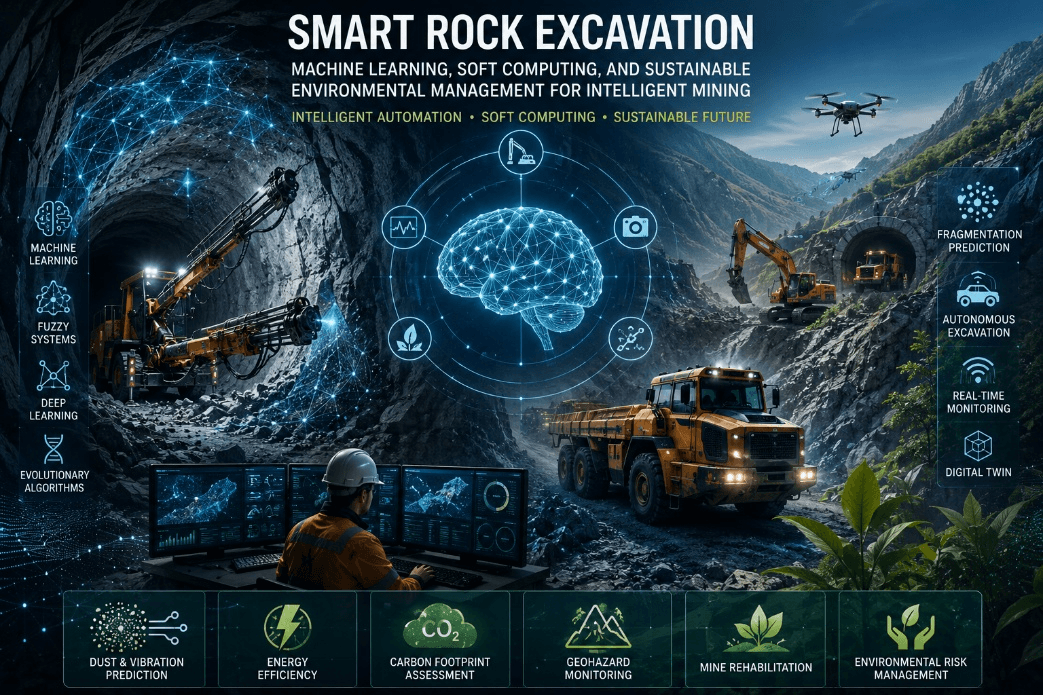
Artificial intelligence (AI), machine learning (ML), soft computing, and intelligent automation are transforming rock excavation and mining by enabling predictive, autonomous, and data-driven decision-making. Recent advances in computational intelligence provide powerful tools for modelling complex rock–machine interactions, optimizing excavation processes, improving operational efficiency, and enhancing safety and sustainability.
This Special Issue focuses on methodological and computational innovations that apply AI, machine learning, soft computing, intelligent systems, and data-driven approaches to rock excavation and sustainable mining automation. Contributions should emphasize the development or application of intelligent algorithms, predictive models, optimization techniques, computer vision, digital twins, autonomous systems, explainable AI, or hybrid computational methods as the primary scientific contribution.
Objectives of the Special Issue:
· To promote methodological advances in machine learning, artificial intelligence, and soft computing for intelligent rock excavation and mining automation.
· To showcase predictive modeling, optimization algorithms, and intelligent decision-support systems for excavation processes.
· To encourage research on computer vision, digital twins, explainable AI, intelligent sensing, and autonomous excavation technologies.
· To advance data-driven solutions for equipment performance prediction, predictive maintenance, and operational optimization.
· To promote AI-enabled environmental monitoring, geohazard prediction, and sustainable mining automation.
· To encourage interdisciplinary research integrating mining engineering with computational intelligence and intelligent automation.
· To identify emerging research trends and future directions in AI-driven rock excavation and sustainable mining systems.
Submissions should demonstrate a clear methodological contribution in AI, machine learning, soft computing, intelligent systems, or computational intelligence. Manuscripts focusing primarily on conventional mining engineering, rock mechanics, blasting practice, field investigations, or environmental management without a significant intelligent computing or data-driven component are outside the scope of this Special Issue.
Graphic Abstract
Keywords
rock excavation, smart mining, machine learning, artificial intelligence, soft computing, deep learning, intelligent automation, drilling and blasting, fragmentation prediction, digital twins, computer vision, sustainable mining, environmental management, mine rehabilitation

 Login
Login Register
 Submit a Paper
 Propose a Special lssue