
 Login
Login Register
 Submit a Paper
 Propose a Special lssue
 Open Access
ARTICLE

Sodium Alginate Nanoemulsions for the Delivery of Eucalyptus staigeriana Essential Oil: Production, Characterization, and Ovicidal and Larvicidal Effects against Haemonchus contortus
1 Programa de Pós-graduação em Ciências Veterinárias, Faculdade de Veterinária, Campus do Itaperi, Universidade Estadual do Ceará, 60714-903, CE, Brasil
2 Centro Universitário, Faculdade Metropolitana, Campus Fortaleza, 60040-531, CE, Brasil
3 Pós-graduçâo em Ciências Naturais, Centro de Ciências e Tecnologia, Campus do Itaperi, Universidade Estadual do Ceará, Fortaleza, 60714-903, CE, Brasil
4 Departamento de Patologia e Medicina Legal, Faculdade de Medicina, Campus do Porangabuçu, Universidade Federal do Ceará, Fortaleza, 60430-160, CE, Brazil
5 Departamento de Fisiologia e Farmacologia, Faculdade de Medicina, Campus do Parangaboçu, Universidade Federal do Ceará, Fortaleza, 60430-275, CE, Brazil
* Corresponding Author: Claudia M. L. Bevilaqua. Email:
Journal of Renewable Materials 2026, 14(2), 7 https://doi.org/10.32604/jrm.2025.02025-0138
Received 06 June 2025; Accepted 27 October 2025; Issue published 25 February 2026
 View Full Text
 Download PDF
Abstract
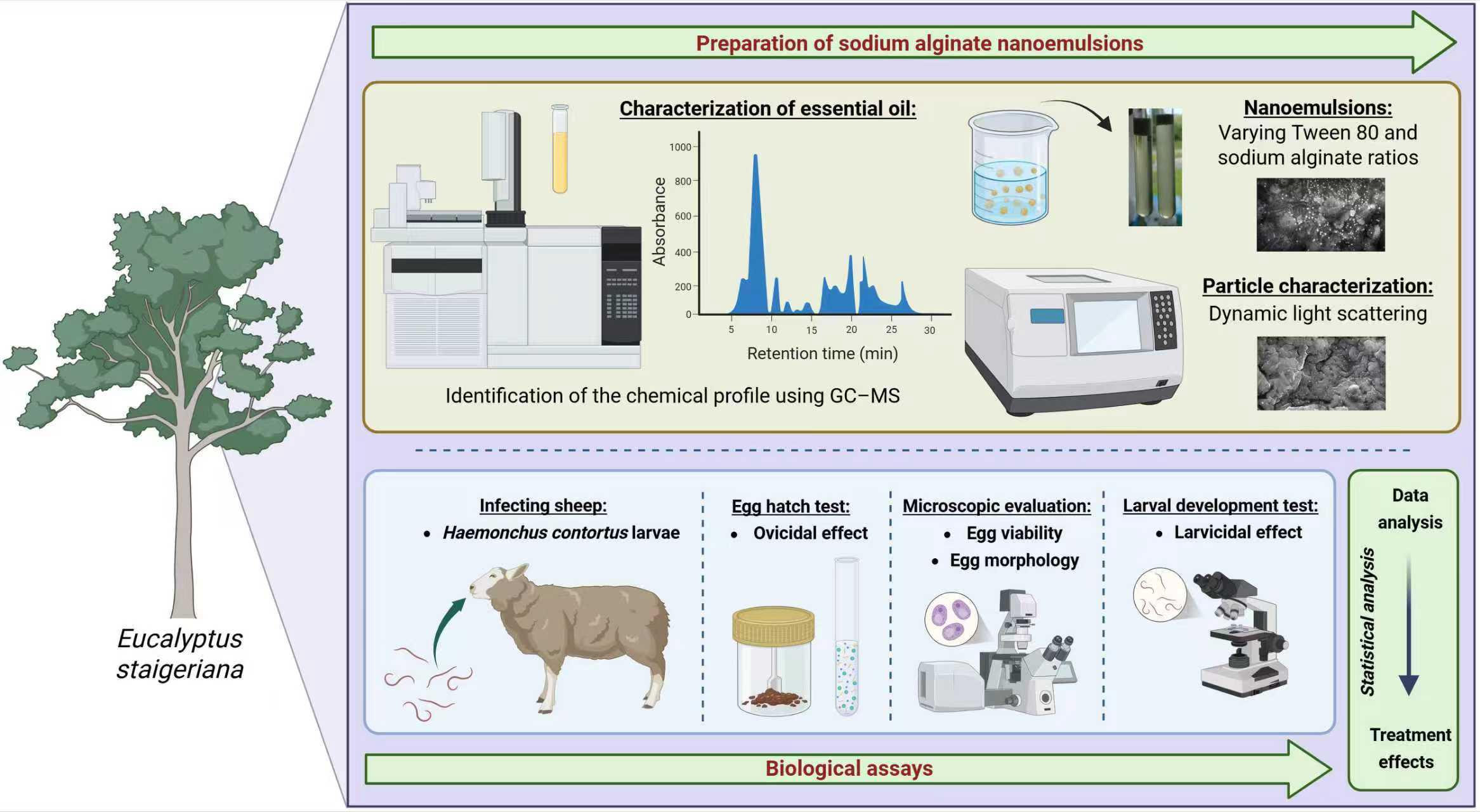
Eucalyptus staigeriana essential oil (EsEO) has well-known anthelmintic activity in small ruminants. However, its volatility limits its therapeutic action. The aim of this study was to develop a water-in-oil sodium alginate-based nanoemulsion with an effective in vitro effect on the eggs and larvae of Haemonchus contortus, a gastrointestinal parasite of sheep and goats. Four oil-in-water sodium alginate-based emulsions were prepared using a high-energy method with different proportions of Tween 80, EsEO, and sodium alginate (ALG) 4%. The physical-chemical characterization included stability, particle size, zeta potential and infrared spectra. The effects of the emulsions were evaluated against H. contortus via the egg hatching test (EHT) and larval development test (LDT). The results showed that the emulsions were stable over 7 days, nanometer scale particles (218.8 to 371.5 nm) predominating and with negative zeta potentials (−28.9 to −46.9 mV). All four emulsions were more effective than EsEO in the EHT, with 50% effective concentrations (EC50) of 0.088 to 0.15 mg/mL for the emulsions and 0.308 mg/mL for EsEO. However, in the LDT, the emulsions and essential oil had similar effects, with EC50 values of 3.91 to 4.60 mg/mL for the emulsions and 4.17 mg/mL for EsEO. Emulsion 2, with low Tween 80/EsEO and ALG/EsEO ratios, was considered better overall in terms of physical, chemical and anthelmintic assessment and is a promising candidate for further in vivo assays against adult H. contortus.Graphic Abstract
Keywords
Supplementary Material
Supplementary Material FileCite This Article
 Copyright © 2026 The Author(s). Published by Tech Science Press.
This work is licensed under a Creative Commons Attribution 4.0 International License , which permits unrestricted use, distribution, and reproduction in any medium, provided the original work is properly cited.
 Downloads
 Citation Tools
