Guest Editor(s)
Prof. Dr. Flavia Oliveira Monteiro da Silva Abreu
Email: flavia.monteiro@uece.br
Affiliation: Natural Polymers Laboratory , PPGCN , State University of Ceará , Fortaleza, 60.714.903 , Brazil
Homepage:
Research Interests: polyssacharides, nanoemulsions, biomaterials, nanoparticles

Prof. Dr. Bruno Peixoto de Oliveira
Email: bruno.peixoto@ufca.edu.br
Affiliation: Instituto de Formação de Educadores, Universidade Federal do Cariri, Brejo Santo, 63260-000, Brazil
Homepage:
Research Interests: biomaterials, materials chemistry

Prof. Dr. Brbara Elisabeth Teixeira-Costa
Email: betcosta@id.uff.br
Affiliation: Department of Nutrition and Dietetics, Federal Fluminense University (UFF), Niteri,24220-900, Brizal
Homepage:
Research Interests: food science, food hydrocolloids, natural polymers, encapsulation, polysaccharides, nanoemulsions, biomaterials, nanoparticles, biotechnology

Summary
Nanoemulsions, with their nanometer-scale droplets, have gained significant attention across fields like medicine, food, cosmetics, and agriculture due to their unique properties. In drug delivery, they offer advantages such as efficient encapsulation, controlled release, and biocompatibility, addressing challenges like low solubility and multidrug resistance. This special issue aims to highlight advancements, challenges, and future perspectives in biobased nanoemulsions, fostering interdisciplinary collaboration and innovation.
This special issue focuses on the development, characterization, and application of biobased nanoemulsions in drug delivery systems. It aims to explore innovative approaches to enhance the stability, bioavailability, and efficacy of nanoemulsions while emphasizing sustainable and environmentally friendly practices.
The objective is to provide a comprehensive platform for researchers to share advancements in biobased nanoemulsions, fostering interdisciplinary collaboration and driving innovation in drug delivery technologies.
In this special issue, the following proposed topics are of interest but are not limited to:
·Formulation and Characterization of Biobased Nanoemulsions
·Biobased Nanoemulsions in Drug Delivery Systems
·Sustainability in Nanoemulsion Technology
·Nanoemulsions for Antimicrobial Applications
·Advances in Natural Emulsifiers for Nanoemulsions
·Biobased Nanoemulsions in Agriculture
·Challenges in Scaling Up Nanoemulsion Production
·Nanoemulsions for Food and Nutraceutical Applications
·Future Trends in Biobased Nanoemulsion Research
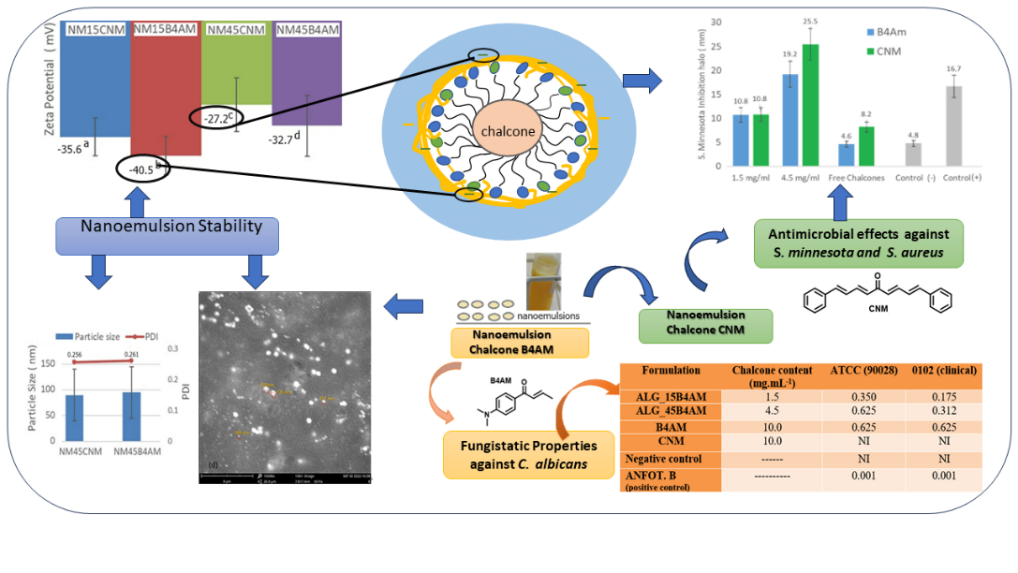
Graphic Abstract
Keywords
Biobased nanoemulsions; Antimicrobial applications; Natural emulsifiers; Agricultural nanotechnology; Food-grade nanoemulsions; Encapsulation techniques; Future trends in nanotechnology
Published Papers

 Login
Login Register
 Submit a Paper
 Propose a Special lssue