Home / Journals / FHMT / Online First / doi:10.32604/fhmt.2025.073409
Special Issues

Open Access

ARTICLE

Cavitation Effects and Flow Field Analysis of a Jet Impingement-Negative Pressure Ammonia Removal Reactor

Dong Hu1,2, Lingxing Hu3, Facheng Qiu3,*
1 College of Mechanical Engineering, Sichuan Vocational College of Chemical Technology, Luzhou, 646300, China
2 The Key Laboratory of Manufacturing and Application of Intelligent Well Control for Oil and Gas Production and Transportation of Luzhou, Sichuan Vocational College of Chemical Technology, Luzhou, 646300, China
3 College of Chemistry and Chemical Engineering, Chongqing University of Technology, Chongqing, 400054, China
* Corresponding Author: Facheng Qiu. Email: email
(This article belongs to the Special Issue: Enhancement Technologies for Fluid Heat and Mass Transfer)

Frontiers in Heat and Mass Transfer https://doi.org/10.32604/fhmt.2025.073409

Received 17 September 2025; Accepted 10 November 2025; Published online 22 December 2025
Abstract

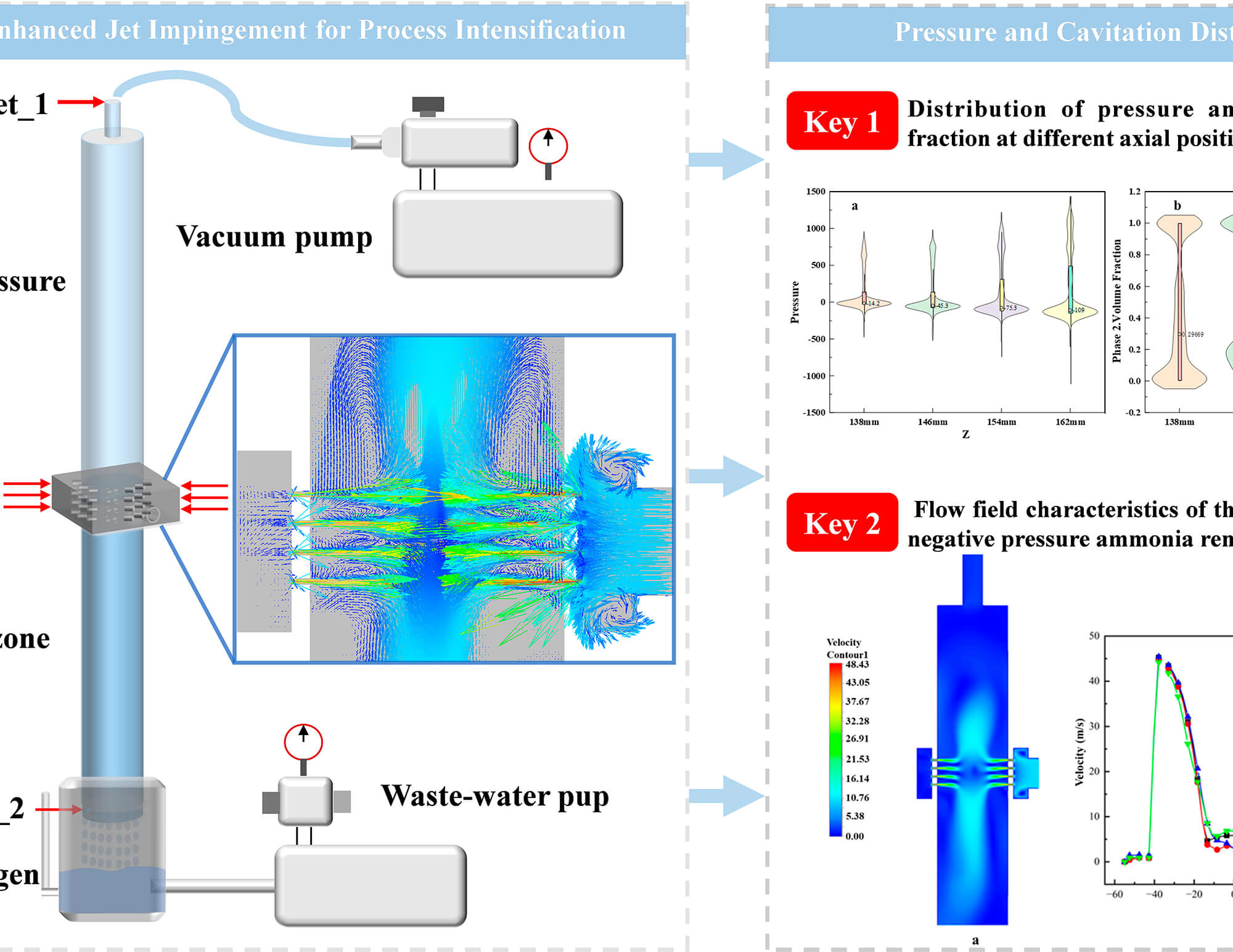
With the acceleration of industrialization and urbanization, ammonia nitrogen pollution in water bodies has become increasingly severe, making the development of efficient and low-consumption wastewater treatment technologies highly significant. This study employs three-dimensional computational fluid dynamics (CFD) to investigate the cavitation mechanisms and flow field characteristics in a novel jet impingement-negative pressure ammonia removal reactor. The simulation, validated by experimental pressure data with a high degree of consistency, utilizes the Mixture model, the Realizable k-ε turbulence model, and the Schnerr-Sauer cavitation model. The results demonstrate that the flow velocity undergoes a substantial acceleration within the orifice nozzle, triggering a dramatic pressure drop from an inlet value of approximately 1.17 MPa to below the saturated vapor pressure, reaching as low as −109 kPa, which induces intense cavitation. Cavitation bubbles primarily originate on the inner wall of the nozzle, with the vapor volume fraction peaking at about 0.42 within the orifice. A strong positive correlation was observed between the local vapor fraction and the flow velocity, indicating that cavitation enhances jet intensity. Furthermore, vortex structures near the wall and within the jacket sustain low-pressure zones, facilitating continuous cavitation and efficient mixing. This study quantitatively elucidates the cavitation dynamics and its interplay with the flow field, providing a solid theoretical and numerical basis for optimizing the reactor design to enhance ammonia removal efficiency.

Graphical Abstract

Cavitation Effects and Flow Field Analysis of a Jet Impingement-Negative Pressure Ammonia Removal Reactor

Keywords

Jet impingement; negative-pressure ammonia removal; numerical simulation; cavitation effects; gas phase volume distribution; flow field analysis
  • 22

    View

  • 4

    Download

  • 0

    Like

Share Link