Home / Journals / SDHM / Online First / doi:10.32604/sdhm.2026.067525
Special Issues
Table of Content

Open Access

ARTICLE

Mechanisms of Concrete Durability against Seawater (Case Study: Concrete as Dock)

Niken Chatarina*, Suyadi Suyadi, Noorhidana Vera Agustriana, Chairani Zilia, Mariyanto Mariyanto
Civil Engineering Department, University of Lampung, Bandar Lampung, 35145, Indonesia
* Corresponding Author: Niken Chatarina. Email: email
(This article belongs to the Special Issue: Sustainable and Durable Construction Materials)

Structural Durability & Health Monitoring https://doi.org/10.32604/sdhm.2026.067525

Received 06 May 2025; Accepted 22 August 2025; Published online 02 February 2026
Abstract

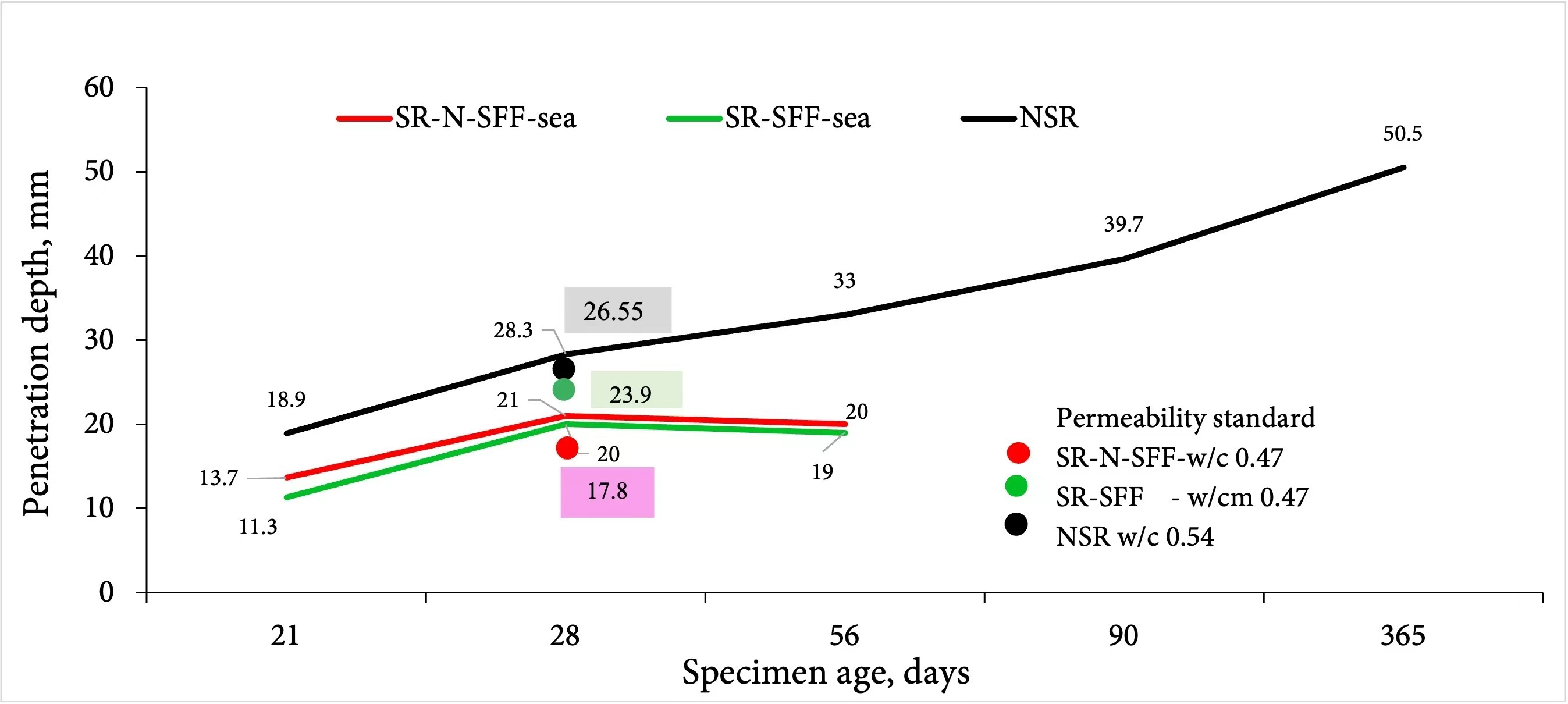
In strong aggressive areas, Indonesian standards specify a maximum penetration of 30 mm. Concrete utilizes sulfate-resistant Portland Pozzolan Cement (PPC) for a target strength of 30 MPa, with and without silica fume and plastic fiber (SR-SFF-sea and SR-N-SFF). Some samples of SR-N-SFF are immersed in the sea (SR-N-SFF-sea), while others are protected (SR-N-SFF-protected). Additionally, concrete using non-sulfate-resistant cement (NSR-sea) with a strength of 20.75 MPa was also evaluated. All samples were subjected to penetration depth testing according to the DIN EN 12390-8 standard, demonstrating that they met the penetration requirements for intense aggression. The study employed cylindrical samples measuring 15 cm in diameter and 30 cm in height to assess compressive strength and natural penetration from the split tensile test. Samples were placed into the sea at the fishing boat dock in Lampung, Indonesia, at 9 days of age following 7 days of immersion curing. The results indicated that sulfate-resistant Portland Composite Cement (PCC) is unsuitable for protected areas, as its strength is inferior to that of concrete submerged in seawater. Concrete featuring sulfate-resistant PCC, silica fume, and plastic fiber (SR-SFF-sea) exhibited lower strength compared to SR-N-SFF-protected samples. Conversely, SR-N-SFF-sea achieved the highest strength of 46 MPa at 56 days, with a notable increase in strength occurring from 21 to 56 days, while no increase in penetration depth was observed during this period. The standard penetration depth of SR-N-SFF-sea is 17.8 mm, which can serve as a guideline for creating durable concrete in marine environments.

Graphical Abstract

Mechanisms of Concrete Durability against Seawater (Case Study: Concrete as Dock)

Keywords

Concrete; penetration; PET fiber; PPC; sea; silica fume; sulfate resistant cement
  • 102

    View

  • 19

    Download

  • 0

    Like

Share Link