Home / Journals / IJMHP / Vol.27, No.6, 2025
Special Issues
cover

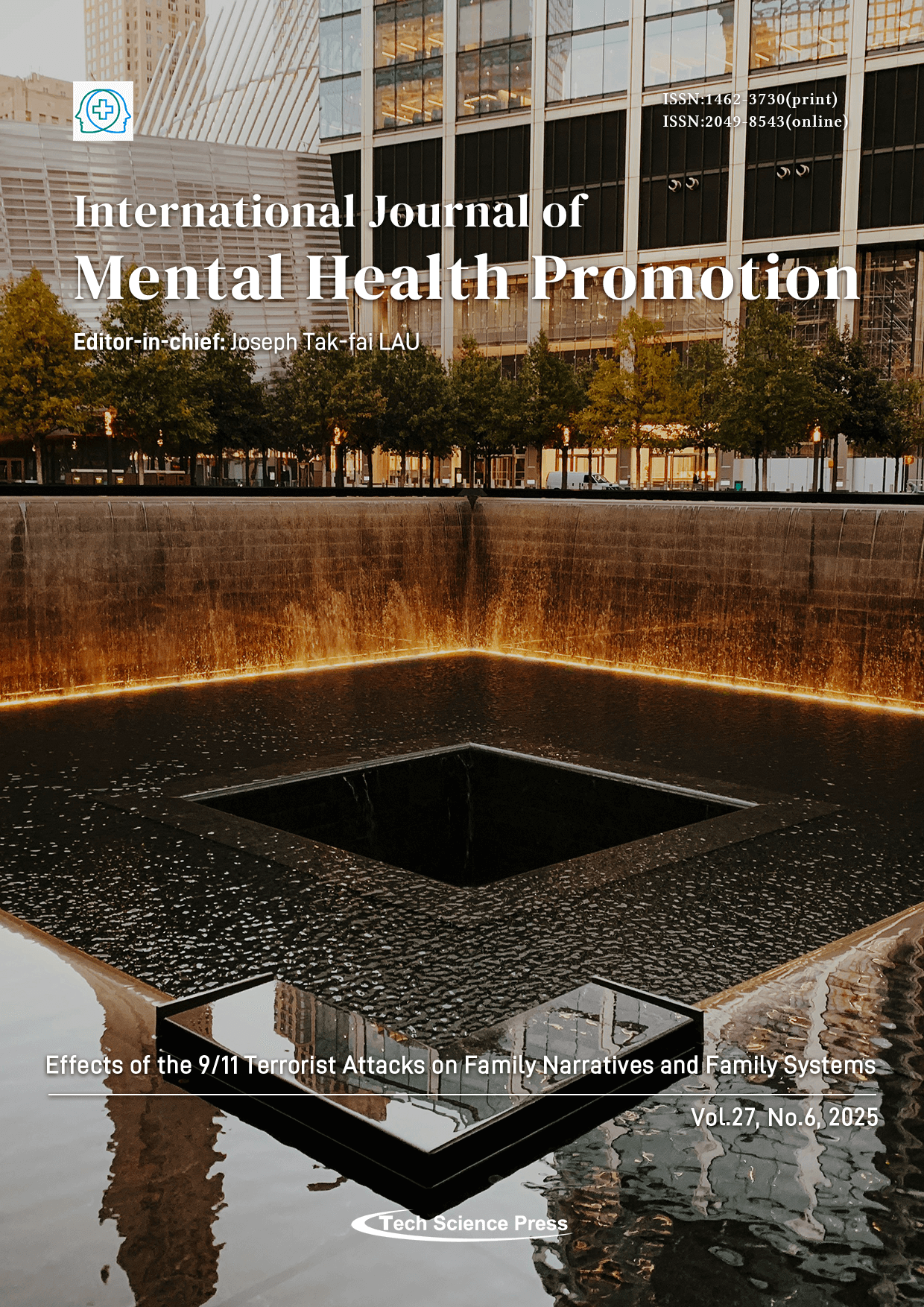
On the Cover

While disaster mental health outcomes are influenced by family systems, existing research typically focuses on individuals or dyads, lacking exploration of whole-family dynamics and community interactions over time. This mixed-methods study addressed this gap by examining 25 families (60 members) of employees affected by the 9/11 World Trade Center attacks. Quantitative data from structured diagnostic interviews revealed that although employees experienced high trauma exposure (with about one-fourth developing PTSD), this did not consistently translate directly to psychopathology in their spouses or children. Qualitative analysis of detailed personal narratives from four illustrative families identified distinct family coping patterns or archetypes. Findings suggest that family systems dynamics significantly shape how members support each other and cope with disaster, interacting complexly with outside community influences. This understanding can inform targeted psychosocial support strategies in disaster response based on specific family patterns.

View this paper

  • Open AccessOpen Access

    ARTICLE

    Effects of the 9/11 Terrorist Attacks on Family Narratives and Family Systems

    Cesar E. Montelongo Hernandez1,*, Carol S. North1, E. Whitney Pollio2, David E. Pollio3
    International Journal of Mental Health Promotion, Vol.27, No.6, pp. 737-752, 2025, DOI:10.32604/ijmhp.2025.065317 - 30 June 2025
    (This article belongs to the Special Issue: Safeguarding the Mental Health of Disaster Survivors and Frontline Healthcare Workers During Pandemics)
    Abstract Background: Disaster mental health outcomes of individuals may be affected by the families they inhabit, with effects rippling through the entire family system. Existing research on the experience of children in disasters has typically been limited to examining single individuals or, at most, family dyads. Research is needed to explore interactions within families as a whole, including interactions among multiple family members, as well as with community entities in a broad systems approach with dynamic analysis of family systems over time. The purpose of this study was to combine quantitative and qualitative data using structured… More >

  • Open AccessOpen Access

    REVIEW

    The Association between Mindfulness and Learning Burnout among University Students: A Systematic Review and Meta-Analysis

    Zhimei Cai1,2,*, Faridah Mydin Kutty1,*, Muhammad Syawal Amran1
    International Journal of Mental Health Promotion, Vol.27, No.6, pp. 753-769, 2025, DOI:10.32604/ijmhp.2025.064983 - 30 June 2025
    (This article belongs to the Special Issue: Mental Health and Subjective Well-being of Students: New Perspectives in Theory and Practice)
    Abstract Background: considering the significant issue of learning burnout among university students, it is essential to investigate the connection between mindfulness and learning burnout. This systematic review and meta-analysis sought to thoroughly examine the direct and indirect relationships between mindfulness and learning burnout. Methods: a comprehensive literature search was conducted in Scopus, Google Scholar, and Web of Science databases until 07 July 2024. A comprehensive literature review analysis of 19 articles was included, which identified three dimensions of learning burnout: emotions, behaviors, and outcomes, determined the indirect and direct relationships between mindfulness and learning burnout, and… More >

  • Open AccessOpen Access

    ARTICLE

    Is Meeting 24-Hour Movement Guidelines Associated with Emotion Regulation among Children and Adolescents?

    Shanshan Xu1, Liang Hu1,2,*
    International Journal of Mental Health Promotion, Vol.27, No.6, pp. 771-785, 2025, DOI:10.32604/ijmhp.2025.064984 - 30 June 2025
    (This article belongs to the Special Issue: Healthy Lifestyle Behaviours and Mental Health in Children and Adolescents)
    Abstract Background: The Canadian 24-h movement guidelines (24-HMG) emphasize the holistic consideration of physical activity (PA), sedentary behavior, and sleep in shaping health outcomes. This study aimed to examine the associations between meeting 24-HMG and emotion regulation-related indicators among children and adolescents. Methods: A total of 534 Chinese children and adolescents aged 12.94 ± 1.10 years (49.81% males) participated in this study and completed self-report measures assessing 24-h movement behaviors, emotion regulation strategies, emotion regulation flexibility, and regulatory emotional self-efficacy. Results: Only 7.12% of the participants adhered to two or all three guidelines. The number of guidelines More >

  • Open AccessOpen Access

    ARTICLE

    The Relationship between Adverse Childhood Experiences and Health Risk Behaviors of Adolescents: The Mediating Role of Executive Function Deficits

    Riza Hayati Ifroh, Xiaosong Gai*
    International Journal of Mental Health Promotion, Vol.27, No.6, pp. 787-807, 2025, DOI:10.32604/ijmhp.2025.065065 - 30 June 2025
    (This article belongs to the Special Issue: Healthy Lifestyle Behaviours and Mental Health in Children and Adolescents)
    Abstract Background: Adverse childhood experiences (ACEs) are a significant issue in adolescent health due to their robust correlation with deficits in executive functions (EF) and health risk behaviors (HRBs). This study aimed to examine the association between ACEs and a range of HRBs, including substance use, sexual risk behavior, suicidal ideation, physical inactivity, and violence. Methods: This cross-sectional study used self-administered questionnaire and cluster sampling in seven junior high schools in Samarinda, Indonesia, with a sample size of 534 students. Data analysis using descriptive statistics, the Chi-square test, the independent t-test, ANOVA, binary logistic regression, and mediation… More >

  • Open AccessOpen Access

    ARTICLE

    The Developmental Trajectory of Family Functioning in Junior High School Students: Effects on Preference for Solitude and Social Avoidance

    Liuyan Ren1,2,#, Ruining Wang3,#, Hohjin Im4, Baojuan Ye1,*, Qi Dai1
    International Journal of Mental Health Promotion, Vol.27, No.6, pp. 809-822, 2025, DOI:10.32604/ijmhp.2025.065246 - 30 June 2025
    (This article belongs to the Special Issue: Latent Profile Analysis in Mental Health Research: Exploring Heterogeneity through Person Centric Approach)
    Abstract Objectives: Positive family functioning (FF) is critical for adolescent development, yet only a few studies have examined this developmental trajectory pathway. This study aimed to identify different types of FF development trajectories during junior high school students, investigate their influence on social avoidance (SA), and further examine the mediating role of preference for solitude (PS) between them. Methods: A three-wave longitudinal study was used with six-month intervals. Questionnaire data were collected from 436 junior high school students in Jiangxi Province, China. Participants ranged in age from 11 to 14 years old (Mean = 12.89 years,… More >

  • Open AccessOpen Access

    ARTICLE

    Rumination and Coping as Pathways from Stress to Emotional Exhaustion among Hospital Pharmacists

    Shazia Rehman1,2, Erum Rehman3,*, Mehmood Ahmad4
    International Journal of Mental Health Promotion, Vol.27, No.6, pp. 823-843, 2025, DOI:10.32604/ijmhp.2025.063582 - 30 June 2025
    (This article belongs to the Special Issue: Interdisciplinary Perspectives on Social and Behavioral Determinants of Mental Health: From Theory to Practice)
    Abstract Objectives: Emotional exhaustion among healthcare professionals, particularly pharmacists, significantly impacts their well-being and efficacy in patient care. Understanding the psychological mechanisms contributing to emotional exhaustion is essential for developing effective interventions. The present research sought to investigate the potential mediating roles of rumination and coping strategies (adaptive and maladaptive) in the relationship between perceived stress and emotional exhaustion among pharmacists. Methods: A cross-sectional survey was carried out between September 2023 and January 2024 involving 576 pharmacists working in public hospitals in Punjab who met the inclusion criteria and actively participated in the study. We employed… More >

  • Open AccessOpen Access

    ARTICLE

    Effects of Internet-Based Acceptance and Commitment Therapy on College Students’ Mental Health: A Randomized Controlled Trial

    Jing Wang1, Shuanghu Fang1,*, Zihua Li2, Shaoyong Ma3
    International Journal of Mental Health Promotion, Vol.27, No.6, pp. 845-861, 2025, DOI:10.32604/ijmhp.2025.061476 - 30 June 2025
    Abstract Objectives: College students face increasing mental health challenges. Although Acceptance and Commitment Therapy (ACT) is effective, the efficacy of Internet-based ACT (iACT) needs further exploration. Methods: This study examines the efficacy of iACT on college students’ mental health through a randomized controlled trial. We recruited 90 college students (19.16 ± 1.02 years old) and randomly divided them into the iACT group, face-to-face ACT group, and control group. The effects of the interventions were evaluated using the comprehensive assessment of ACT processes (CompACT) and the Depression Anxiety Stress Scales (DASS-21). Results: Two-factor repeated measures ANOVA revealed a… More >

  • Open AccessOpen Access

    ARTICLE

    Possible Classifications of Social Network Addiction: A Latent Profile Analysis of Chinese College Students

    Lin Luo1,2,*, Junfeng Yuan1, Yanling Wang1, Rui Zhu1, Huilin Xu1, Siyuan Bi1, Zhongge Zhang1
    International Journal of Mental Health Promotion, Vol.27, No.6, pp. 863-876, 2025, DOI:10.32604/ijmhp.2025.064385 - 30 June 2025
    (This article belongs to the Special Issue: Latent Profile Analysis in Mental Health Research: Exploring Heterogeneity through Person Centric Approach)
    Abstract Objectives: Social Network Addiction (SNA) is becoming increasingly prevalent among college students; however, there remains a lack of consensus regarding the measurement tools and their optimal cutoff score. This study aims to validate the 21-item Social Network Addiction Scale-Chinese (SNAS-C) in its Chinese version and to determine its optimal cutoff score for identifying potential SNA cases within the college student population. Methods: A cross-sectional survey was conducted, recruiting 3387 college students. Latent profile analysis (LPA) and receiver operating characteristic (ROC) curve analysis were employed to establish the optimal cutoff score for the validated 21-item SNAS-C. Results:More >

Per Page:

Share Link
