Cellulose-Chitosan Based Bioplastics: Sustainable Production Approaches, Advanced Applications and Emerging Prospects
Gaziza Zhussipnazarova1, Reshmy Rajasekharan2, Sachin Kalumkumvathukkal Sajeev3, Jijo Thomas Koshy3, Dhanaraj Sangeetha3, Rekha Unni4, Raveendran Sindhu5, Akmaral Darmenbayeva1, Mohammed Kuddus6,7,*
1 Department of Chemistry and Chemical Technology, M.Kh. Dulaty Taraz University, Taraz, Kazakhstan
2 Department of Science and Humanities, Providence College of Engineering, Chengannur, Kerala, India
3 Department of Chemistry, School of Advanced Sciences, Vellore Institute of Technology, Vellore, Tamil Nadu, India
4 Department of Chemistry, Research Centre of University of Kerala, Christian College, Chengannur, Kerala, India
5 Santhigiri Scientific and Industrial Research Institute (SSIRI), Trivandrum, Kerala, India
6 Department of Biochemistry, College of Medicine, University of Hail, Hail, Saudi Arabia
7 Department of Bioengineering, Integral University, Lucknow, India
* Corresponding Author: Mohammed Kuddus. Email: 
(This article belongs to the Special Issue: Cellulose and Nanocellulose in Polymer Composites: Sustainable Engineering Approach)
Journal of Polymer Materials https://doi.org/10.32604/jpm.2026.075396
Received 30 October 2025; Accepted 27 April 2026; Published online 29 May 2026
Abstract
It takes centuries for chemically reinforced, short-term designed plastics to decompose naturally. Despite this, there has been a significant surge in plastics production recently, accounting for a considerable part of the total historical output. Forecasts indicate that plastics production could reach unprecedented levels if this trend continues. However, increasing environmental concerns and stricter waste regulations have intensified research into biodegradable alternatives. As a result, there is a growing shift toward sustainable polymeric systems capable of replacing conventional petroleum-based plastics. One such class of promising and renewable materials is cellulose-chitosan bioplastic. This review provides an in-depth justification for the incorporation of cellulose and chitosan into bioplastic matrices, emphasizing their biodegradability, biocompatibility, mechanical performance, and non-toxicity. In addition, specific surface modification strategies are highlighted, including plasma activation, chemical grafting, and nanoparticle-assisted functional coating, which significantly enhance interfacial compatibility and biological activity. The review also summarizes advanced production methodologies, such as solution casting, plasticizer-assisted blending, and controlled cross-linking, to demonstrate improvements in processing cellulose-chitosan bioplastics. Furthermore, emerging biomedical applications are discussed, in which cellulose-chitosan composites show substantial potential due to their antibacterial activity, bioresorbable, and wound-healing properties. These applications encompass vascular graft materials, hernia meshes, dural repair membranes, wound dressings, drug-delivery platforms, and scaffolds for tissue engineering. Overall, this review aims to outline “Cellulose-chitosan bioplastics: approaches to sustainable production”, while demonstrating how these multifunctional bio composites can reduce environmental burdens. The findings are expected to guide future research toward scalable fabrication, targeted surface engineering, and the development of next-generation biomedical materials.
Graphical Abstract
Keywords
Biocomposite; biomedical; biopolymer; cellulose; chitosan
 Open Access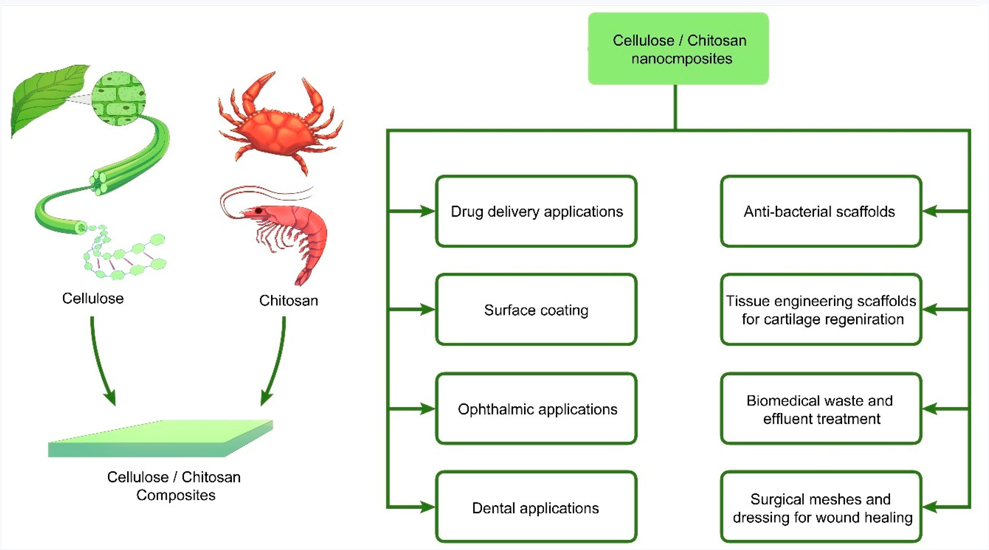

 Login
Login Register
 Submit a Paper
 Propose a Special lssue
 Download PDF
 Downloads
 Citation Tools
