
 Login
Login Register
 Submit a Paper
 Propose a Special lssue
 Open Access
ARTICLE
Effect of Temperature on the Performance of Proton Exchange Membrane Fuel Cell at Atomic Scales
1 Central Department of Physics, Tribhuvan University, Kirtipur, Nepal
2 Department of Physics, Patan Multiple Campus, Tribhuvan University, Lalitpur, Nepal
3 Department of Mechanical and Advance Engineering, Institute of Engineering, Pulchowk Campus, Tribhuvan University, Lalitpur, Nepal
* Corresponding Authors: Saddam Husain Dhobi. Email: ; Suresh Prasad Gupta. Email:
(This article belongs to the Special Issue: Green Energy Engineering: Optimizing Systems for Net Zero Emissions)
Energy Engineering 2026, 123(5), 6 https://doi.org/10.32604/ee.2026.076691
Received 25 November 2025; Accepted 19 January 2026; Issue published 27 April 2026
 View Full Text
 Download PDF
Abstract
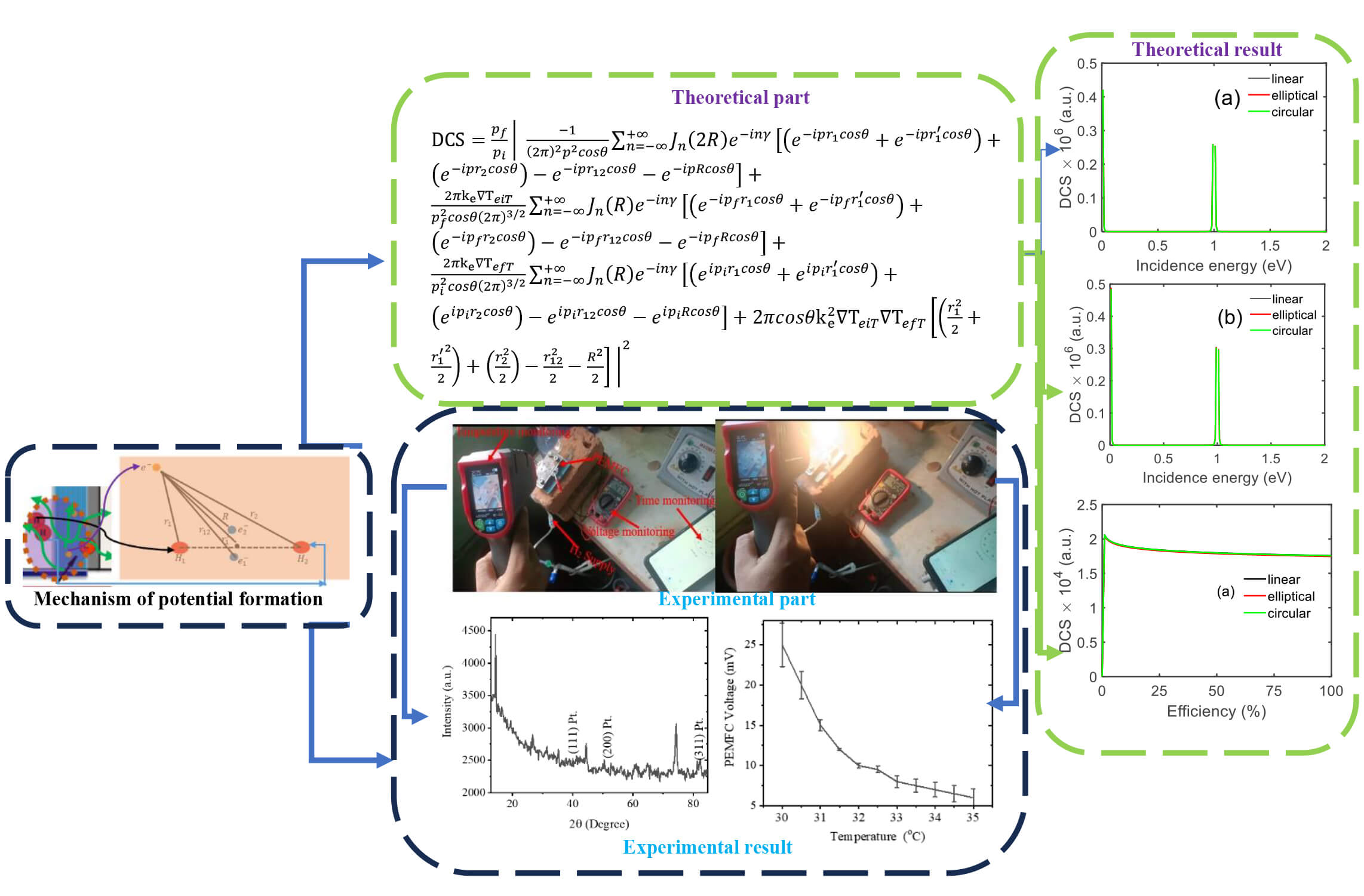
Increasing requirements on clean, efficient, and sustainable energy technologies have raised interest in hydrogen fuel cells, particularly proton exchange membrane fuel cells (PEMFCs), which are operationally characterized by high efficiency with zero emissions. The objective of this work is to study the scattering behaviors of particles participating in scattering under various conditions (energy, efficiency, temperature, cell voltage) at/around the electrode of PEMFC theoretically. For this, we developed a model using a scattering matrix, the Kroll-Watson approximation, the thermal wave function of an electron in a laser field, interaction potential, and Bessel functions to study the interaction dynamics of electrons using the differential cross-section (DCS) technique. As we are interested in studying the effect of temperature and voltage on DCS and its verification experiment. For the experiment, Pt-coated stainless-steel electrodes were prepared by electrodeposition in 1 mg Aqua Regia Pt solution at 45°C. From the solution, platinum was deposited on a 1 cm2 area of stainless steel (as an electrode) using 0.02 A current for 20 s, which is approximately 0.20 mg/cm2 with an estimated film thickness of 93 nm. X-ray diffraction was used to verify that platinum was actually deposited. A PEMFC prototype was fabricated, and hydrogen gas was fed to the prototype at 1.5 mL/min. The external heating was supplied using a 40 W filament lamp applied under a controlled environment (Audino UNO and Digital Thermostat Temperature Control). At ambient temperature, the cell voltage increased from 6 to 25 mV, but as the temperature was raised, the voltage decreased monotonically. Also, under various conditions, the DCS is effective. Results suggest that ambient temperature affects the performance of PEMFC due to an increase in disturbance of particles participating in scattering around the anode of PEMFC. This demonstrates the necessity for accurate thermal management approach to save fuel cell efficiency. This work is helpful for developing the performance and further improving the efficiency of PEMFCs based on exploration in the nature of interaction between particles at atomic scales. By connecting theoretical scattering models with the experimentally validated results, the work offers in-depth understanding of how temperature and activation potential affect fuel cell response. This knowledge is important for the design of better electrodes and thermal management strategies, which in turn will lead to more reliable and efficient clean energy systems.Graphic Abstract
Keywords
Cite This Article
 Copyright © 2026 The Author(s). Published by Tech Science Press.
This work is licensed under a Creative Commons Attribution 4.0 International License , which permits unrestricted use, distribution, and reproduction in any medium, provided the original work is properly cited.
 Downloads
 Citation Tools
