
 Login
Login Register
 Submit a Paper
 Propose a Special lssue
 Open Access
ARTICLE

Active and Reactive Power Control of DFIG-Based Wind Farm Connected to IEEE 9-Bus System Network under Fault Condition
Department of Electrical Engineering, Central Institute of Technology Kokrajhar Deemed to be University, BTR, Kokrajhar, Assam, India
* Corresponding Author: Sanjit Brahma. Email:
Energy Engineering 2026, 123(4), 12 https://doi.org/10.32604/ee.2026.075245
Received 28 October 2025; Accepted 12 January 2026; Issue published 27 March 2026
 View Full Text
 Download PDF
Abstract
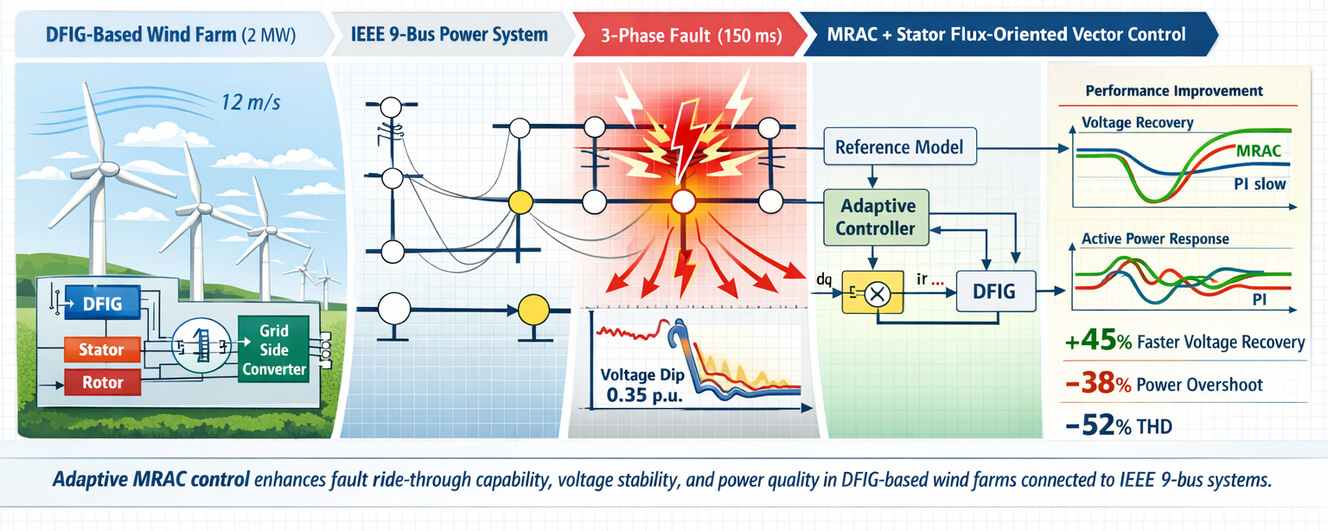
A wind-turbine power system is often challenged by voltage instability, reactive power imbalance, and limited fault ride-through capability under grid disturbances. Doubly Fed Induction Generator based wind farms, owing to their partial coupling with the grid, are particularly vulnerable to voltage dips and excessive reactive power absorption during fault events. This study proposes an adaptive control strategy based on Model Reference Adaptive Control integrated with stator flux-oriented vector control to regulate active and reactive power of a DFIG-based wind farm connected to a standard IEEE 9-bus power system under fault conditions. The proposed control scheme is developed and validated using detailed MATLAB/Simulink modeling under normal operation, symmetrical three-phase fault conditions, and post-fault recovery scenarios. A three-phase-to-ground fault is applied at the wind farm interconnection bus for a duration of 150 ms to evaluate transient performance. Simulation results demonstrate that the adaptive controller ensures fast power tracking, effective reactive power support, and enhanced voltage recovery compared to a conventional proportional–integral controller. Quantitatively, the proposed method improves voltage recovery time by approximately 45%, reduces active power overshoot by 38%, and lowers total harmonic distortion by 52% following fault clearance. Furthermore, the adaptive controller maintains stable operation under variations in wind speed and machine parameters without requiring retuning, highlighting its robustness against system uncertainties. The results confirm that the proposed control strategy significantly enhances fault ride-through capability, power quality, and dynamic stability of grid-interfaced wind farms. These findings demonstrate the practical applicability of adaptive control techniques for improving the reliability and resilience of modern power systems with high wind energy penetration.Graphic Abstract
Keywords
DFIG (doubly-fed induction generator); fault ride-through; MRAC; reactive power control; voltage stability; wind energy
Cite This Article
APA Style
Brahma, S., Das, R. (2026). Active and Reactive Power Control of DFIG-Based Wind Farm Connected to IEEE 9-Bus System Network under Fault Condition. Energy Engineering, 123(4), 12. https://doi.org/10.32604/ee.2026.075245
Vancouver Style
Brahma S, Das R. Active and Reactive Power Control of DFIG-Based Wind Farm Connected to IEEE 9-Bus System Network under Fault Condition. Energ Eng. 2026;123(4):12. https://doi.org/10.32604/ee.2026.075245
IEEE Style
S. Brahma and R. Das, “Active and Reactive Power Control of DFIG-Based Wind Farm Connected to IEEE 9-Bus System Network under Fault Condition,” Energ. Eng., vol. 123, no. 4, pp. 12, 2026. https://doi.org/10.32604/ee.2026.075245
 Copyright © 2026 The Author(s). Published by Tech Science Press.
This work is licensed under a Creative Commons Attribution 4.0 International License , which permits unrestricted use, distribution, and reproduction in any medium, provided the original work is properly cited.
 Downloads
 Citation Tools
