
Home / Journals / ENERGY / Online First / doi:10.32604/ee.2026.080799
Special Issues

Open Access

ARTICLE

Risk Assessment and Probabilistic Two-Stage Robust Optimization for Defense Resource Allocation in Intelligent Substations under Extreme Natural Disasters

Jin Li1,*, Xiaowen Liang1, Chunfang Liu2, Hongyao Wu1, Zilun Kuang1, Kunquan Liang2, Bo Jiang2
1 Zhaoqing Power Supply Bureau of Guangdong Power Grid Co., Ltd., Zhaoqing, China
2 Foshan Electric Power Design Institute Co., Ltd., Foshan, China
* Corresponding Author: Jin Li. Email: email
(This article belongs to the Special Issue: Digital and Intelligent Planning and Operation Technologies for Flexible Distribution Network)

Energy Engineering https://doi.org/10.32604/ee.2026.080799

Received 14 February 2026; Accepted 13 April 2026; Published online 19 May 2026
Abstract

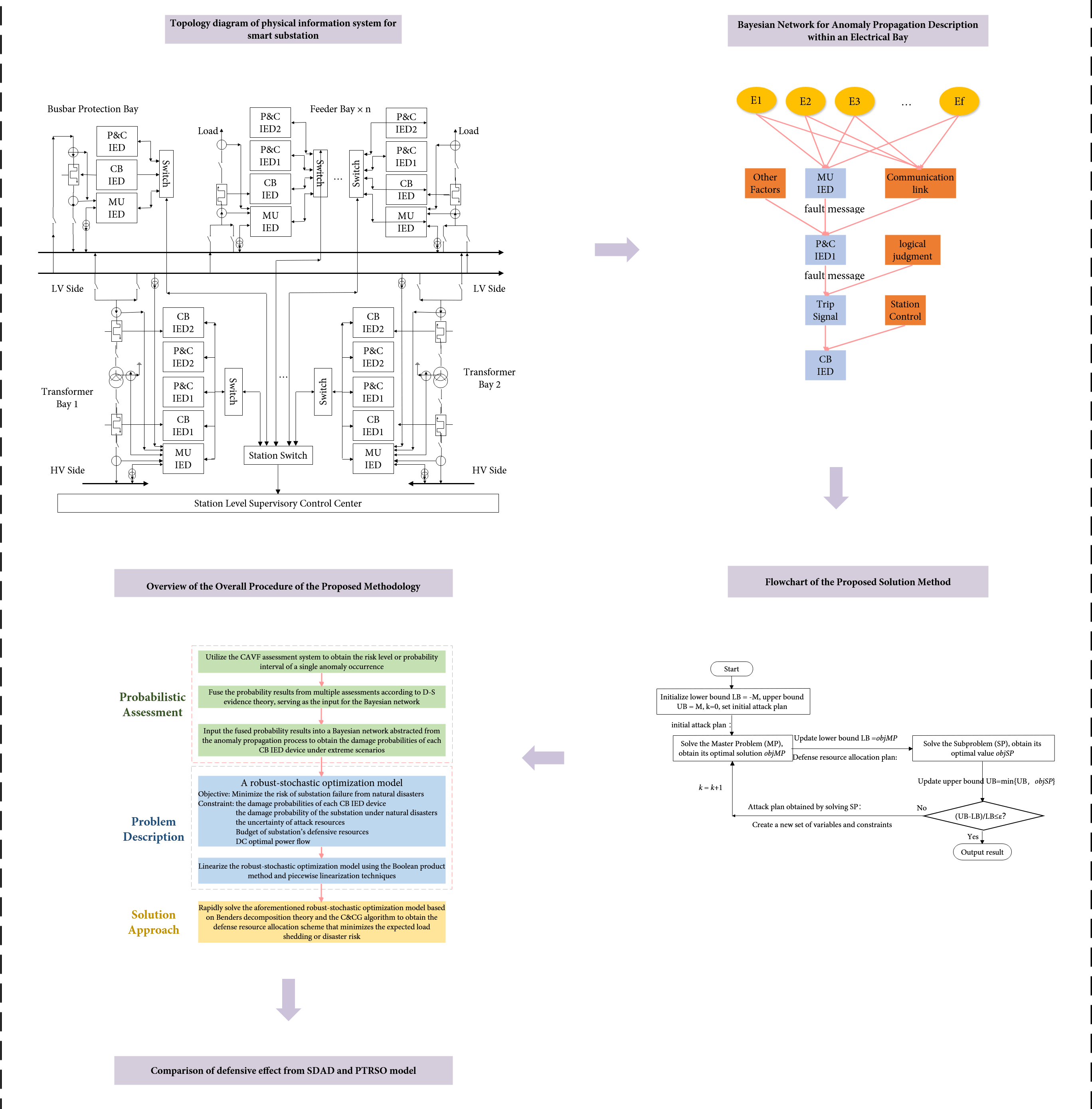
With the increasing need for resilience enhancement in modern power systems under extreme natural disasters, this paper proposes an integrated framework for risk assessment and pre-disaster defense resource allocation in intelligent substations. The framework first performs preliminary abnormality screening and probability elicitation, then fuses interval evidence through Dempster–Shafer (D–S) theory, subsequently propagates the resulting probabilistic information through a knowledge-driven Bayesian network (BN), and finally incorporates the inferred tripping risk of the intelligent electronic device for circuit breaker control (CB IED) into a probabilistic two-stage robust optimization (PTSRO) model for pre-disaster defense resource allocation. Within this framework, a knowledge-driven Bayesian network is developed to characterize the major anomaly propagation process from physical-side abnormalities to CB IED tripping events, thereby providing a more decision-relevant probabilistic risk description for substation protection. Furthermore, a probability-informed PTSRO is established to determine the optimal pre-disaster defense resource allocation under limited defense resources and adverse disruption conditions. To improve computational tractability, the proposed model is reformulated into a mixed-integer linear form and solved using a column-and-constraint generation (C&CG)-based procedure. Flooding is selected as the representative hazard scenario in the case studies. Results on the IEEE 24-bus and IEEE 118-bus systems show that the proposed framework can effectively reduce disaster-risk values and provide useful support for substation-oriented defense planning.

Graphical Abstract

Risk Assessment and Probabilistic Two-Stage Robust Optimization for Defense Resource Allocation in Intelligent Substations under Extreme Natural Disasters

Keywords

Power grid resilience; robust optimization; risk assessment; Bayesian network; circuit breaker; intelligent electronic device
  • 4

    View

  • 0

    Download

  • 0

    Like

Share Link



