
 Login
Login Register
 Submit a Paper
 Propose a Special lssue
 Open Access
ARTICLE
Assessment of Carbon Reduction Potential Driven by High Energy Consumption Enterprises’ Electricity Usage Behavior
1 Dongguan Power Supply Bureau of Guangdong Power Grid Co., Ltd., Dongguan, 523129, China
2 Foshan Graduate School of Innovation, Northeastern University, Foshan, 528312, China
* Corresponding Author: Xiaoshun Zhang. Email:
(This article belongs to the Special Issue: Low-Carbon Situational Awareness and Dispatch Decision of New-Type Power System Operation)
Energy Engineering 2026, 123(5), 2 https://doi.org/10.32604/ee.2025.072462
Received 27 August 2025; Accepted 22 October 2025; Issue published 27 April 2026
 View Full Text
 Download PDF
Abstract
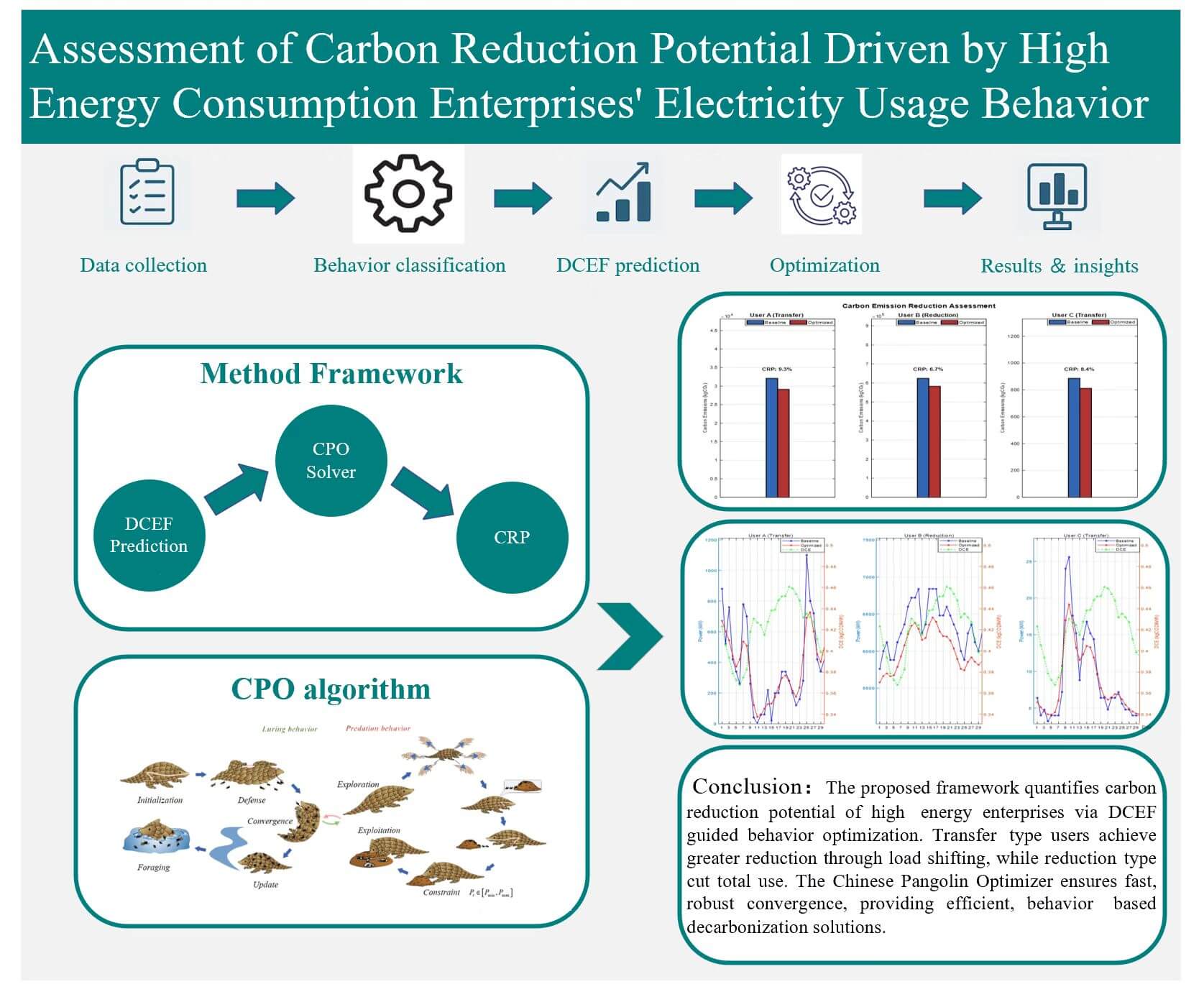
Addressing global climate challenges necessitates urgent low carbon transitions in high energy consuming enterprises (HECEs). This study proposes a comprehensive framework to assess their carbon reduction potential (CRP) by integrating electricity usage behavior analysis and dynamic carbon emission factor (DCEF) prediction. HECEs are classified into “electricity reduction” and “electricity transfer” categories based on load characteristics, enabling tailored optimization strategies. The framework employs machine learning to predict DCEFs, capturing real time variations in grid carbon intensity. A low carbon optimization model is then formulated to minimize emissions while adhering to production requirements and grid constraints, solved efficiently by a swarm intelligence algorithm (Chinese Pangolin Optimizer). Case studies demonstrate the framework’s effectiveness in quantifying emission reduction pathways and guiding differentiated strategies for HECEs. User A and User C, designated as “electricity transfer” types, achieved significant carbon reductions of 9.3% and 8.4% respectively through optimizing electricity usage timing. User B, categorized as “electricity reduction,” realized a notable 6.7% carbon reduction by cutting electricity consumption, exceeding its predefined target. This highlights substantial CRP achievable via DCEF guided behavioral optimization. The Chinese Pangolin Optimizer (CPO) algorithm exhibits superior convergence and computational efficiency compared to the Genetic Algorithm, ensuring robust and stable low carbon solutions. This systematic approach prioritizes behavioral and operational adjustments, fostering sustainable development aligned with global climate goals.Graphic Abstract
Keywords
Cite This Article
 Copyright © 2026 The Author(s). Published by Tech Science Press.
This work is licensed under a Creative Commons Attribution 4.0 International License , which permits unrestricted use, distribution, and reproduction in any medium, provided the original work is properly cited.
 Downloads
 Citation Tools
