Dynamic Thermal Comfort Investigation and Adaptive Control of Solar-Assisted Heating Systems in Expressway Service Buildings
Man Fan1, Shize Li1, Yingshan Liu1,2, Zhengping Shi1, Xiangfei Kong1,*, Wandong Zheng3,*, Han Li1, Jianjuan Yuan1
1 School of Energy and Environmental Engineering, Hebei University of Technology, Tianjin, China
2 Capital Engineering & Research Incorporation Limited, Beijing, China
3 School of Environmental Science and Engineering, Tianjin University, Tianjin, China
* Corresponding Author: Xiangfei Kong. Email:  ; Wandong Zheng. Email:
(This article belongs to the Special Issue: Smart Thermal Management: Emerging Energy Technologies for Built and Industrial Systems)
Energy Engineering https://doi.org/10.32604/ee.2026.078647
Received 05 January 2026; Accepted 09 March 2026; Published online 09 April 2026
Abstract
Highway service buildings, as critical transportation hubs, required efficient heating solutions to accommodate fluctuating occupant densities. Conventional thermal control systems struggled to accommodate dynamic occupant flux, often resulting in mismatches between thermal demand and supply. While existing research predominantly focused on static temperature regulation, this study bridged a critical gap by investigating the coupling effects of dynamic thermal comfort and energy efficiency. Firstly, field measurements and occupant surveys reveald substantial variations in thermal environment parameters across different functional zones within service buildings. Analysis of Thermal Sensation Vote (TSV) and Thermal Comfort Vote (TCV) distributions, augmented by Ridit statistical evaluation, demonstrated significant disparities in subjective thermal experiences across different zones. Through field-data-driven analysis of a service building in Tianjin, we established zone-specific thermal benchmarks: lobby + supermarket (RWI = 0.08), open-plan dining area (SET = 20.61°C), enclosed dining area (PET = 20.29°C) and toilets (RWI = 0.06). Subsequently, a solar-assisted heating system was developed with TRNSYS software, using real-time thermal index feedback for dynamic zonal control, and PID algorithm to regulate fan coil water flow rates. Comparative analysis revealed conventional static temperature control caused dual inefficiencies: enclosed zones (e.g., enclosed dining area and toilets) exhibited underheating (8.0%–14.0% comfort deviation) while dynamic zones (e.g., lobby, supermarket and open-plan dining area) incurred overheating (2.7%–8.0% excess energy). This study established an intelligent feedback framework for transitional space heating systems, successfully reconciling zonal occupant comfort with energy conservation, thereby advancing sustainable infrastructure practices for green service buildings.
Graphical Abstract
Keywords
Adaptive control strategy; dynamic thermal comfort; expressway service building; field investigation; solar-assisted heating system
 Open Access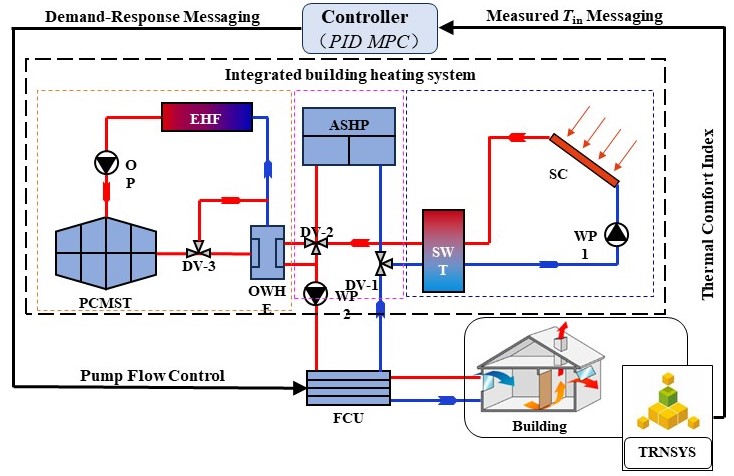

 Login
Login Register
 Submit a Paper
 Propose a Special lssue
 Download PDF
 Downloads
 Citation Tools
