Analyze the Impact of Weather on Rooftop Solar Power Generation by Applying Ensemble Learning: Lessons from Kurunegala, Sri Lanka
Jeevani Jayasinghe1,2, Chee-Onn Chow2, Lasini Wickramasinghe1, Upaka Rathnayake3,*
1 Department of Electronics, Faculty of Applied Sciences, Wayamba University of Sri Lanka, Kuliyapitiya, Sri Lanka
2 Department of Electrical Engineering, University of Malaya, Kuala Lumpur, Malaysia
3 Faculty of Engineering and Design, Atlantic Technological University, Sligo, Ireland
* Corresponding Author: Upaka Rathnayake. Email: 
(This article belongs to the Special Issue: Artificial Intelligence Applications in Renewable Energy Forecasting: Methods, Challenges, and Future Directions)
Energy Engineering https://doi.org/10.32604/ee.2026.085002
Received 03 May 2026; Accepted 09 June 2026; Published online 10 July 2026
Abstract
Rooftop solar photovoltaic (PV) systems operate under weather conditions that differ significantly from Standard Test Conditions (STC), particularly in tropical regions. This study examines the impact of climatic factors on rooftop PV power generation in the Kurunegala district of Sri Lanka using measured power output and meteorological data. Three grid-connected PV systems with a capacity of 5 kW were monitored over six months, with hourly power output and inverter temperature recorded during the daytime. Corresponding weather data, including solar irradiance, ambient temperature, relative humidity, and cloud cover, were used in this research to identify their impact on power generation. In addition, monthly power generation data over 30 months were analyzed to assess seasonal trends. The results confirm that solar irradiance is the primary driver of PV power generation, while ambient temperature, inverter temperature, and relative humidity have notable secondary effects. Several deep learning and conventional machine learning techniques were applied to develop power prediction models based on the corresponding weather conditions. In addition to individual training, the models were trained using ensemble techniques of bagging, boosting, stacking, and voting. A comparative assessment of the model performance shows that ensemble learning approaches outperform individual machine learning techniques for limited, high-quality datasets. The CatBoost model that was trained using the ensemble technique of boosting achieved the highest predictive accuracy, with the highest coefficient of determination (R
2 = 0.94) and the lowest Mean Squared Error (MSE = 0.09). The developed models effectively capture diurnal and short-term variations, demonstrating strong potential for reliable rooftop PV forecasting and grid integration in tropical climates.
Graphical Abstract
Keywords
Ensemble techniques; power generation; prediction; solar irradiance; solar photovoltaic systems
 Open Access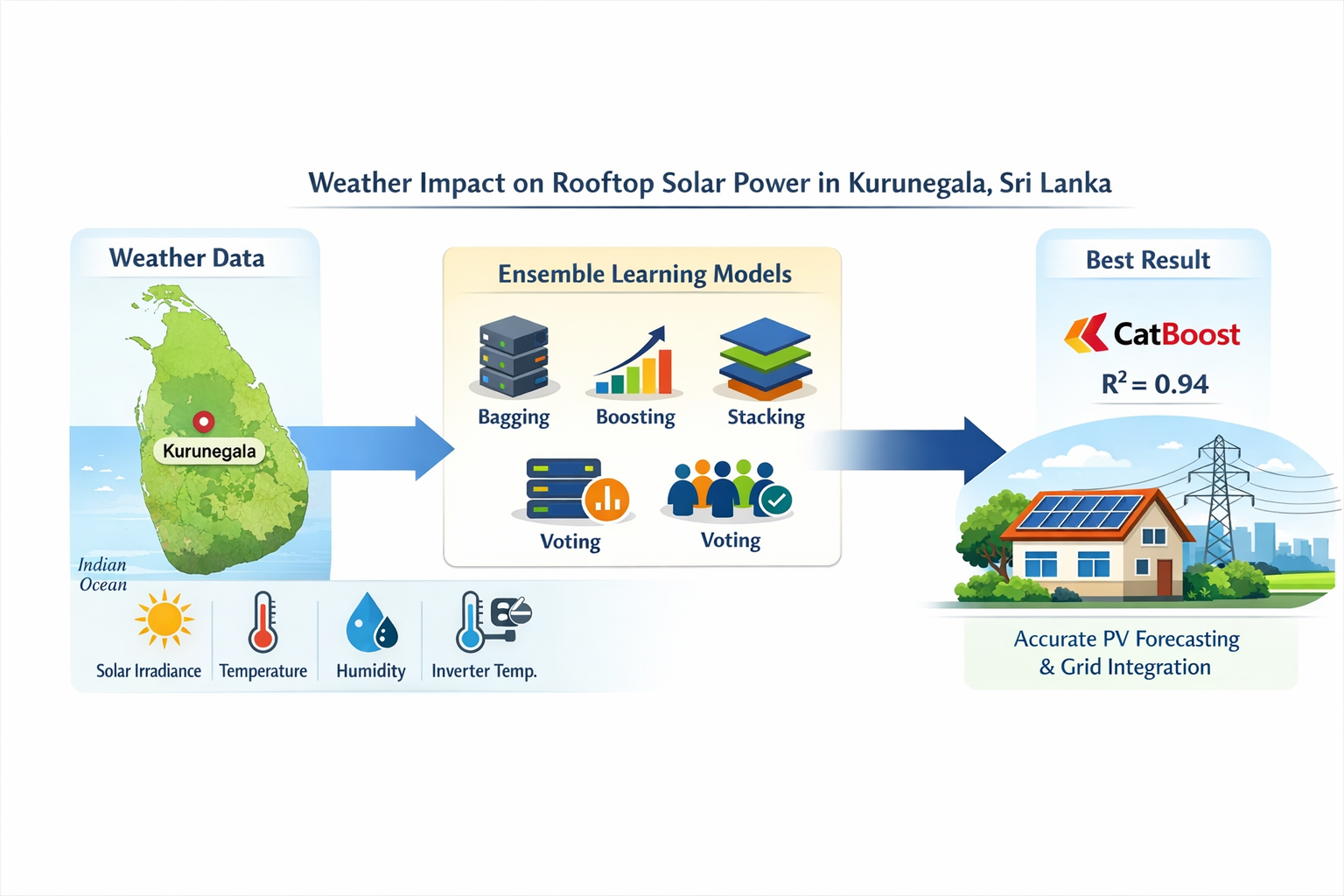

 Login
Login Register
 Submit a Paper
 Propose a Special lssue
 Download PDF
 Downloads
 Citation Tools
