Guest Editor(s)
Assoc. Prof. Dr. Wong Keng Yinn
Email: kengyinnwong@utm.my
Affiliation: Faculty of Mechanical Engineering, Universiti Teknologi Malaysia, Johor, Malaysia
Homepage:
Research Interests: intelligent HVAC and ventilation systems, computational fluid dynamics (CFD), indoor and outdoor air quality, smart environmental monitoring, and energy-efficient sustainable built environments

Dr. Tan Huiyi
Email: huiyitan@utm.my
Affiliation: Faculty of Chemical & Energy Engineering, Universiti Teknologi Malaysia, Johor, Malaysia
Homepage:
Research Interests: renewable and sustainable energy systems, energy efficiency, low-carbon technologies, and intelligent energy optimization for sustainable industrial applications

Prof. Dr. Maria Anityasari
Email: maria@ie.its.ac.id
Affiliation: Department of Industrial and Systems Engineering, Institut Teknologi Sepuluh Nopember, East Java, Indonesia
Homepage:
Research Interests: sustainable energy and low-carbon industrial systems, circular economy, waste-to-resource technologies, sustainable manufacturing, and energy–environment optimization for industrial decarbonization

Assoc. Prof. Dr. Lee Kee Quen
Email: lkquen@utm.my
Affiliation: Malaysia-japan International Institute Of Technology (MJIIT), Universiti Teknologi Malaysia, Kuala Lumpur, Malaysia
Homepage:
Research Interests: intelligent dynamics and vibration engineering, vortex-induced vibration, fluid–structure interaction, CFD and hydrodynamic analysis, vibration/noise control, structural health monitoring, and machine-learning-based condition monitoring

Summary
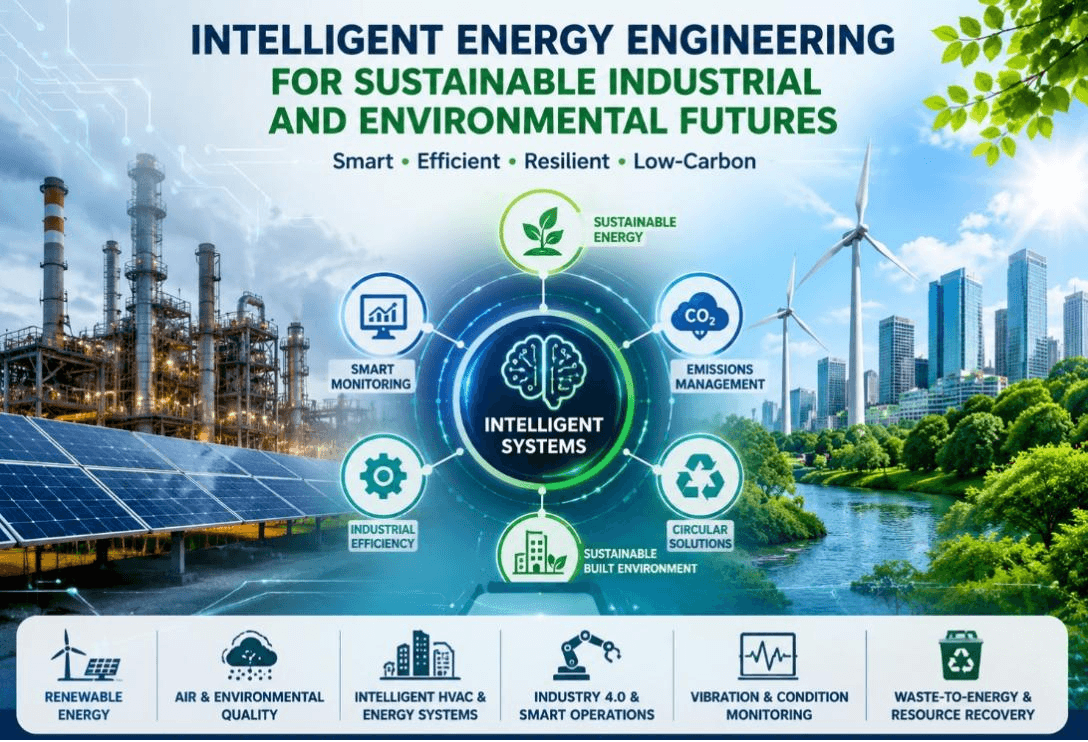
The rapid transition toward low-carbon and sustainable development requires intelligent energy engineering solutions that can simultaneously improve energy efficiency, industrial productivity, environmental quality, and system resilience. The integration of artificial intelligence, advanced modelling, smart sensing, digital technologies, renewable energy, and sustainable engineering is creating new opportunities to address increasingly complex energy and environmental challenges. In this context, intelligent energy systems can support real-time monitoring, predictive analysis, optimization, and autonomous decision-making across industrial and environmental applications.
This Special Issue, "Intelligent Energy Engineering for Sustainable Industrial and Environmental", aims to provide a multidisciplinary platform for researchers and practitioners to present innovative technologies, methodologies, and applications that integrate intelligent systems with sustainable energy and environmental engineering. Contributions addressing theoretical developments, experimental investigations, numerical modelling, artificial intelligence, and practical industrial applications are particularly encouraged.
Suggested themes include, but are not limited to:
· Intelligent and renewable energy systems
· AI and machine learning for energy optimization
· Energy-efficient HVAC and sustainable built environments
· Smart environmental monitoring and air-quality management
· CFD, digital twins, and intelligent modelling
· Industrial energy efficiency and decarbonization
· Sustainable manufacturing and Industry 4.0
· Vibration, condition monitoring, and intelligent mechanical systems
· Waste-to-energy and circular economy technologies
· Hydrogen, alternative fuels, and low-carbon energy technologies
· Integrated energy–environment systems and sustainable engineering
Graphic Abstract
Keywords
intelligent energy systems, artificial intelligence and machine learning, energy efficiency and optimization, renewable and low-carbon energy, sustainable industrial engineering, smart environmental monitoring, computational fluid dynamics and digital twins, industrial decarbonization and industry 4.0, hydrogen and alternative fuels, circular economy and waste-to-energy

 Login
Login Register
 Submit a Paper
 Propose a Special lssue