
Home / Journals / ENERGY / Online First / doi:10.32604/ee.2026.082419
Special Issues

Open Access

ARTICLE

Towards Reliable Detection of False Data Injection Attacks in Energy Storage Systems: A GAT-BiGRU-GAMNE Approach

Jinyan Pan1,2, Jianhua Zhang1,2, Pengfei Cheng1,2,*, Xinyu Wang3,*
1 Research School of Electrical and Control Engineering, Xuzhou University of Technology, Xuzhou, China
2 Jiangsu Province Engineering Research Center of Robot Vision Sensing and Collaborative Control, Xuzhou University of Technology, Xuzhou, China
3 School of Electrical Engineering, Yanshan University, Qinhuangdao, China
* Corresponding Author: Pengfei Cheng. Email: email; Xinyu Wang. Email: email
(This article belongs to the Special Issue: AI for Next Generation Flexible, Reliable, Resilient and Sustainable Energy Systems)

Energy Engineering https://doi.org/10.32604/ee.2026.082419

Received 16 March 2026; Accepted 13 May 2026; Published online 08 June 2026
Abstract

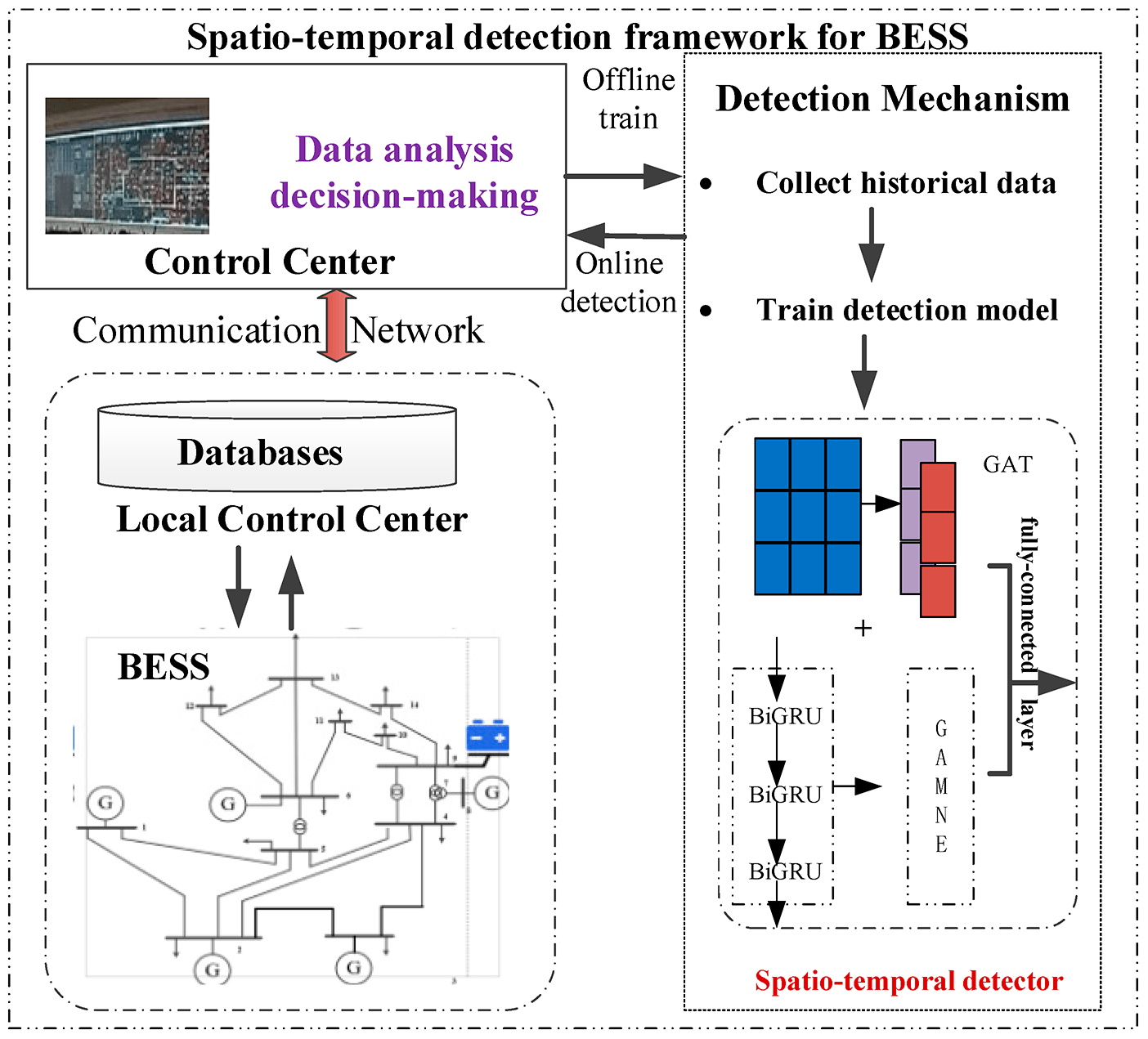
To address the increasing security concerns associated with battery energy storage systems (BESS) in distribution networks, this paper proposes a hybrid detection model based on a Graph Attention Network–Bidirectional Gated Recurrent Unit–Graph Attention Memory Network Enhanced mechanism (GAT-BiGRU-GAMNE) for effectively identifying False Data Injection Attacks (FDIAs). By leveraging the structural dependencies among grid nodes and the temporal evolution of BESS operations, the proposed spatio-temporal feature fusion framework integrates topological spatial feature extraction, bidirectional temporal dependency modeling, and memory-enhanced prototype matching. First, GAT layers are applied to capture dynamic interaction patterns from multi-node BESS operational data; Subsequently, BiGRU model the bidirectional temporal dynamics of the system; And the GAMNE mechanism is incorporated to adaptively retrieve and reinforce critical attack signatures from a learnable memory bank. The fusion of spatio-temporal feature fusion framework can enhance the model’s capability to recognize subtle and evolving attack patterns. Simulation experiments are conducted on the IEEE 14-bus and 57-bus test systems to validate the detection performance. Results indicate that the proposed method can successfully identify the FDIAs by exploiting the inherent topological correlations and temporal dependencies within BESS data streams. In comparison with existing detection techniques, the proposed model demonstrates clear performance improvements: accuracy, precision, recall, and F1-score increase by 1.33%, 0.56%, 0.83%, and 0.76%, respectively.

Graphical Abstract

Towards Reliable Detection of False Data Injection Attacks in Energy Storage Systems: A GAT-BiGRU-GAMNE Approach

Keywords

Energy storage systems; attack detection; false data injection attack; spatial-temporal detection model
  • 8

    View

  • 1

    Download

  • 0

    Like

Share Link



