
 Login
Login Register
 Submit a Paper
 Propose a Special lssue
 Open Access
ARTICLE
Single-Cell and Multi-Omics-Based Characterization of Gastric Cancer Identifies TPP1 as a Potential Target for Gastric Cancer Progression and Treatment
1 Department of Oncology, Yueyang People's Hospital of Hunan Normal University, Yueyang, China
2 Department of Gastroenterology, First Affiliated Hospital of Zhengzhou University, Zhengzhou, China
3 Henan Key Laboratory of Cancer Epigenetics, Cancer Institute, The First Affiliated Hospital, College of Clinical Medicine, Henan University of Science and Technology, Luoyang, China
* Corresponding Author: Shuxian Pan. Email:
(This article belongs to the Special Issue: Machine Learning for Disease Subtyping, from Molecular to Clinical Features)
Oncology Research 2026, 34(4), 27 https://doi.org/10.32604/or.2026.070208
Received 10 July 2025; Accepted 04 January 2026; Issue published 23 March 2026
 View Full Text
 Download PDF
Abstract
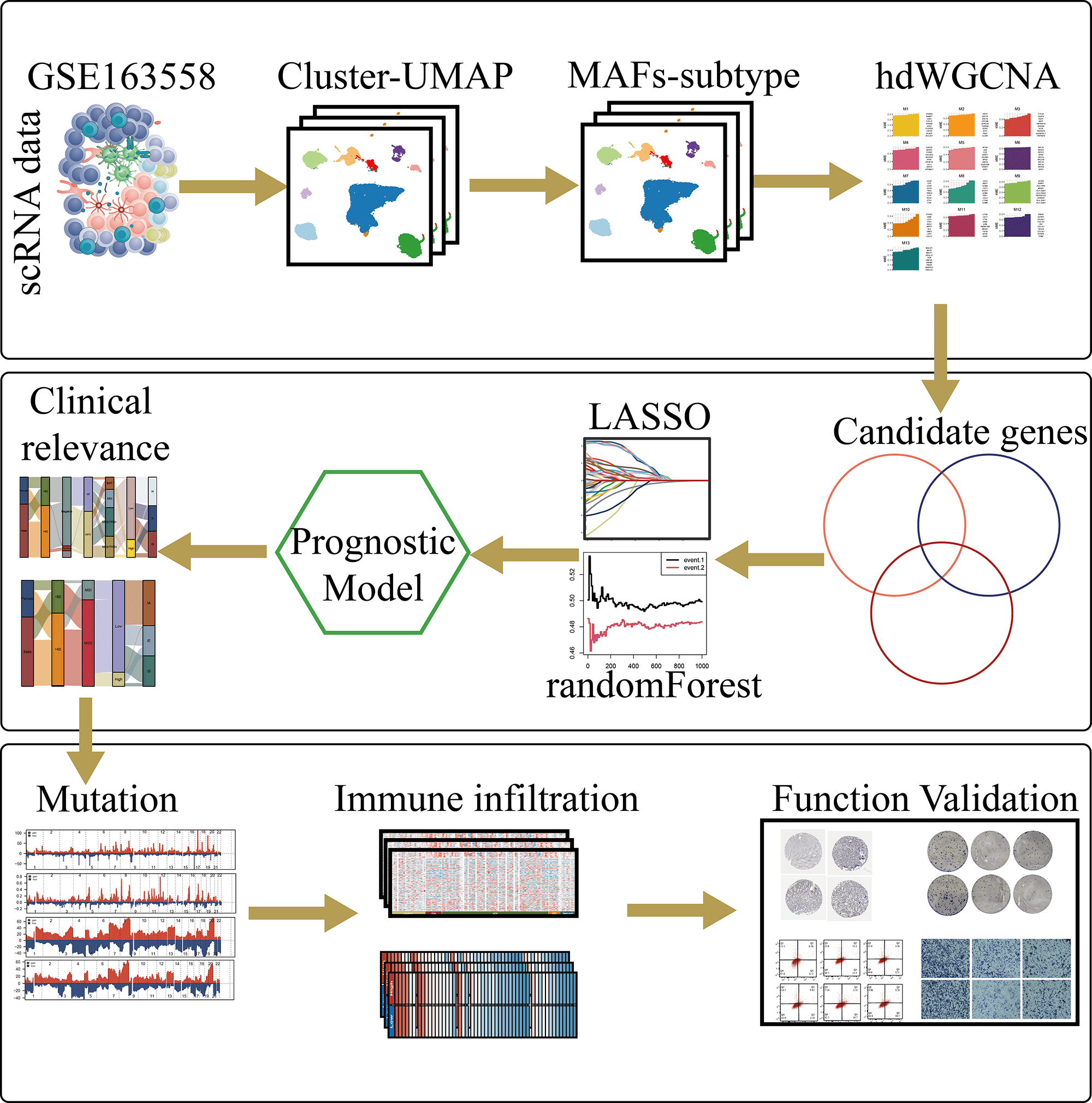
Background: Cancer-associated fibroblasts (CAFs) play critical roles in tumor progression and immunosuppression; however, their contribution to the functional classification and personalized treatment of gastric cancer remains poorly defined. This study aimed to identify effective therapeutic targets to facilitate individualized treatment strategies for patients with gastric cancer. Methods: Single-cell and bulk transcriptomic analyses were integrated to characterize gastric cancer fibroblasts. “Seurat”, “Slingshot”, and “CellChat” were used for dimensionality reduction, trajectory inference, and cell–cell communication analyses, respectively. Key metastasis-associated fibroblast modules were identified using High-dimensional weighted gene co-expression network analysis (hdWGCNA) to construct a prognostic model, which was further evaluated for immune infiltration, therapeutic response, and mutational features. The expression and function of the core gene tripeptidyl peptidase 1 (TPP1) were validated through immunoblotting, PCR, and functional assays. Results: Eight fibroblast subpopulations associated with gastric cancer metastasis exhibited distinct differentiation trajectories and transcriptional heterogeneity. Prognostic analysis indicated that metastasis-associated fibroblasts correlated with poor clinical outcomes. The high-risk subgroup showed marked immunosuppression, resistance to immunotherapy, and reduced mutational burden, with tumor progression–related pathways significantly enriched in this group. In vitro experiments further confirmed that TPP1 knockdown suppressed gastric cancer cell metastasis, invasion, and clonogenic capacity while inducing apoptosis. Conclusion: This study characterized the heterogeneity of gastric cancer–associated fibroblasts using single-cell transcriptomic analysis and established a prognostic model based on metastasis-related fibroblast markers. The model demonstrated strong predictive performance for patient prognosis, immune landscape, and immunotherapy response. Furthermore, the findings highlighted the pivotal role of TPP1 in gastric cancer progression and its potential as a therapeutic target.Graphic Abstract
Keywords
Cite This Article
 Copyright © 2026 The Author(s). Published by Tech Science Press.
This work is licensed under a Creative Commons Attribution 4.0 International License , which permits unrestricted use, distribution, and reproduction in any medium, provided the original work is properly cited.
 Downloads
 Citation Tools
