Navigating the Labyrinth of Hepatocellular Carcinoma: Leveraging AI/ML for Precision Oncology
Abdul Manan1,2, Sidra Ilyas2,*
1 Department of Molecular Science and Technology, Ajou University, Suwon, Republic of Korea
2 Department of Herbal Pharmacology, College of Korean Medicine, Gachon University, 1342 Seongnamdaero, Sujeong-gu, Seongnam-si, Republic of Korea
* Corresponding Author: Sidra Ilyas. Email: 
(This article belongs to the Special Issue: Molecular Targets and Combinatorial Therapeutics of Liver Cancer)
Oncology Research https://doi.org/10.32604/or.2026.074185
Received 05 October 2025; Accepted 16 January 2026; Published online 05 February 2026
Abstract
Hepatocellular carcinoma (HCC) remains a significant global health challenge, with therapeutic efficacy in advanced stages often limited by underlying liver dysfunction and adaptive resistance. In this review, the evolving landscape of molecular targets and combinatorial strategies is critically examined, with a particular focus on the transition from preclinical discovery to clinical application. While traditional molecular heterogeneity is acknowledged, the aim is to elucidate how emerging computational paradigms are redefining target discovery and therapeutic stratification in HCC. The primary purpose is to evaluate the role of Artificial Intelligence (AI) and Machine Learning (ML) as integrative tools for translating high-dimensional multi-omics data into clinically actionable insights for HCC management. Special attention is given to the capacity of AI-driven frameworks to analyze complex datasets derived from genomics, transcriptomics, proteomics, metabolomics, and epigenomics, thereby enabling the identification of novel predictive biomarkers, patient subgroups, and rational drug combinations. By synthesizing recent preclinical and clinical evidence, this review highlights how AI-guided approaches can accelerate biomarker validation and optimize therapeutic decision-making. Furthermore, the convergence of AI with spatial transcriptomics, digital pathology, and single-cell technologies is discussed as a transformative infrastructure for decoding tumor–microenvironment interactions and spatial heterogeneity. These integrative strategies provide unprecedented resolution into tumor evolution, immune landscapes, and resistance mechanisms. Collectively, the evidence reviewed supports the conclusion that AI-enabled, multi-omics–driven approaches are instrumental in advancing HCC treatment toward a new era of adaptive, spatially informed, and precision-based personalized medicine.
Graphical Abstract
Keywords
Hepatocellular carcinoma; immunotherapies; transcriptomic; multi-omics; artificial intelligence; machine learning
 Open Access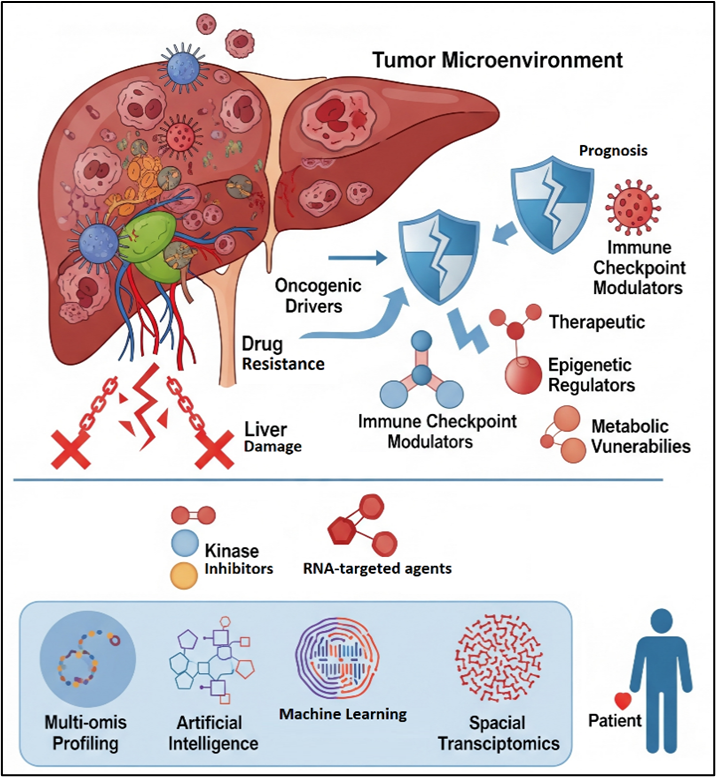

 Login
Login Register
 Submit a Paper
 Propose a Special lssue
 Download PDF
 Downloads
 Citation Tools
