
Home / Journals / OR / Online First / doi:10.32604/or.2026.078924
Special Issues
Table of Content

Open Access

REVIEW

Navigating the Metabolic-Genomic Paradigm: Mitochondrial Reprogramming as a Driver of Cancer Plasticity

Yen-Dun Tony Tzeng1,2,#, Chen-Yueh Wen3,4,#, Su-Boon Yong5,6, Zhi-Hong Wen7,8, An-Jen Chiang9,*, Chia-Jung Li8,10,11,12,*
1 Department of Surgery, Kaohsiung Veterans General Hospital, Kaohsiung, Taiwan
2 Center of General Education, Shu-Zen Junior College of Medicine and Management, Kaohsiung, Taiwan
3 Division of Urology, Show Chwan Memorial Hospital, Changhua, Taiwan
4 Division of Urology, Chang Bing Show Chwan Memorial Hospital, Changhua, Taiwan
5 Department of Allergy and Immunology, China Medical University Children’s Hospital, Taichung, Taiwan
6 Research Center for Allergy, Immunology, and Microbiome (A.I.M.), China Medical University Hospital, Taichung, Taiwan
7 Department of Marine Biotechnology and Resources, National Sun Yat-sen University, Kaohsiung, Taiwan
8 National Museum of Marine Biology & Aquarium, Pingtung, Taiwan
9 Department of Medical Education and Research, Kaohsiung Veterans General Hospital Kaohsiung, Kaohsiung, Taiwan
10 Department of Obstetrics and Gynecology, Kaohsiung Veterans General Hospital, Kaohsiung, Taiwan
11 Center of General Education, Cheng Shiu University, Kaohsiung, Taiwan
12 Institute of BioPharmaceutical Sciences, National Sun Yat-sen University, Kaohsiung, Taiwan
* Corresponding Author: An-Jen Chiang. Email: email; Chia-Jung Li. Email: email
# These authors contributed equally to this study
(This article belongs to the Special Issue: Tumor Biomarkers for Diagnosis, Prognosis and Targeted Therapy)

Oncology Research https://doi.org/10.32604/or.2026.078924

Received 10 January 2026; Accepted 26 March 2026; Published online 07 May 2026
Abstract

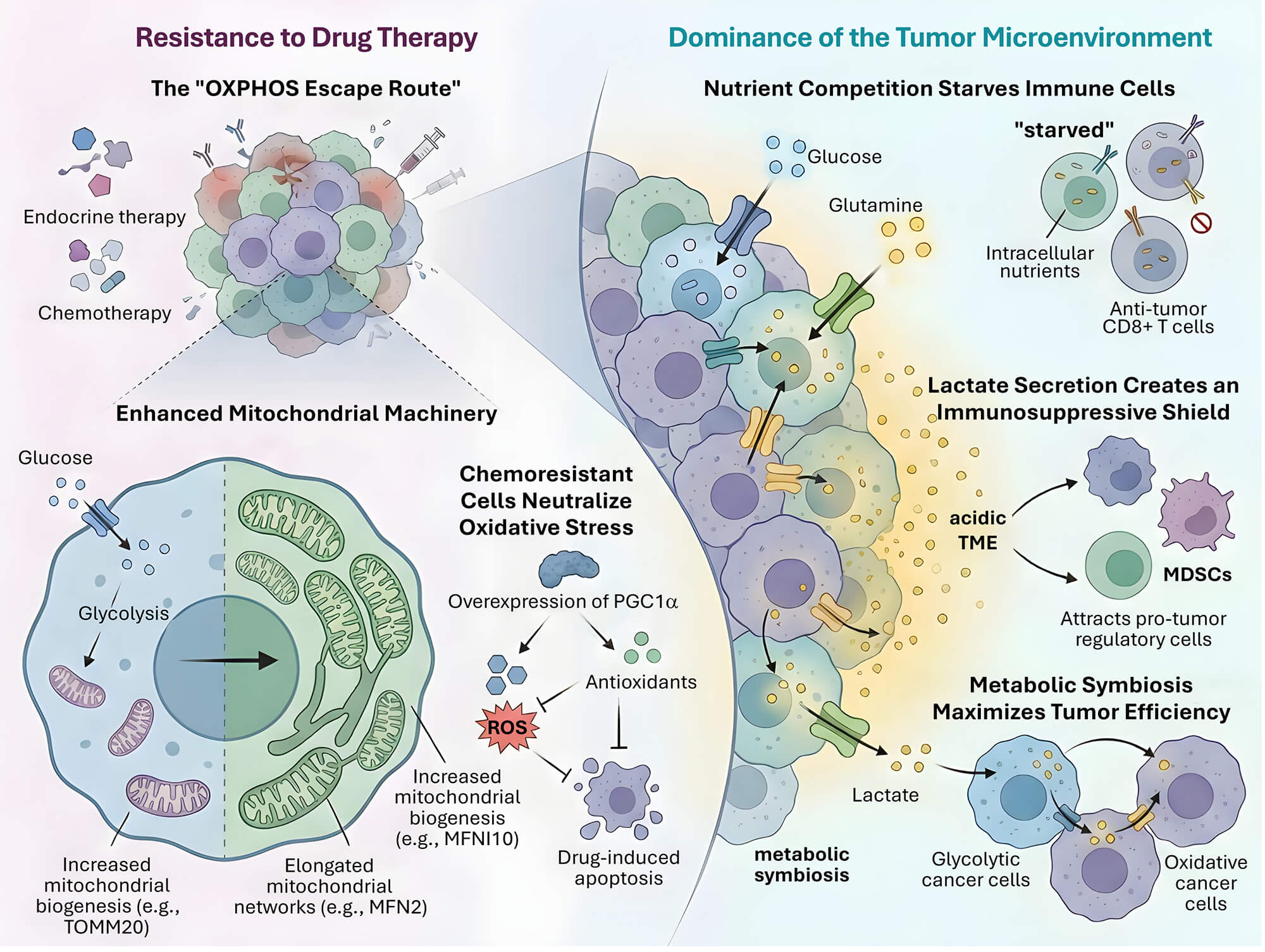
Breast cancer (BC) management has transitioned from histological classification to molecular subtyping, yet therapeutic resistance and intratumor heterogeneity remain critical clinical challenges. This review examines the emerging paradigm shift toward integrating mitochondrial metabolism into the precision medicine framework. We detail the complex mitonuclear crosstalk where nuclear genetic alterations, such as Breast Cancer 1 (BRCA1) deficiency and TP53 mutations, fundamentally reprogram mitochondrial bioenergetics. Specifically, the loss of BRCA1 function triggers a systemic NAD+ depletion trap through PARP1 hyperactivation, while oncogenic drivers like MYC coordinate with PGC1α to enhance mitochondrial biogenesis for metastatic survival. We evaluate the diagnostic potential of mitochondrial DNA heteroplasmy and machine learning derived metabolic gene signatures as high performance biomarkers for patient stratification and the detection of minimal residual disease via liquid biopsy. Furthermore, we analyze current clinical efforts to target mitochondrial vulnerabilities, including respiratory chain inhibitors like metformin and BH3 mimetics, while highlighting the significant challenges posed by metabolic plasticity and nutrient competition in the tumor microenvironment. The analysis of clinical trial data, such as the MA.32 study, suggests that metabolic interventions require precise patient selection based on specific metabolic phenotypes rather than broad application. Looking forward, the integration of genome scale metabolic models and artificial intelligence (AI) offers a transformative pathway to simulate patient specific metabolic fluxes and identify novel synthetic lethal targets. By bridging the gap between nuclear genomic drivers and dynamic mitochondrial adaptations, this review aims to provide a preliminary framework for the exploration of metabolic-genomic precision oncology in BC.

Graphical Abstract

Navigating the Metabolic-Genomic Paradigm: Mitochondrial Reprogramming as a Driver of Cancer Plasticity

Keywords

Breast cancer (BC); precision medicine; metabolic reprogramming; therapeutic resistance; artificial intelligence (AI)
  • 148

    View

  • 28

    Download

  • 0

    Like

Share Link



