
Home / Journals / CMES / Online First / doi:10.32604/cmes.2026.074675
Special Issues
Table of Content

Open Access

ARTICLE

Computational Modelling of Control of Laminar Separation Bubble over an Airfoil Using an Integrated Tubercle and Vortex Generator

Mustafa Özden1,2,3, Sinem Keskin1,4, Eren Anıl Sezer1,4,5, Muhammed Hatem1,4, Mustafa Serdar Genç1,5,*, Halil Hakan Açıkel1
1 Wind Engineering and Aerodynamic Research Laboratory, Department of Energy Systems Engineering, Erciyes University, Kayseri, Turkey
2 Scientific Research Projects Unit of Erciyes University, Erciyes University, Kayseri, Turkey
3 Dominion Energy Innovation Center, Clemson University, North Charleston, SC, USA
4 Graduate School of Natural and Applied Science, Erciyes University, Kayseri, Türkiye
5 MSG Teknoloji Ltd. Şti, Erciyes Teknopark Tekno-1 Binası, 61/20, Kayseri, Türkiye
* Corresponding Author: Mustafa Serdar Genç. Email: email

Computer Modeling in Engineering & Sciences https://doi.org/10.32604/cmes.2026.074675

Received 15 October 2025; Accepted 26 January 2026; Published online 14 February 2026
Abstract

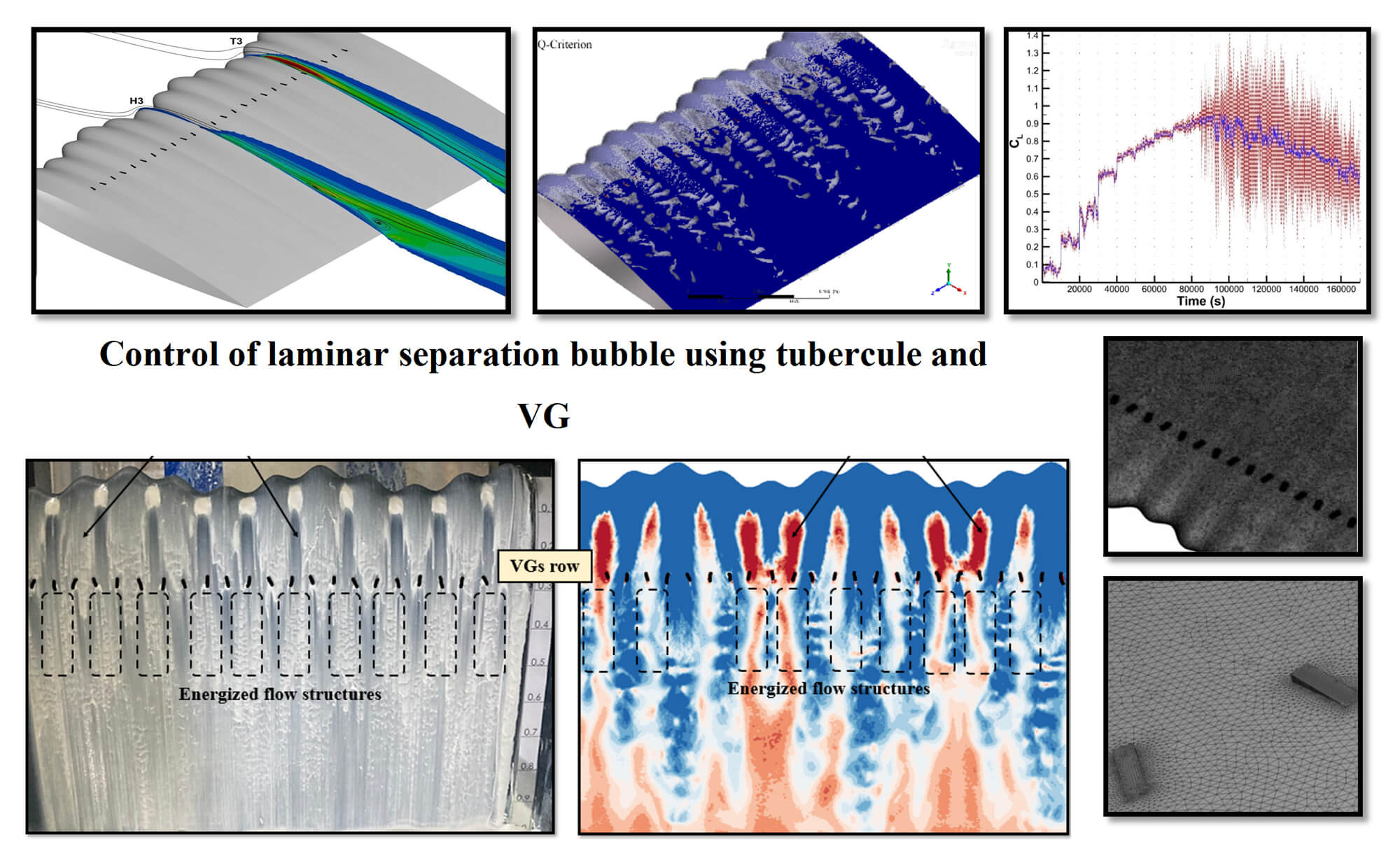
This paper examines a model that combines vortex generators and leading-edge tubercles for controlling the laminar separation bubble (LSB) over an airfoil at low Reynolds numbers (Re). This new concept of passive flow control technique utilizing a tubercle and vortex generator (VG) close to the leading edge was analyzed numerically for a NACA0015 airfoil. In this study, the Shear Stress Transport (SST) turbulence model was employed in the numerical modelling. Numerical modelling was completed using the ANSYS-Fluent 18.2 solver. Analyses were conducted to investigate the flow pattern and understand the underlying LSB control phenomena that enabled the new passive flow control method to provide this significant performance benefit. The findings indicated that the new concept of passive flow control technique suppressed the formation of an LSB at the suction surface of the NACA0015 airfoil, resulting in a higher lift coefficient and improved aerodynamic performance. Improvements in LSB dynamics and aerodynamic performance through the passive flow control method lead to increased energy output and enhanced stability.

Graphical Abstract

Computational Modelling of Control of Laminar Separation Bubble over an Airfoil Using an Integrated Tubercle and Vortex Generator

Keywords

Laminar separation bubble; airfoil; tubercle; vortex generator; flow control
  • 117

    View

  • 32

    Download

  • 0

    Like

Share Link



