Guest Editor(s)
Assistant Professor Sinan Chen
Email: chensinan@gold.kobe-u.ac.jp
Affiliation: Center of Mathematical and Data Sciences, Kobe University, Kobe, Japan
Homepage:
Research Interests: machine learning, human computer interaction, multimodal AI

Assistant Professor Jialong Li
Email: lijialong@fuji.waseda.jp
Affiliation: Department of Computer Science and Engineering, Waseda University, Kitakyushu, 8080135, Japan
Homepage:
Research Interests: human-computer interaction, self-adaptive systems, requirement engineering

Summary
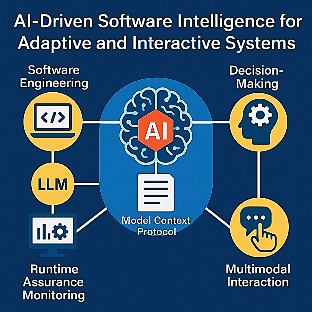
The rapid evolution of large language models (LLMs), multimodal interaction, and autonomous intelligent systems is transforming how software is designed, developed, and assured. As these systems become more embedded in real-world environments, ensuring robust real-time decision-making, contextual awareness, and dynamic adaptability is increasingly critical. At the heart of this transformation is the integration of model-driven reasoning mechanisms and protocols such as the Model Context Protocol (MCP), which enables systems to maintain and interpret situational knowledge during execution.
This Special Issue aims to explore innovative methodologies, frameworks, and technologies at the intersection of software engineering, intelligent systems, and human-centered interaction. We seek high-quality submissions that address the design, analysis, verification, and operation of LLM-augmented software systems capable of runtime decision-making and assurance in dynamic, multimodal contexts.
Particular interest lies in research that leverages MCP to formalize, communicate, and manage execution-time context information, enabling intelligent systems to reason about their environment and adjust behavior accordingly. We also encourage work on runtime assurance monitoring mechanisms that integrate contextual models and use LLMs to support explainability, verifiability, and interaction management. Topics that push the boundaries of adaptive decision-making, information fusion, and explainable multimodal interfaces are highly welcome. Interdisciplinary contributions combining systems science, information science, and AI-driven software design are strongly encouraged.
The following subtopics are the particular interests of this special issue, including but not limited to:
• Software engineering for LLM-integrated intelligent systems
• Runtime assurance and trustworthiness in adaptive decision-making
• Human-AI interaction via multimodal interfaces
• Explainability and verifiability of AI-driven software
• Information fusion and situational awareness in complex systems
• Agent-based modeling and monitoring in intelligent environments
• Systems engineering approaches for real-time LLM applications
Graphic Abstract
Keywords
software engineering, large language model, intelligent systems, decision-making, runtime assurance monitoring, multimodal interaction, model context protocol

 Login
Login Register
 Submit a Paper
 Propose a Special lssue