Guest Editor(s)
Prof. K. Raju
Email: rajuk@sjec.ac.in
Affiliation: Department of Mechanical Engineering, St Joseph Engineering College, Mangaluru,575 028, India
Homepage:
Research Interests: spray forming of Al-Si ternary and quaternary alloys, tribological behavior of Al-Si hypereutectic alloys, metal matrix and polymer matrix composites, wear, microstructural, and mechanical characterization of Al-Si alloys under elevated temperatures, thermal ageing and heat treatment effects on aerospace alloys, surface engineering and coating behavior

Prof. Dayanand M. Goudar
Email: dmgoudar@tce.ac.in
Affiliation: Department of Mechanical Engineering, Tontadarya College of Engineering, Gadag,582101, India
Homepage:
Research Interests: spray forming and processing of Al-Si and Al-Mg₂Si alloys, reinforced metal matrix and polymer composites, computational and experimental design of high-performance structural materials, artificial intelligence and optimization in materials engineering, wear, microstructural, and mechanical characterization under elevated temperatures, thermal ageing and heat treatment effects on aerospace alloys, surface engineering and coating behavior, finite element simulation and predictive modeling of material behavior, data-driven and AI-assisted material development and property prediction

Prof. Rajashekar V. Kurahatti
Email: rajukurahatti@gmail.com
Affiliation: Basaveshwar Engineering College, Bagalkot, 587102, India
Homepage:
Research Interests: mechanical and tribological properties of epoxy and bismaleimide based nanocomposites

Summary
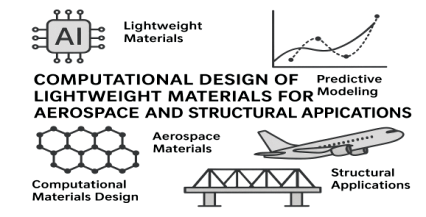
The growing demand for lightweight materials in aerospace and structural engineering stems from the need for enhanced performance, improved fuel efficiency, and increased structural reliability. Traditional material development is often slow and costly, but recent advances in computational methods, artificial intelligence (AI), and multiscale modeling have transformed this process. These tools enable faster prediction, optimization, and customization of material properties. This Special Issue highlights the use of these technologies in designing next-generation composite and functional materials for critical aerospace and structural applications.
This Special Issue aims to bring together recent advances in computational techniques and AI-driven approaches for the design and development of lightweight materials tailored for aerospace and structural applications. It seeks to highlight how data-driven modeling, machine learning, and simulation methods are transforming the landscape of materials engineering.
This Special Issue welcomes original research articles, reviews, and case studies in the following areas:
· Computational modeling and simulation of lightweight composite and functional materials
· AI and machine learning applications in material design and optimization
· Multiscale and multiphysics modeling for structural performance prediction
· Data-driven design of materials for aerospace structures
· Materials informatics for lightweight alloy development
· Integration of experimental and computational methods
· High-performance polymers, metal matrix composites, and ceramic composites
· Structural integrity, durability, and failure prediction in lightweight materials
· Sustainable and energy-efficient solutions for aerospace materials
Graphic Abstract
Keywords
Lightweight Materials, Computational Materials Design, Aerospace Materials, Structural Applications, Machine Learning in Materials Science, Multiscale Modeling

 Login
Login Register
 Submit a Paper
 Propose a Special lssue