Guest Editor(s)
Assoc. Prof. Nur Syazreen Ahmad
Email: syazreen@usm.my
Affiliation: School of Electrical and Electronic Engineering, Universiti Sains Malaysia, Penang, Malaysia
Homepage:
Research Interests: intelligent control and sensing, intelligent optimization, autonomous systems, sensor networks

Assist. Prof. Mohd Fitri Mohd Yakub
Email: mfitri.kl@utm.my
Affiliation: Malaysia- Japan International Institute of Technology, Universiti Teknologi Malaysia, Kuala Lumpur, Malaysia
Homepage:
Research Interests: intelligent control, automatic and robust control, motion control, vehicle dynamics system, IoT, machine learning application

Dr. Andika Aji Wijaya
Email: andika@ubt.edu.sa
Affiliation: Department of Mechanical Engineering, University of Business and Technology, Jeddah, Saudi Arabia
Homepage:
Research Interests: nonlinear control, vibration control, intelligent systems

Summary
Introduction
Intelligent control and sensing play a critical role in the advancement of industrial and autonomous systems, allowing machines to perceive their environment, learn from data, and respond adaptively. Their integration supports improved performance, safety, and operational reliability in demanding real-world scenarios.
Aim and Scope
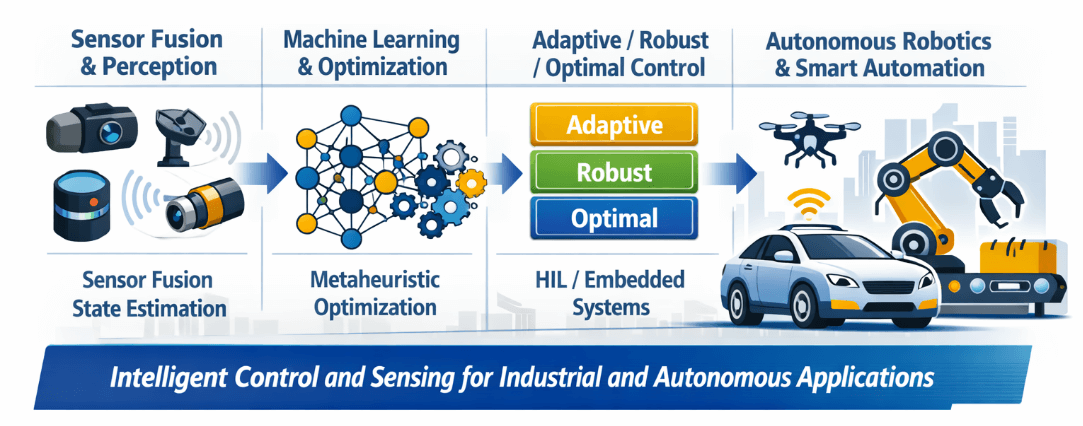
This Special Issue aims to showcase recent advances in intelligent control and sensing for industrial and autonomous applications. Topics of interest include data-driven modeling, machine learning-based sensing, optimal, adaptive, and robust control strategies, sensor fusion, and metaheuristic optimization algorithms that support decision-making and controller tuning. Contributions involving theoretical methods, computational tools, embedded implementations, and real-world case studies are welcome. Relevant application domains include robotics, industrial automation, transportation, and smart manufacturing, with emphasis on interdisciplinary research that bridges control, sensing, optimization, and practical deployment challenges.
Themes
· Machine learning and data-driven methods for sensing and control
· Optimal, adaptive, and robust control strategies
· Metaheuristic and evolutionary optimization algorithms for tuning and decision-making
· Sensor fusion, perception, and state estimation in autonomous systems
· Industrial automation, smart manufacturing, and process control
· Embedded sensing, real-time computing, and hardware-in-the-loop validation
· Applications in robotics, transportation, logistics, and infrastructure inspection
Graphic Abstract
Keywords
intelligent control, intelligent sensing, metaheuristic optimization, machine learning, sensor fusion, state estimation, robotics and autonomous systems, industrial automation, smart manufacturing, data-driven modeling
Published Papers

 Login
Login Register
 Submit a Paper
 Propose a Special lssue