Guest Editor(s)
Dr. Sana Ullah Jan
Email: s.jan@napier.ac.uk
Affiliation: School of Computing, Engineering, and the Built Environment, Edinburgh Napier University, Edinburgh, United Kingdom
Homepage:
Research Interests: cybersecurity, artificial intelligence & machine learning/deep learning, intrusion detection systems, fuzzy systems, cyber-physical systems, internet-of-things

Mr. Shafi Ullah Khan
Email: shafiullah.khan@uta.edu
Affiliation: Department of Computer Science and Engineering, The University of Texas at Arlington, Arlington, United States
Homepage:
Research Interests: wireless communication, machine learning, federated learning, digital health care, fault diagnosis and Internet of Things

Summary
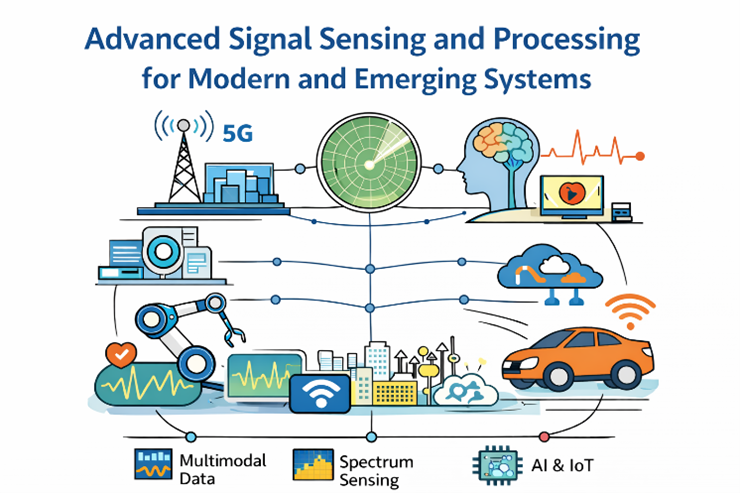
Modern engineering systems are increasingly driven by computational methods for sensing, processing, and interpreting complex signals. Advances in artificial intelligence, signal processing, data analytics, and edge intelligence enable real-time inference, adaptive decision-making, and scalable deployment across distributed environments. Accordingly, signal sensing and processing have evolved toward data-driven and AI-enabled paradigms, integrating machine learning, multimodal data fusion, and system-level modeling. Approaches such as edge AI, federated learning, and distributed intelligence support robust and privacy-aware solutions under real-world constraints, including non-IID data, resource limitations, and dynamic environments, highlighting the need for efficient and scalable signal processing methods that bridge sensing, analytics, and system-level deployment.
This Special Issue focuses on advanced computational approaches for signal sensing and processing, emphasizing AI-enabled sensing, signal processing algorithms, intelligent data analytics, and cyber-physical system integration. The goal is to bring together innovative research that advances data-driven modeling, edge intelligence, multimodal fusion, and practical system-level implementations, while addressing challenges in scalability, robustness, and real-time operation.
• Multimodal sensing and data fusion
• Machine learning for signal analysis and inference
• Time–frequency analysis and data-driven modeling
• Edge AI and real-time signal processing
• Distributed and federated learning for sensing systems
• Intelligent data analytics for sensing applications
• Cyber-physical systems and IoT-based sensing
• Signal processing for fault detection and predictive maintenance
• Biomedical signal processing and healthcare analytics
Graphic Abstract
Keywords
multimodal sensing, signal processing, data fusion, machine learning, edge AI, federated learning, real-time inference, cyber-physical systems, IoT sensing, biomedical signal analytics

 Login
Login Register
 Submit a Paper
 Propose a Special lssue