
Home / Journals / CMES / Online First / doi:10.32604/cmes.2026.075537
Special Issues
Table of Content

Open Access

ARTICLE

LANET: A Deep Lightweight Attention Network for Skin Cancer Segmentation

Abdulrahman Dira Khalaf1,2,*, Hazlina Hamdan1,*, Alfian Abdul Halin1, Noridayu Manshor1
1 Faculty of Computer Science and Information Technology, Universiti Putra Malaysia (UPM), Serdang, Malaysia
2 Department of Computer Center, University of Fallujah, Anbar, Iraq
* Corresponding Author: Abdulrahman Dira Khalaf. Email: email; Hazlina Hamdan. Email: email
(This article belongs to the Special Issue: Artificial Intelligence Models in Healthcare: Challenges, Methods, and Applications)

Computer Modeling in Engineering & Sciences https://doi.org/10.32604/cmes.2026.075537

Received 03 November 2025; Accepted 30 December 2025; Published online 22 April 2026
Abstract

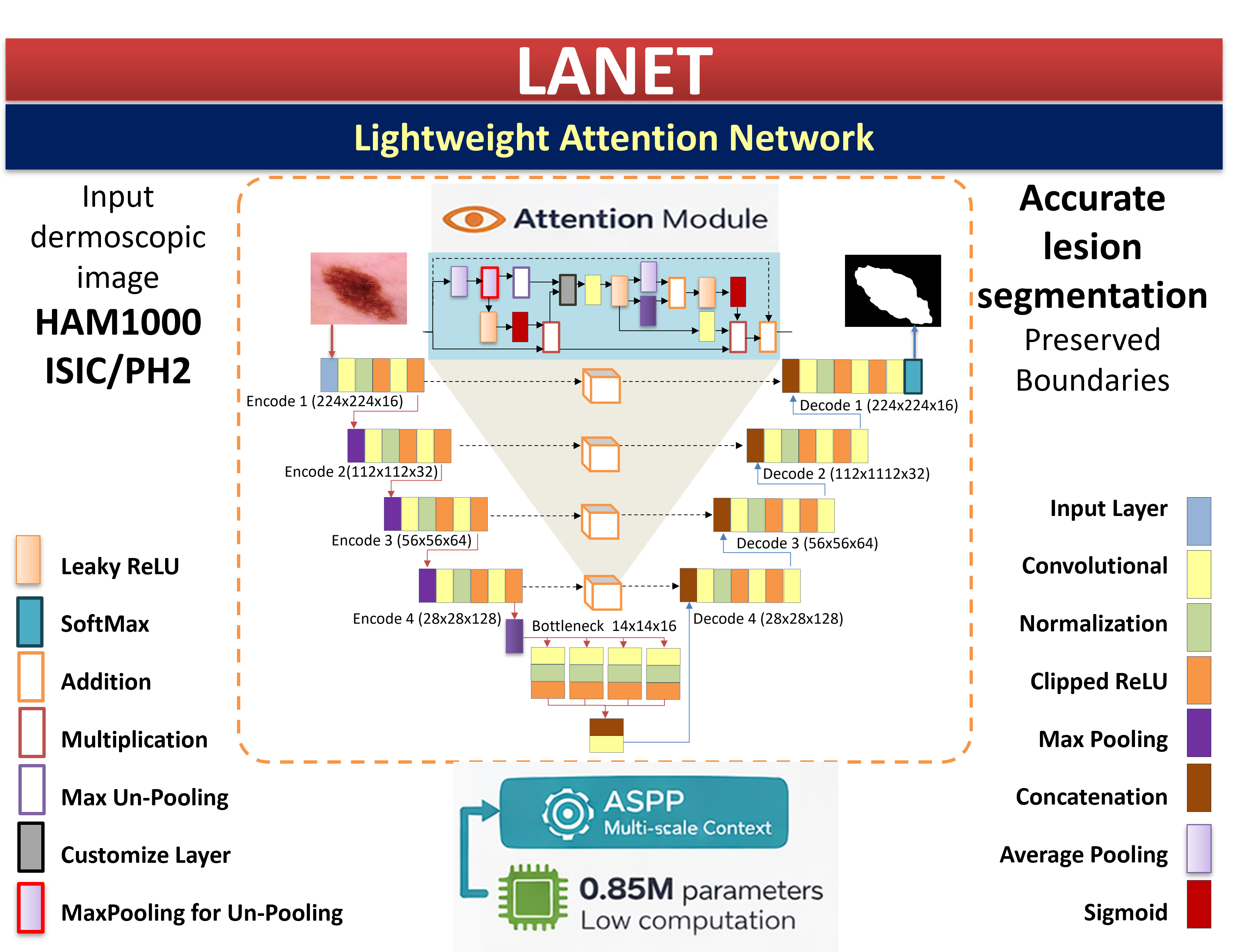
Current automated lesion segmentation methods have limited success, particularly for segmenting small, irregular, or heterogeneous lesions. Moreover, such models require significant computational power, which restricts their scalability and clinical application. To overcome these limitations, a lightweight LANET, which is a layer-attention network based on an encoder–decoder deep-learning architecture, has the explicit goal of increasing the segmentation performance and computational efficiency. The LANET is coupled with three new modules: (i) an attention module that includes a depthwise separable convolution operator to reduce the number of parameters, (ii) a custom attention mechanism, and (iii) an atrous spatial pyramid pooling (ASPP) module designed to model substantial features at multiple scales under ideal conditions. Through experiments on benchmark datasets, LANET demonstrated robustness, resulting in accuracies of 96.44%, 96.8%, 96.3%, and 97.9% for HAM10000, ISIC 2017, ISIC 2018, and PH2, respectively. These results exceed those of classical architectures, such as U-Net, UNet++, and DeepLabv3+, as well as more recent state-of-the-art approaches. Simultaneously, it integrates only 846,786 parameters of the LANET, which leads to a minimum number of overall parameters, and thus, lower computational costs in terms of inference. Furthermore, techniques such as Grad-CAM and activation-map visualizations help explain model decisions and highlight clinically relevant regions. The results show that the LANET provides a robust, scalable, and interpretable real-time segmentation system. This design specifically improves the segmentation of small- or low-contrast lesions. This approach offers a practical path for integrating efficient segmentation models into clinical workflows for skin disease analyses.

Graphical Abstract

LANET: A Deep Lightweight Attention Network for Skin Cancer Segmentation

Keywords

Attention; deep learning; lightweight models; segmentation; skin cancer; U-Net
  • 136

    View

  • 26

    Download

  • 0

    Like

Share Link



