Special Issues
Table of Content

Modeling and Applications of Bubble and Droplet in Engineering and Sciences

Submission Deadline: 30 June 2026 View: 1054 Submit to Special Issue

Guest Editors

Prof. Dr. Van-Tu Nguyen

Email: vantunguyen@pusan.ac.kr

Affiliation: School of Mechanical Engineering, Pusan National University, Busan, 46241, South Korea

Homepage:

Research Interests: Computational Fluid Dynamics: Numerical methods, Numerical algorithms, Numerical programming; Fluid Dynamics: Multiphase flows, Shock Capturing, Free surface flows, Water entry/ Water exit, Cavitation, Bubble dynamics, Cavitation erosion, Droplet, Heat and mass transfer, Gas dynamics and Industrial gas flows, Supercavitation, High-speed subsonic-supersonic flows; Mechanical Systems: Energy System, Mechanical System Design, Control Automated System, Nuclear Energy System

图片1.png


Prof. Dr. Qingyun Zeng

Email: qyzeng@hrbeu.edu.cn

Affiliation: College of Shipbuilding Engineering, Harbin Engineering University, Harbin, 150006, China

Homepage:

Research Interests: Cavitation bubble dynamics, Computational fluid dynamics, Droplets

图片2.png


Dr. Phuong Nguyen

Email: nguyen@ibpc.fr

Affiliation: The National Centre for Scientific Research (CNRS), Paris, 75005, France

Homepage:

Research Interests: Development and application of molecular dynamics and particle dynamics simulation techniques to study bubble cavitation-induced biological barrier disruption, with the aim of enhancing drug delivery and facilitating blood-brain barrier opening

图片3.png


Summary

Welcome to the Special Issue on "Modeling and Applications of Bubbles and Droplets in Engineering and Sciences". This fascinating field spans a wide array of disciplines, including environmental science, mechanical and ocean engineering, biomedical engineering, alcoholic beverage fermentation, soil improvement, bacterial sterilization, and more. The study of bubbles and droplets in fluids is central to understanding many natural and industrial processes. Phenomena such as cavitation, bubble collapse, and bubble oscillation further illustrate the dual nature of bubbles in fluids. On the one hand, these phenomena can produce microjets that cause corrosion and severe vibrations. On the other hand, bubble oscillations generate microjets, temperature spikes, and shock waves, enabling applications in areas such as drug delivery, kidney stone disintegration, eye surgery, medical treatments, surface cleaning, and more. Droplets, whether liquid or solid, play critical roles in diverse applications, such as inkjet printing, spray cooling, fuel injection, aerosol medicine delivery, and environmental pollutant transport. Their behavior—encompassing formation, breakup, coalescence, and evaporation—poses both scientific challenges and engineering opportunities.


This issue aims to highlight the latest advancements and insights into the dynamic and interdisciplinary study of bubbles and droplets in fluids, showcasing their fundamental mechanisms and practical applications. Recent advancements in the study of bubble and droplet dynamics have introduced new tools for analyzing the fundamental chemical, mechanical, and physical aspects of these phenomena and applying them in a myriad of fields. This special topic seeks to serve as a collaborative platform, inviting researchers and scientists to present and discuss their original contributions through letters, research articles, full-length/mini-reviews, and more. Our ultimate objective is to propel the field forward by offering novel theoretical insights, cutting-edge numerical modeling, innovative simulations, and experimental revelations.


We encourage you to participate in this Special Issue and contribute to the ongoing exploration of these phenomena and their far-reaching applications. Join us in shaping the future of this dynamic and multidisciplinary field.


Key Areas of Interest (Keywords):

• Fundamental areas:

- Nano to millimeter bubbles

- Bubble and droplet dynamics

- Oscillation of bubble and/or droplet

- Cavitation

- Cavitation Bubble

- Acoustic Cavitation

- Boiling and Condensation

- Nucleating Bubbles

- Cavitation Erosion

- Shock Wave

- Capillary Flow; Surfactant; Heat Convection

- Analytical methods

- Molecular simulations

- Numerical modeling and CFD simulations


• Application areas:

- Marine Propulsion

- Environment and Water Treatment

- Biomedicine: Kidney Stone Fragmentation/ Eye Surgery/ Cancer Treatment/ Drug Delivery/ Wound and Dental Cleaning/ Tissue Engineering/ Ultrasound Imaging and Diagnosis/ Pharmaceutical Manufacturing…

- Industry and Mechanics: Water Jet Cutting/ Industrial Cleaning/ Fuel Injection/ Hydraulic Erosion Control/ Hydroelectric Power Generation/ Food Processing/ Inkjet Printing

- Chemical Synthesis
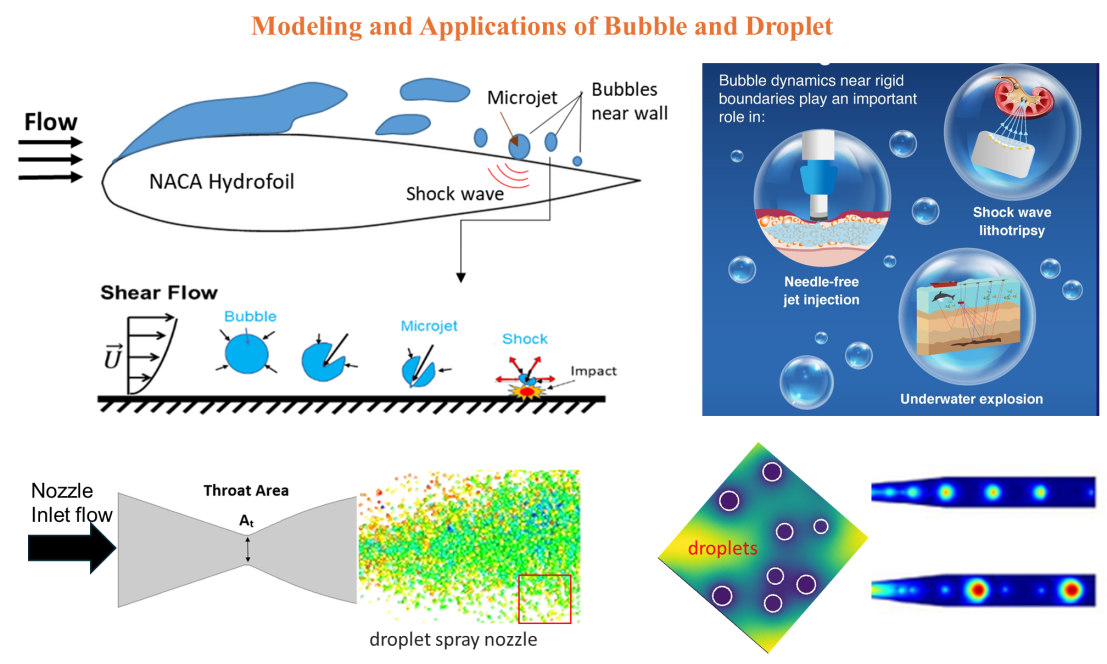

Graphic Abstract

Modeling and Applications of Bubble and Droplet in Engineering and Sciences


Published Papers


  • Open Access

    ARTICLE

    Numerical Analysis of Pressure Propagation Emitted by Collapse of a Single Cavitation Bubble near an Oscillating Wall

    Quang-Thai Nguyen, Duong Ngoc Hai, The-Duc Nguyen, Van-Tu Nguyen, Jinyul Hwang, Warn-Gyu Park
    CMES-Computer Modeling in Engineering & Sciences, DOI:10.32604/cmes.2025.070570
    (This article belongs to the Special Issue: Modeling and Applications of Bubble and Droplet in Engineering and Sciences)
    Abstract This study presents a numerical analysis of the effects of a rigid flat wall with oscillating motion on the pressure wave propagation during a single spherical cavitation bubble collapse at different initial bubble positions. Different nondimensional distances S = 0.8, 0.9, 1.0, 1.1, 1.2 and 1.3 were considered to investigate the effects of initial in-phase and out-of-phase oscillations of the flat wall. Numerical simulations of cavitation bubble collapse near an oscillating wall were conducted using a compressible two-phase flow model. This model incorporated the Volume of Fluid (VOF) interface-sharpening technique on a general curvilinear moving… More >

    Graphic Abstract

    Numerical Analysis of Pressure Propagation Emitted by Collapse of a Single Cavitation Bubble near an Oscillating Wall

  • Open Access

    ARTICLE

    Energy Transfer during Strong Oscillations of a Spherical Bubble with Non-Ideal Gas Equations of State

    Minki Kim, Jenny Jyoung Lee
    CMES-Computer Modeling in Engineering & Sciences, Vol.145, No.1, pp. 345-366, 2025, DOI:10.32604/cmes.2025.070524
    (This article belongs to the Special Issue: Modeling and Applications of Bubble and Droplet in Engineering and Sciences)
    Abstract Spherical bubble oscillations are widely used to model cavitation phenomena in biomedical and naval hydrodynamic systems. During collapse, a sudden increase in surrounding pressure initiates the collapse of a cavitation bubble, followed by a rebound driven by the high internal gas pressure. While the ideal gas equation of state (EOS) is commonly used to describe the internal pressure and temperature of the bubble, it is limited in its capacity to capture molecular-level effects under highly compressed conditions. In the present study, we employ non-ideal EOS for the gas (the van der Waals EOS and its… More >

  • Open Access

    ARTICLE

    Numerical Modeling of Bubble-Particle Attachment in a Volume-of-Fluid Framework

    Hojun Moon, Donghyun You
    CMES-Computer Modeling in Engineering & Sciences, Vol.145, No.1, pp. 367-390, 2025, DOI:10.32604/cmes.2025.071648
    (This article belongs to the Special Issue: Modeling and Applications of Bubble and Droplet in Engineering and Sciences)
    Abstract A numerical method is presented to simulate bubble–particle interaction phenomena in particle-laden flows. The bubble surface is represented in an Eulerian framework by a volume-of-fluid (VOF) method, while particle motions are predicted in a Lagrangian framework. Different frameworks for describing bubble surfaces and particles make it difficult to predict the exact locations of collisions between bubbles and particles. An effective bubble, defined as having a larger diameter than the actual bubble represented by the VOF method, is introduced to predict the collision locations. Once the collision locations are determined, the attachment of particles to the More >

  • Open Access

    ARTICLE

    Simulation of Dynamic Evolution for Oil-in-Water Emulsion Demulsification Controlled by the Porous Media and Shear Action

    Heping Wang, Ying Lu, Yanggui Li
    CMES-Computer Modeling in Engineering & Sciences, Vol.145, No.1, pp. 391-410, 2025, DOI:10.32604/cmes.2025.069763
    (This article belongs to the Special Issue: Modeling and Applications of Bubble and Droplet in Engineering and Sciences)
    Abstract With oily wastewater treatment emerging as a critical global issue, porous media and shear forces have received significant attention as environmentally friendly methods for oil–water separation. This study systematically simulates the dynamics of oil-in-water emulsion demulsification under porous media and shear forces using a color-gradient Lattice Boltzmann model. The morphological evolution and demulsification efficiency of emulsions are governed by porous media and shear forces. The effects of porosity and shear velocity on demulsification are quantitatively analyzed. (1) The presence of porous media enhances the ability of the flow field to trap oil droplets, with lower More >

  • Open Access

    ARTICLE

    Cavitation Performance Analysis of Tip Clearance in a Bulb-Type Hydro Turbine

    Feng Zhou, Qifei Li, Lu Xin, Shiang Zhang, Yang Liu, Ming Guo
    CMES-Computer Modeling in Engineering & Sciences, Vol.145, No.1, pp. 411-429, 2025, DOI:10.32604/cmes.2025.069639
    (This article belongs to the Special Issue: Modeling and Applications of Bubble and Droplet in Engineering and Sciences)
    Abstract Bulb-type hydro turbines are commonly used in small- to medium-scale hydropower stations due to their compact design and adaptability to low-head conditions. However, long-term operation often results in wear at the runner rim, increasing tip clearance and triggering leakage flow and cavitation. These effects reduce hydraulic efficiency and accelerate blade surface erosion, posing serious risks to unit safety and operational stability. This study investigates the influence of tip clearance on cavitation performance in a 24 MW prototype bulb turbine. A three-dimensional numerical model is developed to simulate various operating conditions with different tip clearance values… More >

Share Link

