Submission Deadline: 31 December 2026 View: 413 Submit to Special Issue
Prof. Dr. Dagang Wang
Email: wangdg@cumt.edu.cn
Affiliation: School of Mechanical and Electrical Engineering, China University of Mining and Technology, Xuzhou, China
Research Interests: severe plastic deformation, intelligent condition monitoring, machine learning for engineering fault diagnosis, optimal design of engineering components, tribology and interface science

Prof. Dr. Xiaoyong Ren
Email: xiaoyong_ren@cumtb.edu.cn
Affiliation: School of Mechanical and Electrical Engineering, China University of Mining and Technology (Beijing), Beijing, China
Research Interests: multi-scale damage modelling, fatigue life prediction

Prof. Dr. Si Chen
Email: chensi@ujs.edu.cn
Affiliation: Research Center of Fluid Machinery Engineering and Technology, Jiangsu University, Zhenjiang, China
Research Interests: numerical simulation, machine learning

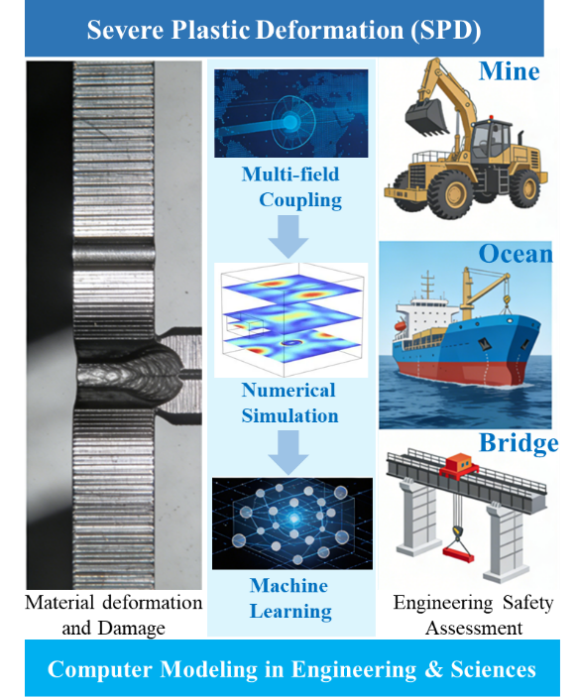
Severe Plastic Deformation (SPD) is a core mechanical process driving irreversible material damage and performance degradation of metal components under alternating loads and harsh service environments. It is the primary inducement of fatigue fracture, friction wear, and sudden failure of key bearing components in mining machinery, marine drilling rigs, bridge engineering, and oil & gas equipment, with critical engineering safety implications.
Research on SPD-induced material damage highly relies on advanced computer modelling, numerical simulation, and data-driven intelligent analysis. Despite recent progress, critical challenges remain in high-precision coupled modelling of SPD and material damage under multi-field conditions, quantitative characterization of SPD-induced tribo-fatigue damage, machine learning-based micro-damage identification, and service safety assessment of engineering components.
This special issue aims to collect the latest innovative research results and advanced technical solutions in the field of computer modelling for SPD induced material damage. Both fundamental theory-focused studies and application-driven engineering research are highly welcome, especially original papers with in-depth exploration of damage mechanisms, novel computer modelling methods, intelligent damage identification technology, and emerging engineering applications in mechanical equipment safety.
Potential topics include, but are not limited to the following:
· Material Damage Evolution Simulation
· Tribo-fatigue Damage Modelling
· Machine Learning
· Numerical Simulation
· Multi-scale Damage Modelling
· Fatigue Life Prediction
· Finite Element Modelling
· Intelligent Damage Detection


 Login
Login Register
 Submit a Paper
 Propose a Special lssue