Special Issues
Table of Content

Secure and Scalable Blockchain–IoT Architectures for Next-Generation Distributed Systems

Submission Deadline: 31 December 2026 View: 12887 Submit to Special Issue

Guest Editor(s)

Prof. Chin-Ling Chen

Email: clc@mail.cyut.edu.tw

Affiliation: Department of Computer Science and Information Engineering, Chaoyang University of Technology, Taichung, Taiwan

Homepage:

Research Interests: blockchain, cryptography, authentication, network security, computer security, privacy, web service, M-Commerce, wireless sensor network, medical safety service

图片3.png


Assoc. Prof. Yu-Chih Wei

Email: vickrey@mail.ntut.edu.tw

Affiliation: Department of Information and Finance Management, National Taipei University of Technology, Taipei, Taiwan

Homepage:

Research Interests: fintech security, AI security, supervisory technology, internet of things (IoT) security, health informatics security, information security risk assessment

图片4.png


Dr. Abel C. H. Chen

Email: chchen.scholar@gmail.com

Affiliation: Information & Communications Security Laboratory, Chunghwa Telecom Laboratories, Taoyuan, Taiwan

Homepage:

Research Interests: post-quantum cryptography, quantum computing, deep learning and machine learning, intelligent transportation systems

图片5.png


Prof. Hsing-Chung Chen

Email: cdma2000@asia.edu.tw

Affiliation: Department of Computer Science and Information Engineering, Asia University, Taichung, Taiwan

Homepage:

Research Interests: information and communication security, blockchain technology, IoT security, artificial intelligence of things (AIoT), medical and bio-information image processing, AI and soft computing, applied cryptography

图片6.png


Summary

The rapid integration of blockchain and the Internet of Things (IoT) is reshaping distributed system architectures by enabling decentralized trust, secure data exchange, and autonomous device coordination. As large-scale IoT deployments continue to expand across industrial, urban, and enterprise environments, ensuring scalability, data integrity, privacy preservation, and system resilience becomes increasingly critical.


This Special Issue aims to collect high-quality research advancing secure, scalable, and trustworthy blockchain–IoT architectures. The focus is on engineering-oriented system design grounded in solid theoretical foundations, addressing challenges such as lightweight consensus for resource-constrained IoT devices, secure device identity management, trusted data provenance, decentralized access control, and efficient on-chain/off-chain integration mechanisms.


Topics of interest include, but are not limited to:
· Blockchain-enabled IoT security frameworks
· Lightweight consensus mechanisms for IoT environments
· Decentralized identity (DID) and access control for IoT
· Scalable blockchain architectures for massive IoT networks
· Edge–blockchain collaborative computing models
· Secure firmware updates and device lifecycle management
· Post-quantum cryptography (PQC)–based blockchain systems
· Module-lattice-based key encapsulation and signature schemes
· Stateless hash-based digital signatures for blockchain integration
· Performance evaluation and security analysis of blockchain–IoT systems


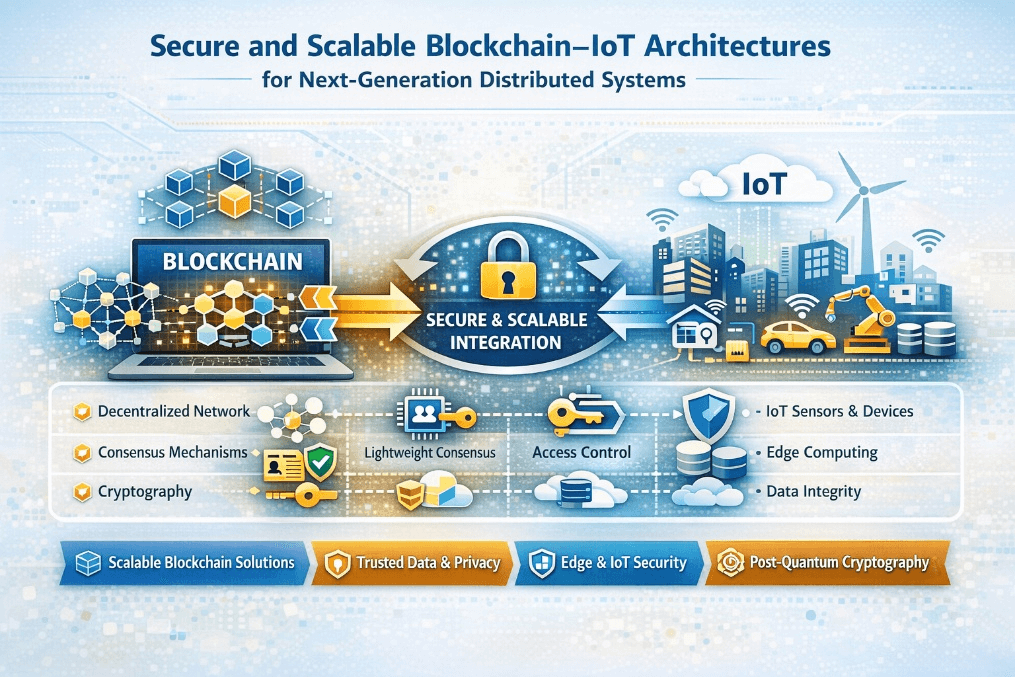
Graphic Abstract

Secure and Scalable Blockchain–IoT Architectures for Next-Generation Distributed Systems

Keywords

artificial intelligence, internet of things (IoT), blockchain, cybersecurity, PQC-based blockchain, blockchain for securing AI, real world assets (RWA) security, module-lattice-based key-encapsulation, module-lattice-based digital signature, stateless hash-based digital signature

Published Papers


  • Open Access

    ARTICLE

    Feasibility-Aware Reinforcement Learning for Reliable Hop-Constrained Routing in Wireless Sensor Networks

    Adeel Iqbal, Muhammad Faisal Siddiqui
    CMC-Computers, Materials & Continua, Vol.89, No.1, 2026, DOI:10.32604/cmc.2026.084851
    (This article belongs to the Special Issue: Secure and Scalable Blockchain–IoT Architectures for Next-Generation Distributed Systems)
    Abstract Hop-constrained packet routing is a fundamental problem in wireless sensor networks (WSNs), where latency constraints, energy limitations, and practical feasibility requirements greatly restrict routing choices. Traditional methods based on shortest path and greedy routing have low complexity but cannot adapt to dynamic network changes well, while reinforcement learning for routing has the potential to adapt to network variations but has not been well explored in the hard hop-constrained setting. The current study attempts to fill the gap by modeling hop-constrained routing as the decision-making problem in a finite-horizon setting. An integrated simulation environment is proposed… More >

  • Open Access

    ARTICLE

    IoT-Enabled Middleware for Smart City Environmental Monitoring with Integrated Analytics and Visualization

    Zulfiqar Ali, Azhar Mahmood, Shaheen Khatoon, Seyed Ali Ghorashi
    CMC-Computers, Materials & Continua, Vol.89, No.1, 2026, DOI:10.32604/cmc.2026.084386
    (This article belongs to the Special Issue: Secure and Scalable Blockchain–IoT Architectures for Next-Generation Distributed Systems)
    Abstract Smart city systems increasingly depend on data analytics and visualization to support informed and timely decision making in complex urban environments. However, existing middleware solutions predominantly focus on data acquisition and communication, while analytical processing and visualization are typically delegated to external applications, resulting in increased development complexity, reduced reusability, and fragmented system architectures. This study presents analytics and visualization-centric middleware named “Service-Oriented Middleware for Smart City Applications” (SOMSCA), in which these capabilities are embedded directly within the middleware layer. SOMSCA adopts a service-oriented approach, exposing analytics and visualization functionalities as reusable platform services, and… More >

  • Open Access

    ARTICLE

    A Blockchain-Assisted BIM–IoT Digital Twin Architecture for Trusted Operational Risk Prediction in Smart Buildings

    Yuh-Shihng Chang, Hsuan-Chao Huang
    CMC-Computers, Materials & Continua, Vol.89, No.1, 2026, DOI:10.32604/cmc.2026.083954
    (This article belongs to the Special Issue: Secure and Scalable Blockchain–IoT Architectures for Next-Generation Distributed Systems)
    Abstract The integration of Building Information Modeling (BIM), Internet of Things (IoT), digital twins, and artificial intelligence (AI) has enabled advanced smart building operations with real-time monitoring and data driven decision-making capabilities. However, existing systems still face critical challenges in ensuring trusted data provenance, secure cross-layer data exchange, and robust access control in distributed IoT environments. These limitations significantly affect the reliability and trustworthiness of data driven analytics and system-level decision-making. To address these challenges, this study proposes a blockchain-assisted BIM–IoT digital twin architecture for trusted operational risk prediction in smart buildings. The proposed framework integrates… More >

Share Link