Home / Journals / FDMP / Vol.22, No.4, 2026
Special Issues
Table of Content
cover

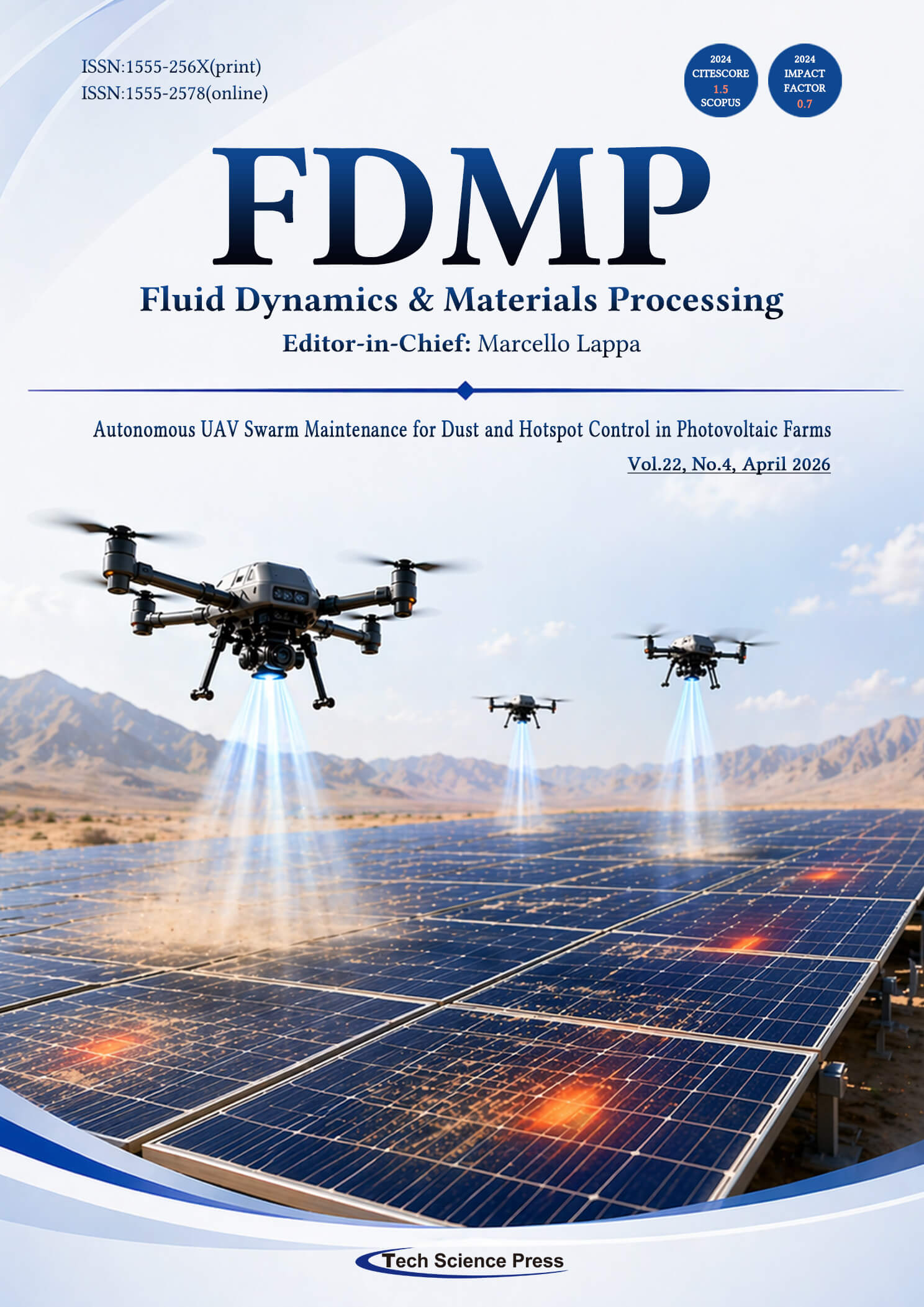
On the Cover

This work introduces an autonomous maintenance strategy for desert photovoltaic installations, addressing efficiency losses caused by dust accumulation and hotspot formation. A cooperative swarm of unmanned aerial vehicles enables contactless cleaning and active cooling, combining aerodynamic downwash with advanced control and coordination. High-fidelity simulations and experiments demonstrate dust removal efficiencies exceeding 92% while maintaining structural safety. The system achieves a net positive energy balance, recovering more than 10 kWh per mission. The integrated modeling and swarm framework offers a scalable, reliable solution to enhance performance, durability, and resilience of solar farms operating in harsh desert environments.
This cover image was created using AI-generated content from "Canva". The authors confirm that no human likenesses, copyrighted elements, or misleading representations are included in the image.

View this paper

  • Open AccessOpen Access

    REVIEW

    A Review of Artificial Intelligence in Boiling Heat Transfer: Predictive Modeling, Dynamic Characterization, and Methodological Advances

    Wei-Chen Tang, Xin Chen, Fei Dong*
    FDMP-Fluid Dynamics & Materials Processing, Vol.22, No.4, 2026, DOI:10.32604/fdmp.2026.079861 - 07 May 2026
    (This article belongs to the Special Issue: High-Order Computing and Deep Reinforcement Learning for Multiphase Interfacial Flows)
    Abstract Boiling heat transfer remains a cornerstone of efficient thermal management, with far-reaching implications for energy systems and industrial processes. Advances in this field not only deepen fundamental scientific understanding but also enable transformative improvements in energy efficiency, equipment performance, and operational safety. Contemporary research in this area focuses on accurate parameter prediction, intelligent image analysis, and quantitative characterization of bubble dynamics, collectively advancing both mechanistic insight and engineering optimization. In this context, artificial intelligence (AI), encompassing machine learning and deep learning techniques, has emerged as a powerful paradigm, offering significant advantages in predictive accuracy, data-driven… More >

  • Open AccessOpen Access

    ARTICLE

    Autonomous UAV Swarm Maintenance for Dust and Hotspot Control in Photovoltaic Farms

    Lyu Guanghua1, Dingxiao Jiao2, Abdulrahman AlKassem3, Dakan Ying1, Rizwan Arshad1, Jiahua Ni1, Zhe Liu1, Syed Hadi Hussain Shah1,*
    FDMP-Fluid Dynamics & Materials Processing, Vol.22, No.4, 2026, DOI:10.32604/fdmp.2026.077648 - 07 May 2026
    Abstract Desert photovoltaic, PV, installations experience significant efficiency losses due to dust accumulation, which also promotes localized overheating, known as hotspots, caused by uneven solar irradiance and partial cell shading. These hotspots can accelerate material degradation and increase the risk of permanent panel damage. This study presents an autonomous maintenance strategy based on a cooperative swarm of unmanned aerial vehicles, UAVs, enabling contactless dust removal and active hotspot cooling. The approach combines high-fidelity computational fluid dynamics to characterize aerodynamic downwash for effective dust detachment with fluid–structure interaction analysis to verify the structural integrity of PV panels… More >

  • Open AccessOpen Access

    ARTICLE

    Oblique Magneto-Thermal Flow with Non-Fourier Heat Transfer over a Radiative Rotating Disk

    Abdou Alzubaidi1, Khalid Mahmud2, Rashid Mehmood2,*, Siddra Rana3, Mohammed Alkinidri4
    FDMP-Fluid Dynamics & Materials Processing, Vol.22, No.4, 2026, DOI:10.32604/fdmp.2026.075928 - 07 May 2026
    Abstract Flows over rotating disks are central to numerous engineering applications, including turbines, rotating sensors, and advanced cooling devices, where the incoming fluid often strikes the disk at an angle. This study examines magnetohydrodynamic (MHD) oblique slip flow toward a rotating disk, accounting for critical effects such as velocity slip, thermal slip and thermal radiation. In particular, the Cattaneo–Christov heat flux model is used to capture thermal relaxation phenomena, frequently overlooked in prior analyses, while employing a uniform transverse magnetic field to regulate both momentum and heat transfer. Using similarity transformations, the governing nonlinear equations are… More >

  • Open AccessOpen Access

    ARTICLE

    Base Flow Control through Bullet-Shaped Ribs at Mach 1.6

    Uzma Anis Takkalki1, Sayed Ahmed Imran Bellary2, Sher Afghan Khan3, Abdul Aabid4,*, Muneer Baig4
    FDMP-Fluid Dynamics & Materials Processing, Vol.22, No.4, 2026, DOI:10.32604/fdmp.2026.073927 - 07 May 2026
    (This article belongs to the Special Issue: Analysis of High-Speed Flows using Advanced Computational Methods)
    Abstract The rapid development of space transportation systems and high-speed military aircrafts have intensified interest in turbulent separated flows, particularly under transonic and supersonic conditions. Such flows commonly arise downstream of sudden expansions, where separation and subsequent reattachment generate strong shear layers, increased drag, and a low-pressure recirculation region at the base. In this study, the control of base pressure downstream of a sudden expansion is investigated numerically using a passive bullet-shaped rib. A jet issuing from a nozzle is discharged abruptly into a duct of 25 mm diameter, producing a separated flow with pronounced recirculation.… More >

  • Open AccessOpen Access

    ARTICLE

    Numerical Investigation of Flow and Heat Transfer in a Spider-Web-Inspired Microchannel Heat Sink

    Liang Yin1,*, Youjia Gao2, Jie Ding1, Sichao Su1
    FDMP-Fluid Dynamics & Materials Processing, Vol.22, No.4, 2026, DOI:10.32604/fdmp.2026.079847 - 07 May 2026
    Abstract To address the thermal management challenges associated with localized high heat flux in electronic chips, this study proposes a bionic spider-web microchannel heat sink using deionized water as the coolant. Numerical simulations are conducted for two configurations, one with pinfins at the hotspot (Model A) and one without pinfins (Model B). The effects of Reynolds number and hotspot heat flux on flow distribution, pumping power, thermal resistance and temperature uniformity are systematically analyzed. Results show that the flow distribution varies significantly among channels, with higher flow rates near the inlet. Increasing the Reynolds number raises More >

  • Open AccessOpen Access

    ARTICLE

    Perforated Partition Walls in Extra-Long Tunnels: A One-Dimensional Flow Model Based on Orifice Theory

    Yunchao Du*, Xianming Shi, Zhiqiang Liu, Jian Wu
    FDMP-Fluid Dynamics & Materials Processing, Vol.22, No.4, 2026, DOI:10.32604/fdmp.2026.080083 - 07 May 2026
    Abstract Perforated partition walls are widely employed in complex underground transportation systems to mitigate tunnel pressure waves, harness train-induced piston wind for reduced ventilation energy consumption, and support emergency operations. Building on orifice flow theory, this study develops a one-dimensional flow model for tunnels equipped with perforated partition walls. The model is applied to examine the aerodynamic performance of such walls in extra-long tunnels through a comprehensive parametric analysis, considering the presence of openings, opening ratio, spacing, and spatial arrangement. The results demonstrate that, for opening ratios, defined as the ratio of the perimeter of a… More >

  • Open AccessOpen Access

    ARTICLE

    Three-Dimensional Transient Simulation of Supercritical RP-3 Pyrolysis and Flow Maldistribution in Parallel Regenerative Cooling Channels

    Jiangbo Wu*, Xi Song, Ke Yang, Heyao Sun
    FDMP-Fluid Dynamics & Materials Processing, Vol.22, No.4, 2026, DOI:10.32604/fdmp.2026.079762 - 07 May 2026
    (This article belongs to the Special Issue: Advances in Chemical Propulsion for Space Applications: From Launchers to Small-Scale Thrusters)
    Abstract To investigate transient flow instabilities in parallel-channel regenerative cooling systems subjected to nonuniform heat flux, a three-dimensional transient numerical model was developed to couple variations in supercritical fluid thermophysical properties with endothermic pyrolysis kinetics. The spatiotemporal evolution of RP-3 fuel within parallel channels was analyzed, and the role of a midstream interconnection structure in mitigating flow maldistribution was clarified. During the initial heating stage, the viscosity reduction of the supercritical fuel produced a drag-reduction effect that temporarily maintained a nearly uniform flow distribution. As the wall temperature increased and the pseudocritical region approached, the sharp… More >

  • Open AccessOpen Access

    ARTICLE

    From Stress Redistribution to Energy Accumulation: Lateral Pressure-Driven Chain Evolution in Gas-Bearing Coal

    Wenqi Zheng1,2,3, Feng Gao4, Hanpeng Wang1,2,3,*, Xin Wang1,2,3, Bing Zhang1,2,3, Yue Niu4, Wei Wang1,2,3, Li Ming5, Chunbo Zhou6,*
    FDMP-Fluid Dynamics & Materials Processing, Vol.22, No.4, 2026, DOI:10.32604/fdmp.2026.079913 - 07 May 2026
    (This article belongs to the Special Issue: Fluid Dynamics and Multiphysical Coupling in Rock and Porous Media: Advances in Experimental and Computational Modeling)
    Abstract As coal extraction advances to greater depths, a refined understanding of the coupled evolution of involved physical effects and mechanisms in gas-bearing coal under excavation-induced disturbances becomes indispensable. In this context, “chain evolution” characterizes the progressive and interdependent interplay among stress redistribution, damage propagation, and seepage adjustment. Building upon a seepage–stress–damage coupling model for gas-bearing coal, and supported by triaxial compression tests for validation, this study explores multifield evolution during roadway excavation across lateral pressure coefficients ξ of 0.5, 0.8, 1.0, 1.2, and 1.5. The results reveal that the lateral pressure… More >

  • Open AccessOpen Access

    ARTICLE

    Effect of Surface Hydrophilicity and Hydrophobicity on Droplet Behavior in Tiny Rectangular Flow Channels

    Jian Li1,2,*, Kexiang Wen1, Jian Wei1, Dengke Wen1, Ruihao Sun1
    FDMP-Fluid Dynamics & Materials Processing, Vol.22, No.4, 2026, DOI:10.32604/fdmp.2026.078680 - 07 May 2026
    Abstract The effective management of gas–liquid two-phase flow, emerging within the microchannels of proton exchange membrane fuel cells (PEMFCs) during operations, is crucial for improving energy conversion efficiency. In this study, the influence of surface wettability is examined for hydrophilic and hydrophobic conditions through a visualization-based experimental setup focused on single-droplet dynamics. The impact of key parameters on droplet behavior is systematically explored, while the mechanisms underlying the observed flow patterns are elucidated and the coupling among governing physical factors is clarified. The results show that, under comparable conditions, hydrophobic surfaces exhibit larger advancing contact angles More >

  • Open AccessOpen Access

    ARTICLE

    Optimizing Groove-Enhanced Microchannels for High-Performance Heat Dissipation

    Hongxin Zhang#,*, Yi Zhang#, Jiyun Tang*, Lei Yao
    FDMP-Fluid Dynamics & Materials Processing, Vol.22, No.4, 2026, DOI:10.32604/fdmp.2026.080521 - 07 May 2026
    (This article belongs to the Special Issue: Evolving Trends in Nano Heat and Mass Transfer)
    Abstract Traditional parallel straight microchannels are limited by low heat flux density and non-uniform flow distribution. From a system optimization perspective, incorporating surface grooves provides an effective means to enhance solid-liquid interaction and improve overall performance. Using water as the working fluid, this study numerically investigates the coupled effects of inlet flow rate, groove number, and groove spacing on the thermo-hydraulic behavior of groove-type microchannel heat sinks. The results reveal a fundamental trade-off between heat transfer enhancement and hydraulic resistance. Increasing coolant velocity significantly improves heat dissipation, but also raises the pressure drop, affecting pumping power… More >

Per Page:

Share Link