BCG Induces PD-1 Upregulation on Circulating CD8+ T Cells and IL-6 and IL-8 Secretion In Vitro
Gabriela R. Barbosa1,2, Luciana S. B. Dal Col3,4, Caroline C. Bighetto1, Maria Carolina X. de Godoy1, Marina D. B. P. Campioni4, Marcus V. Sadi2,3, Alessandra Gambero1,2, Leonardo O. Reis1,2,4,*
1 Immuno-Oncology, Pontifical Catholic University of Campinas (PUC-Campinas), Campinas, SP, Brazil
2 INCT UroGen, National Institute of Science, Technology and Innovation in Genitourinary Cancer (INCT), Campinas, SP, Brazil
3 Paulista School of Medicine, Federal University of São Paulo, São Paulo, SP, Brazil
4 UroScience, State University of Campinas (Unicamp), Campinas, SP, Brazil
* Corresponding Author: Leonardo O. Reis. Email: 
Oncology Research https://doi.org/10.32604/or.2026.075738
Received 07 November 2025; Accepted 02 May 2026; Published online 28 May 2026
Abstract
Backgrounds: Bacillus Calmette-Guérin (BCG) remains the most effective adjuvant therapy for non-muscle-invasive bladder cancer (NMIBC); however, the immunological underpinnings of its efficacy remain incompletely understood. This study aims to elucidate the dual immunomodulatory roles of BCG by integrating systemic and tumor-intrinsic analyses, through determining the systemic effects of BCG instillation on immune checkpoint expression and direct inflammatory response in a previously established
in vitro tumor model.
Methods: We investigated systemic and tumor-intrinsic immune responses to BCG. Flow cytometry was used to evaluate immune checkpoint expression on circulating lymphocyte subsets in NMIBC patients (n = 7) at various stages of BCG therapy. In parallel, an
in vitro model of PD-L1 modulation using breast cancer cell lines (MDA-MB-231 and MCF-7) was stimulated with BCG and TLR agonists, and the secretion of IL-6 and IL-8 was assessed using an ELISA.
Results: Peripheral immune profiling revealed stable lymphocyte frequencies, but a significant increase in PD-1 expression on CD8
+ T cells following BCG exposure (
p = 0.0068), with no significant modulation in CTLA-4 levels.
In vitro, MDA-MB-231 cells exhibited robust IL-6 secretion upon high-dose BCG stimulation (
p = 0.0277), whereas MCF-7 cells showed increased IL-8 release (
p < 0.0001). Other TLR agonists had limited effects.
Conclusions: BCG induces dual immunomodulation, characterized by PD-1 upregulation in systemic CD8
+ T cells and the release of pro-inflammatory cytokines from epithelial tumor cells. These findings support the potential of combining BCG with immune checkpoint inhibitors and underscore IL-6 and IL-8 as candidate biomarkers of tumor-intrinsic responsiveness.
Graphical Abstract
Keywords
BCG immunotherapy; breast cancer; Toll-like receptors agonists; bladder cancer
 Open Access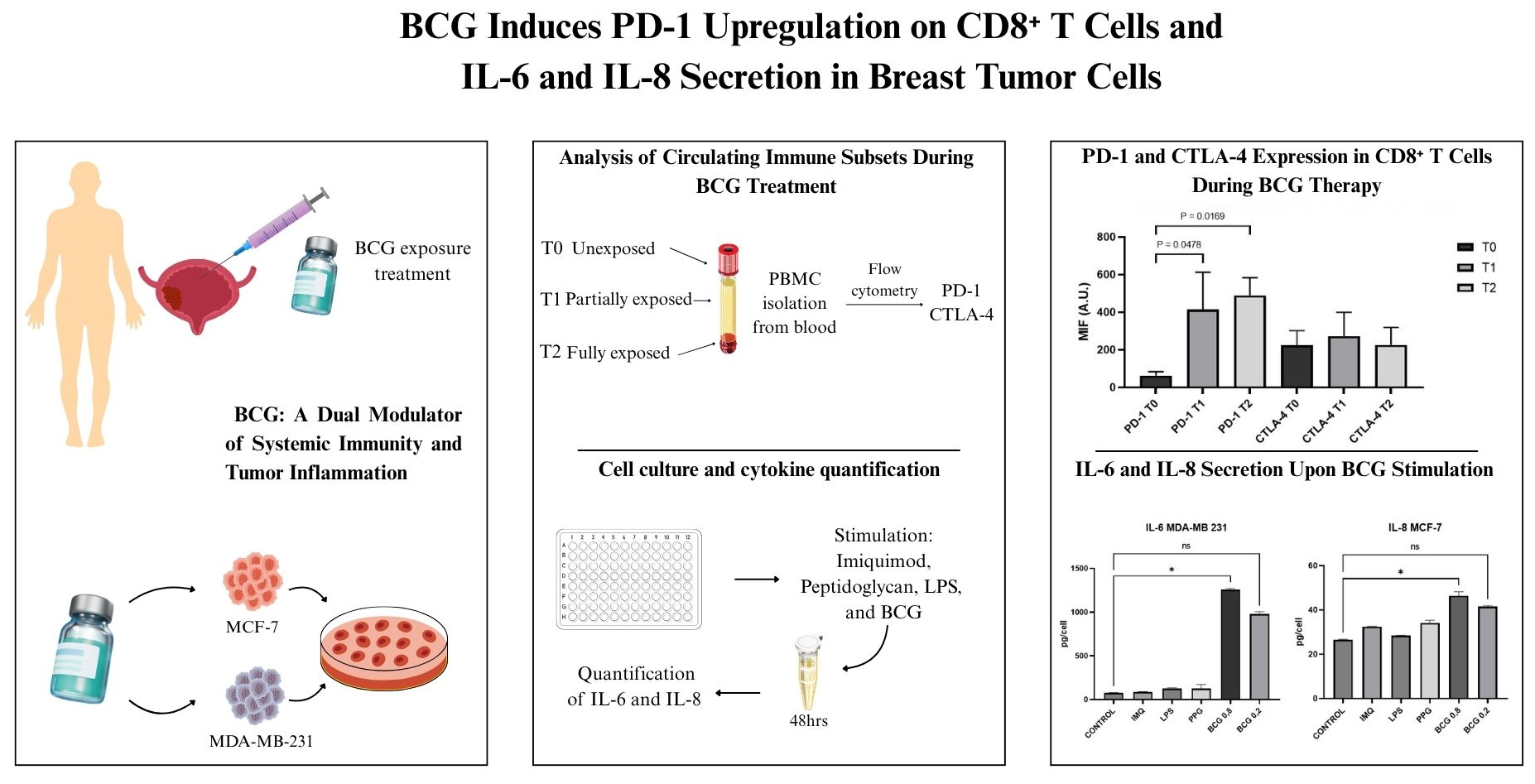

 Login
Login Register
 Submit a Paper
 Propose a Special lssue
 Download PDF
 Supplementary Material File
 Downloads
 Citation Tools
