
Home / Journals / OR / Online First / doi:10.32604/or.2026.075617
Special Issues
Table of Content

Open Access

ARTICLE

Exploring the Role of CD44 in the Progression and Invasion of Chondrosarcoma

Zoe Bell1, Corey D. Chan1,2, Rachel Howarth3, Andrea Atkinson1, Zakareya Gamie1,4, Daniel Frankel5, Oana Bretcanu5, Kenneth S. Rankin1,2,*
1 Newcastle Centre for Cancer, Newcastle University, Paul O’Gorman Building, Framlington Place, Newcastle upon Tyne, UK
2 North of England Bone and Soft Tissue Tumour Service, Freeman Hospital, Newcastle upon Tyne Hospitals NHS Foundation Trust, Newcastle upon Tyne, UK
3 Translational and Clinical Research Institute, Newcastle University, Newcastle upon Tyne, UK
4 Orthopaedic Oncology, Newcastle upon Tyne Hospitals NHS Foundation Trust, Newcastle upon Tyne, UK
5 School of Engineering, Newcastle University, Newcastle upon Tyne, UK
* Corresponding Author: Kenneth S. Rankin. Email: email
(This article belongs to the Special Issue: Targeting the Tumor Microenvironment: Emerging Insights into Cancer Progression and Therapeutics)

Oncology Research https://doi.org/10.32604/or.2026.075617

Received 05 November 2025; Accepted 01 April 2026; Published online 02 June 2026
Abstract

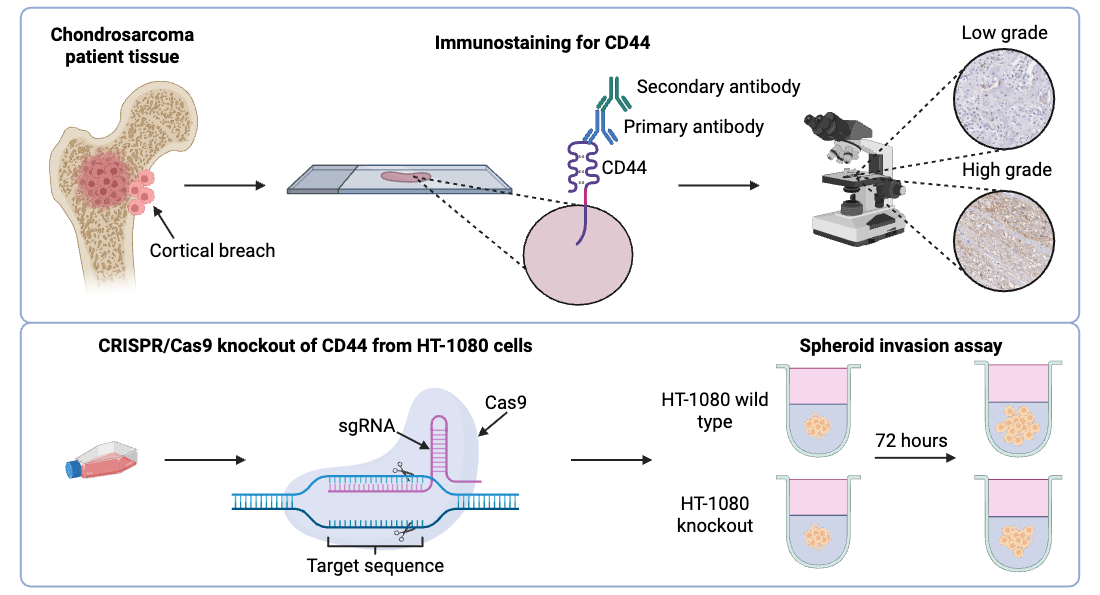
Objectives: Chondrosarcoma is the most common type of primary bone sarcoma in adults with a high risk of local recurrence and metastasis. Chondrosarcomas are largely resistant to chemotherapy and radiotherapy, meaning that surgery is the mainstay of treatment for most patients. Therefore, new therapeutic targets are required. Cluster of differentiation 44 (CD44) is a transmembrane protein that has roles in cell proliferation, adhesion and migration and is shown to be overexpressed in several cancer types. Consequently, this work was undertaken to understand whether CD44 could be a potential therapeutic target in chondrosarcoma. Methods: In this study, tissue sections from chondrosarcoma patients were evaluated for CD44 expression using immunohistochemical analysis. The relationship between CD44 expression in the patient tissue and overall and event-free survival was investigated. Clustered regularly interspaced short palindromic repeats (CRISPR)/CRISPR-associated protein 9 (Cas9) gene editing was used to generate a CD44 knockout chondrosarcoma cell line which was used for a spheroid invasion assay to understand the role of CD44 in chondrosarcoma cell invasion. Results: Cox multivariate analysis of CD44 expression in chondrosarcoma patient tissue revealed that high CD44 expression was linked to decreased overall (p < 0.01) and event-free survival (p < 0.01). The observed invasion of CD44 knockout cells in the spheroid assay was less than that of the wild type cells (p < 0.001). Conclusions: The increased expression of CD44 in intermediate and high grade chondrosarcomas, as well as reduced invasion of CD44 knockout cells suggests that CD44 plays an important role in chondrosarcoma progression and metastasis. These findings support further investigation of CD44 as an imaging and/or therapeutic target for the management of chondrosarcoma.

Graphical Abstract

Exploring the Role of CD44 in the Progression and Invasion of Chondrosarcoma

Keywords

Chondrosarcoma; cluster of differentiation 44 solid tumour; immunohistochemistry; clustered regularly interspaced short palindromic repeats; spheroid; invasion
  • 152

    View

  • 22

    Download

  • 0

    Like

Share Link



