Anomaly-Aware Peripheral Blood Smear Analysis via Hybrid Detection and One-Class Learning
Issac Neha Margret, Rajakumar Krishnan*
School of Computer Science and Engineering, Department of Analytics, Vellore Institute of Technology, Vellore, Tamil Nadu, India
* Corresponding Author: Rajakumar Krishnan. Email: 
Computer Modeling in Engineering & Sciences https://doi.org/10.32604/cmes.2026.079104
Received 14 January 2026; Accepted 18 March 2026; Published online 04 June 2026
Abstract
Background: Examining peripheral blood smears is a vital diagnostic tool in hematology. Although deep learning-based automated systems have improved the accuracy of blood cell detection, most current methods depend on fully supervised learning and need extensive annotations to identify unusual cell shapes. Clinical practice often lacks these complete annotations, limiting the ability to generalize to rare or unseen abnormalities. To address this issue of incomplete annotated data, this paper introduces a hybrid framework that recognizes anomalies for reliable and clear analysis of peripheral blood smears.
Methods: The proposed framework combines supervised blood cell detection with unsupervised one-class anomaly detection. We use a YOLOv8 detector to accurately identify and categorize red blood cells, white blood cells, and platelets in peripheral blood smear images. The detected blood cells are then assessed further using a lightweight Cell Reconstruction Autoencoder, which is trained only on normal-looking cells. To enhance sensitivity to minor variations in the model’s construction, we also introduce a Wasserstein-based method for latent distribution regularization. This method scores anomalies based on how well the reconstruction matches and the deviation in the latent space, without needing any abnormal training samples.
Results: We evaluate detection performance on the TXL-PBC dataset and validate it externally with pathological samples from the ASH Image Bank. The results show high accuracy in detecting abnormalities and in distinguishing normal from abnormal cells (F1-Score/Anomaly = 0.926; AUC = 0.963). Our experiments and statistics confirm that using the hybrid approach with Wasserstein regularization significantly improves sensitivity and robustness compared to individual or reconstruction model-based detection methods.
Conclusions: The hybrid YOLOv8-Cell Reconstruction Autoencoder framework accurately identifies cells and detects previously unseen morphological abnormalities within a one-class learning framework. This approach combines efficiency with anomaly awareness and clear clinical interpretation, making it suitable for practical and scalable analysis of peripheral blood smears in clinical settings.
Graphical Abstract
Keywords
Peripheral blood smear analysis; object detection; one-class learning; deep learning; blood cell detection; you only look once
 Open Access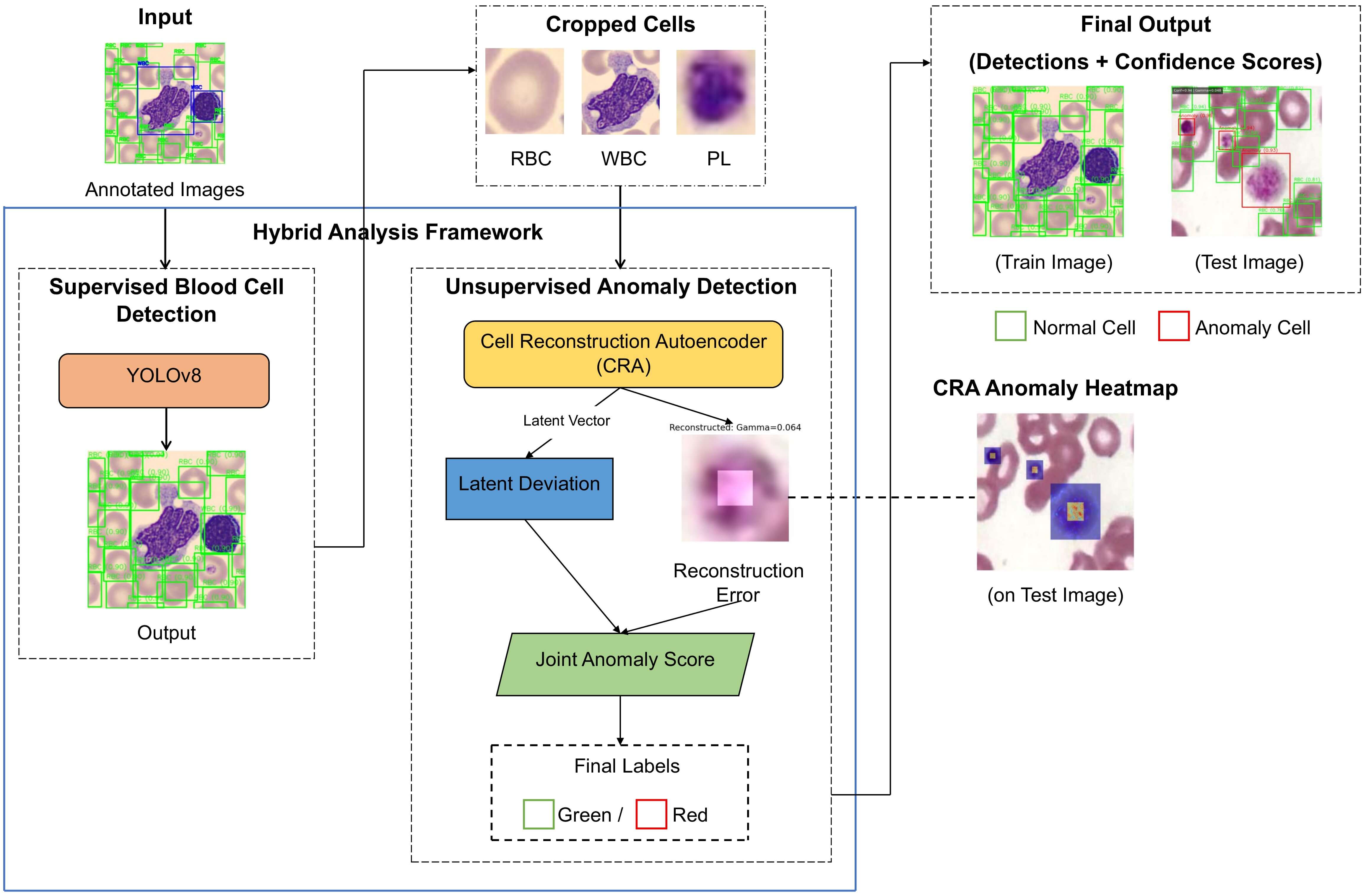

 Login
Login Register
 Submit a Paper
 Propose a Special lssue
 Download PDF
 Downloads
 Citation Tools
