AAC-HABSA: An Adaptive Aspect Conditioning Framework for Interpretable and Robust Aspect-Based Sentiment Analysis
Mahander Kumar1, Lal Khan2,*, Mohammad Zubair Khan3,*, Ibrahim Aljubayri4
1 Department of Computer Science, Mir Chakar Khan Rind University, Sibi, Balochistan, Pakistan
2 Department of AI and SW, Gachon University, Seongnam, 13120, Republic of Korea
3 Faculty of Computer and Information Systems, Islamic University of Madinah, Madinah, Saudi Arabia
4 Department of Computer Science and Information, Imam Mohammad Ibn Saud Islamic University (IMSIU), Riyadh, Saudi Arabia
* Corresponding Author: Lal Khan. Email:  ; Mohammad Zubair Khan. Email:
(This article belongs to the Special Issue: Applied NLP with Large Language Models: AI Applications Across Domains)
Computer Modeling in Engineering & Sciences https://doi.org/10.32604/cmes.2026.081699
Received 07 March 2026; Accepted 27 May 2026; Published online 06 July 2026
Abstract
Aspect-Based Sentiment Analysis (ABSA) is a fundamental Natural Language Processing (NLP) task that aims to determine fine-grained sentiment polarity toward specific aspects mentioned in text. With the emergence of Large Language Models (LLMs) and transformer-based architectures, significant improvements have been achieved in contextual representation learning for sentiment analysis. However, existing LLM-inspired and transformer-based ABSA frameworks often suffer from inadequate aspect-context alignment, redundant feature integration, limited interpretability, and insufficient coordination between contextual and sequential modeling components. To address these challenges, this paper proposes two hybrid architectures, namely HABSA and AAC-HABSA, centered on a novel Adaptive Aspect Conditioning Layer (AACL) that injects aspect information prior to transformer-based contextual encoding. The proposed framework follows a structured pipeline comprising tokenization, token and positional embeddings, AACL, transformer encoding, BiLSTM refinement, aspect-guided attention, fully connected projection, and focal loss optimization. By conditioning token representations before contextual encoding, the framework enables aspect-aware contextual learning that better captures sentiment-relevant semantic dependencies. Subsequent sequential refinement and attention-based reasoning further enhance sentiment polarity alignment while improving model interpretability. To evaluate the proposed approach, a robust ABSA dataset containing approximately 10,000 recent reviews annotated across five sentiment intensity levels was developed. Extensive experiments demonstrate that HABSA and AAC-HABSA consistently outperform transformer-only and conventional hybrid baselines in terms of accuracy, macro-F1 score, robustness, and attention-based interpretability. The proposed framework provides a computationally efficient, mathematically coherent, and interpretable solution for fine-grained sentiment analysis. By strengthening aspect-aware representation learning within transformer and LLM-oriented sentiment analysis pipelines, this work contributes to the development of scalable and deployable AI-driven opinion analytics systems across real-world domains.
Graphical Abstract
Keywords
Large language models; aspect-based sentiment analysis; BI-LSTM; attention; transformers; BERT; adaptive aspect conditioning framework; AASC
 Open Access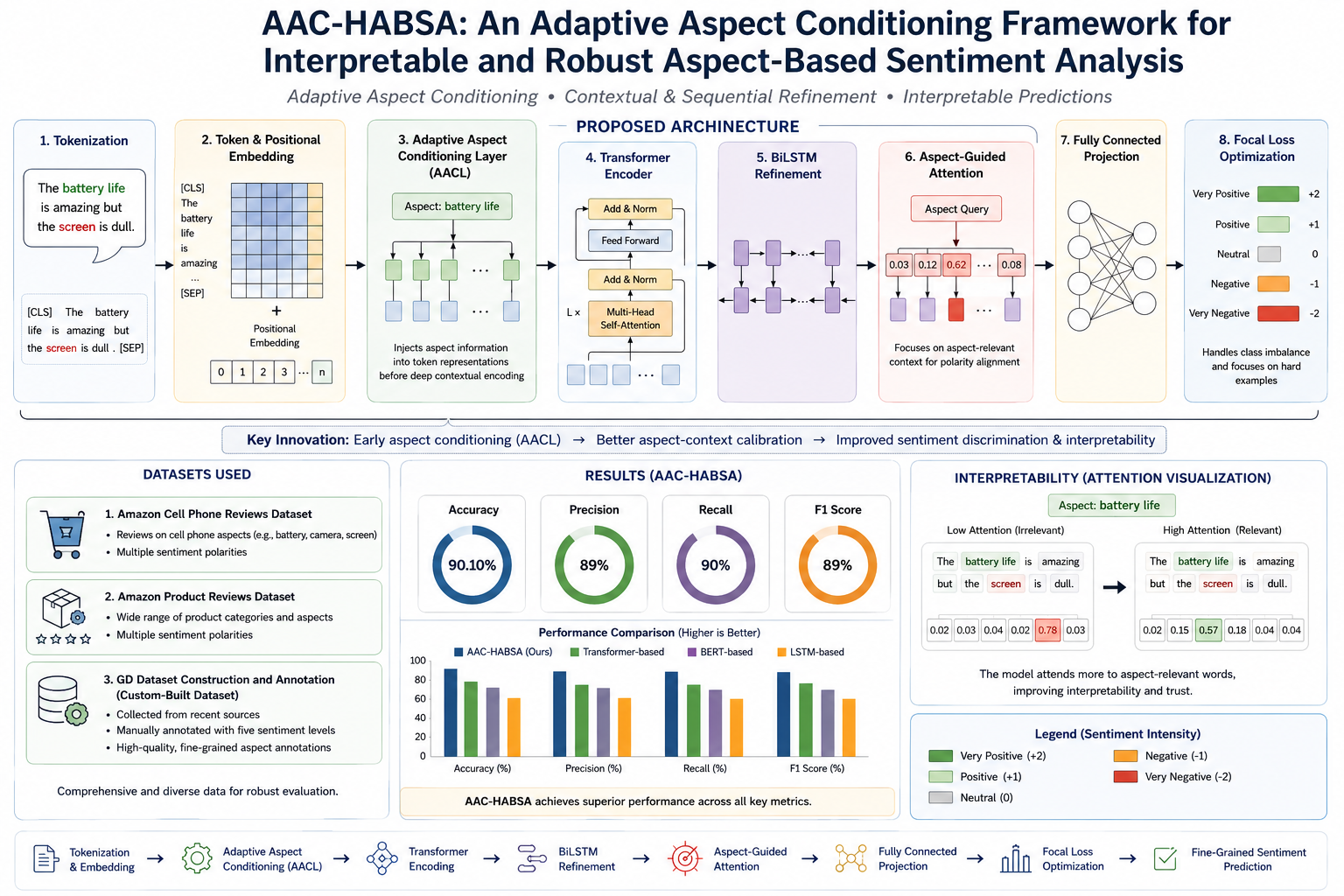

 Login
Login Register
 Submit a Paper
 Propose a Special lssue
 Download PDF
 Downloads
 Citation Tools
