Prediction and Multi-Objective Optimization of Blast-Induced Dust Emissions in Limestone Mine Blasting Using Gene Expression Programming and Grasshopper Algorithm
Kangjia Fan1, Biao He2,*, Shahab Hosseini3, Seyed Yaser Mousavi Siamakani4,*
1 School of Highway Engineering, Shaanxi College of Communications Technology, Xi’an, China
2 European Organization for Nuclear Research, CERN, Geneva, Switzerland
3 Faculty of Engineering, Tarbiat Modares University, Tehran, Iran
4 Civil Engineering Department, College of Engineering, Rangsit University, Mueang, Pathum Thani, Thailand
* Corresponding Author: Biao He. Email:  ; Seyed Yaser Mousavi Siamakani. Email:
(This article belongs to the Special Issue: Computational Intelligent Systems for Solving Complex Engineering Problems: Principles and Applications-III)
Computer Modeling in Engineering & Sciences https://doi.org/10.32604/cmes.2026.084187
Received 17 April 2026; Accepted 11 June 2026; Published online 27 July 2026
Abstract
Mining activities are associated with environmental side effects, which can be successfully predicted and strategies proposed for mitigating their adverse impacts. The cleaner production policies of green blasting focus on ecological issues related to mining operations and reduction plans. As a prediction part of this policy, this research proposed a mathematical model named Gene Expression Programming (GEP) to accurately predict the factors that generated pollutions, i.e., total suspended particles (TSP), particles dust with an analogous aerodynamic diameter of less than 10 μm (PM
10), and dust emission distance due to mine blasting (DEMB), simultaneously. As the reduction component of the proposed green blasting policy, the multi-objective grasshopper optimization algorithm was coupled with the GEP-derived objective functions to simultaneously minimize DEMB, PM
10, and TSP in a limestone mine located near residential and agricultural areas. To strengthen model validation, the predictive performance of GEP was also compared with ANN, SVR, RF, and XGBoost models. The results showed that XGBoost achieved the highest numerical accuracy for DEMB, PM
10, and TSP prediction, with R
2 values of 0.9762, 0.9925, and 0.9982, respectively. However, the GEP models also showed competitive performance, with R
2 values of 0.9447, 0.9883, and 0.9961 for DEMB, PM
10, and TSP, respectively, while providing explicit mathematical equations suitable for direct integration into the optimization framework. The MOGOA process generated four Pareto-optimal blasting plans. Among these solutions, the minimum optimized values of DEMB, PM
10, and TSP were obtained as 103 m, 132, and 270 μg/m
3, respectively. These values correspond to relative reductions of 42.51%, 68.17%, and 69.97%, respectively. Considering both environmental performance and practical feasibility, Plan 1 was recommended as a suitable blasting strategy because it achieved the greatest PM
10 reduction and a substantial TSP reduction while maintaining a comparatively more feasible blasting configuration.
Graphical Abstract
Keywords
Blast-induced dust; dust emission distance; gene expression programming; multi-objective grasshopper optimization algorithm; green blasting; limestone mine
 Open Access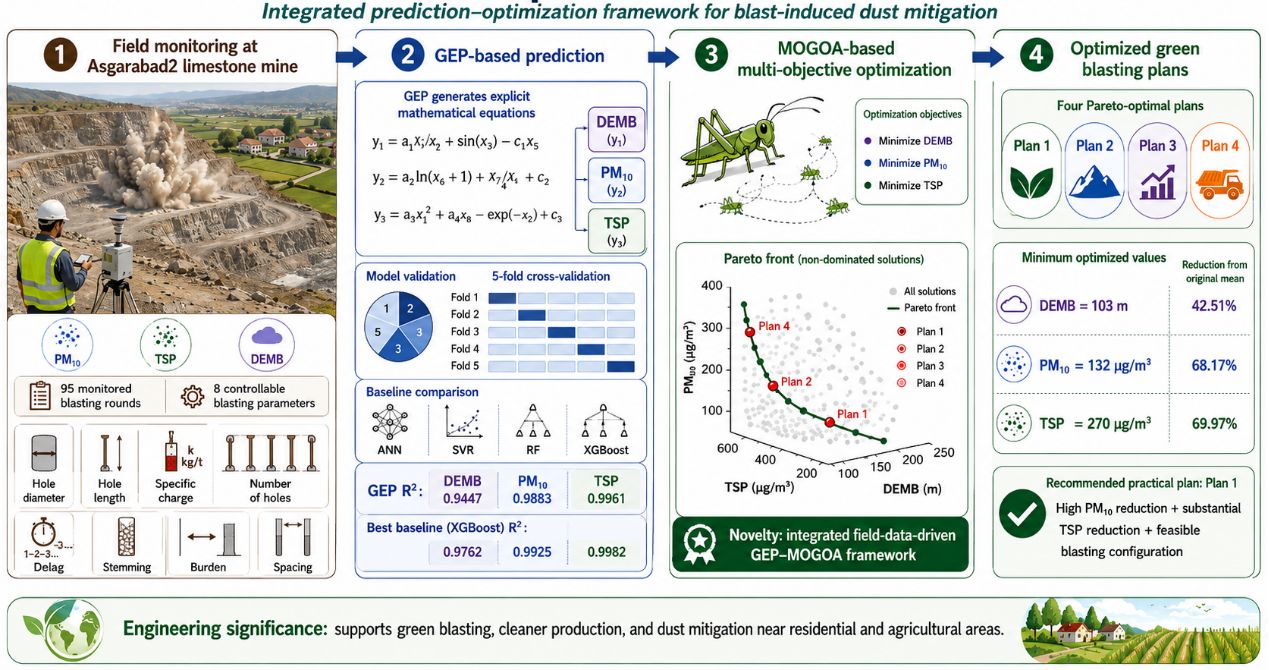

 Login
Login Register
 Submit a Paper
 Propose a Special lssue
 Download PDF
 Downloads
 Citation Tools
